Cold Water
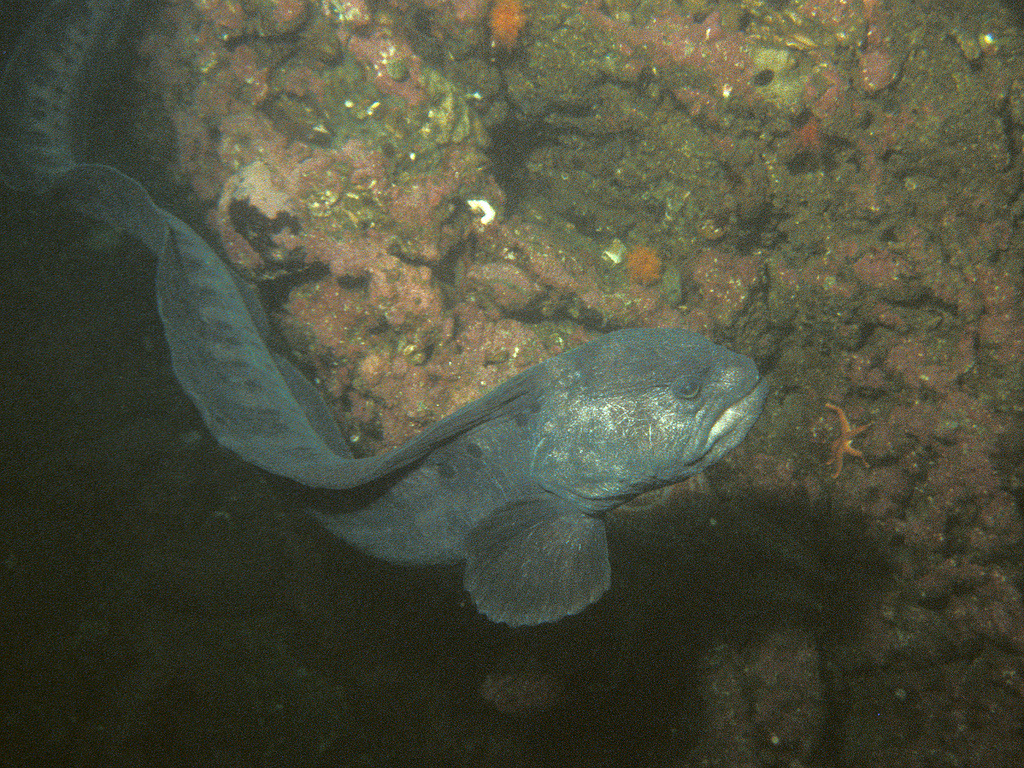
Wolf Eel
Anarrhichthys ocellatus · Bony fish, family Anarhichadidae (wolffishes); an elongated wolffish, not a true eel
Wolf-eels are the gargoyles of the Pacific Northwest (huge gray heads, swollen jowls, teeth like broken crockery) and among its gentlest residents. Not true eels but elongated wolffishes, they pair long-term and share a den, sometimes two faces stacked in one crevice watching the water column go by. The crushing dentition is for urchins, crabs, and clams; divers get curiosity instead, and pairs at well-known dens will ease halfway out to inspect visitors. Juveniles look like a different species, burnt orange with a purple sheen, swimming open water before settling into rock. The old practice of hand-feeding urchins to resident pairs has faded for good reason: fed animals lose caution, and teeth meet fingers by accident. Come in low and off to one side, and let a swimming wolf-eel pass; it is likely commuting between dens.
Waar en wanneer je er een kunt zien
"Resident" betekent dat je ze bij de meeste duiken op die bestemming tegenkomt; "seizoensgebonden" betekent betrouwbaar aanwezig in de vermelde maanden; al het andere is een bonus, geen garantie.
| Bestemming | Betrouwbaarheid | Maanden | Notities |
|---|---|---|---|
| British ColumbiaCanada | Resident: seen on most dives | Het hele jaar door |
Beste maand, in één oogopslag
| Maand | Betrouwbare bestemmingen |
|---|---|
| January | British Columbia |
| February | British Columbia |
| March | British Columbia |
| April | British Columbia |
| May | British Columbia |
| June | British Columbia |
| July | British Columbia |
| August | British Columbia |
| September | British Columbia |
| October | British Columbia |
| November | British Columbia |
| December | British Columbia |
Ze begrijpen
Habitat: Rocky reef dens, wrecks, and boulder jumbles; established pairs keep the same crevice for years, at depths divers visit and far below.
Verspreidingsgebied: North Pacific: from southern California through British Columbia and Alaska to the Sea of Japan.
Gedrag: Pairs share a den long-term, often with both heads visible at the entrance; juveniles are orange with a purple sheen and swim open water before settling. Resident pairs grow tolerant of familiar divers.
Dieet: Sea urchins, crabs, clams, and snails crushed with heavy molar-like teeth and powerful jaws.
Grootte: doorgaans rond 1.8 m; gedocumenteerd tot 2.4 m (total length).
Hoe je je ertegenover gedraagt
Approach a den low and slightly to one side, skip the old urchin hand-feeding routine entirely, and give a free-swimming animal the lane: it is commuting, not fleeing.
Behoud
Not a fishery target and not considered broadly threatened; den fidelity makes known pairs locally precious and easy to disturb.
Gekende duiksites waar je ze tegenkomt
Gemarkeerde locaties zijn voor deze soort in kaart gebracht door onze redacteurs; de getallen zijn GBIF-waarnemingsrecords vastgelegd binnen ongeveer 5 km van een locatie sinds 1990.
Bekijk
Via de officiële kanalen

Wildlife of Monterey | New film in our auditorium

Live Aviary Cam | Monterey Bay Aquarium

Live Aviary Cam | Monterey Bay Aquarium
Video's zijn ingesloten links naar de eigen kanalen van de makers. We hosten niets en vermelden altijd de bron.