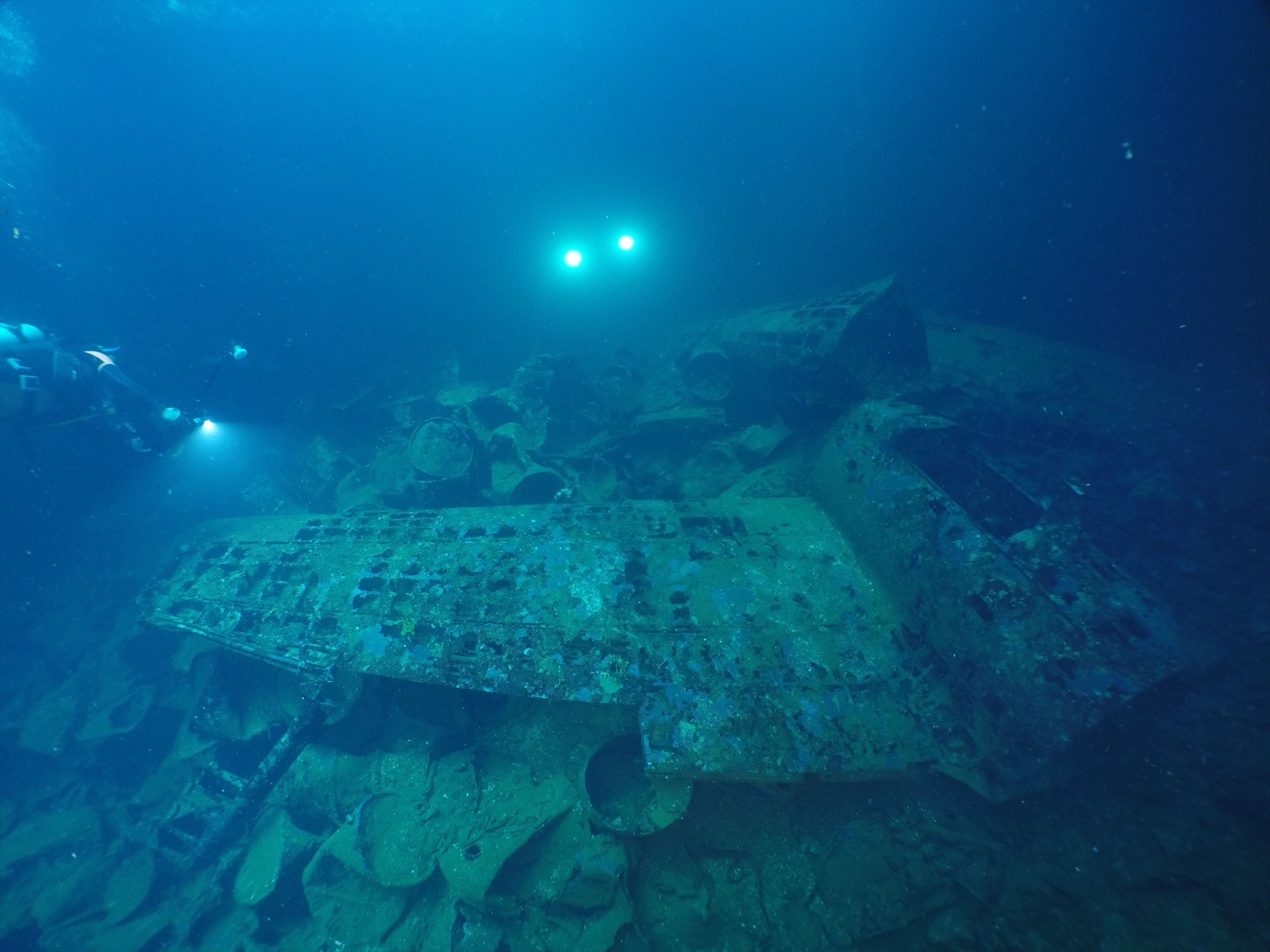
Fujikawa Maru
L'histoire
Built in 1938 for the silk trade and requisitioned by the Imperial Japanese Navy as an aircraft ferry, the Fujikawa Maru was swinging at anchor in Truk Lagoon when Operation Hailstone opened on 17 February 1944. American carrier aircraft caught Japan's great mid-Pacific fleet anchorage with its shipping still in place, and over two days they put more than forty vessels on the lagoon floor. The Fujikawa took an aerial torpedo, burned, and settled upright on the sand with her cargo intact: disassembled Zero fighter fuselages still racked in her forward holds, ammunition, and spares. Her old six-inch guns, First World War relics fitted at bow and stern, now wear a half-century of soft coral. In the machine shop stands the air compressor divers have nicknamed for a film robot. She is the most dived wreck in Chuuk, and like her neighbors she is a war grave: men died aboard, and some remain within.
Comment elle a coulé: Torpedoed and bombed by US carrier aircraft during Operation Hailstone, 17–18 February 1944.
Plongée sur ce site aujourd'hui
Condition: Still coherent but visibly weakening: typhoons and eighty years of corrosion have begun collapsing sections of superstructure.
Pénétration: Full With Training. Holds and the machine shop are standard guided penetrations for wreck-trained divers; deeper engineering spaces are silty and unforgiving. Pénétrer dans tout environnement overhead nécessite une formation spécifique : au minimum une certification épave, et une formation technique épave pour la pénétration complète.
Certification recommandée: Advanced Open Water; wreck training for interiors
Courant: Mild · Visibilité: 15–30 m
Vie marine: The guns and kingposts are pillars of soft coral and anemones; baitfish cloud the superstructure and turtles rest on the deck.
Dangers: Silt-out risk inside, deteriorating steel overhead, and munitions in the holds that must never be handled.
Protection & réglementation
Chuuk's wrecks are protected as an underwater historical monument; a state dive permit/fee applies.
Human remains rest in this ship. Japanese missions have recovered and honored some of the dead; treat every interior space with the restraint owed a grave.
Artifact removal is illegal under Chuuk state law and has already thinned these wrecks. Leave everything.
Regarder
Depuis les canaux officiels

Deep-Sea Coral Fireworks

Camera 2: 2026 American Samoa ROV + Mapping Exploration (EX2606)
Les vidéos sont des liens intégrés vers les chaînes de leurs créateurs. Nous n'hébergeons rien et créditons tout.