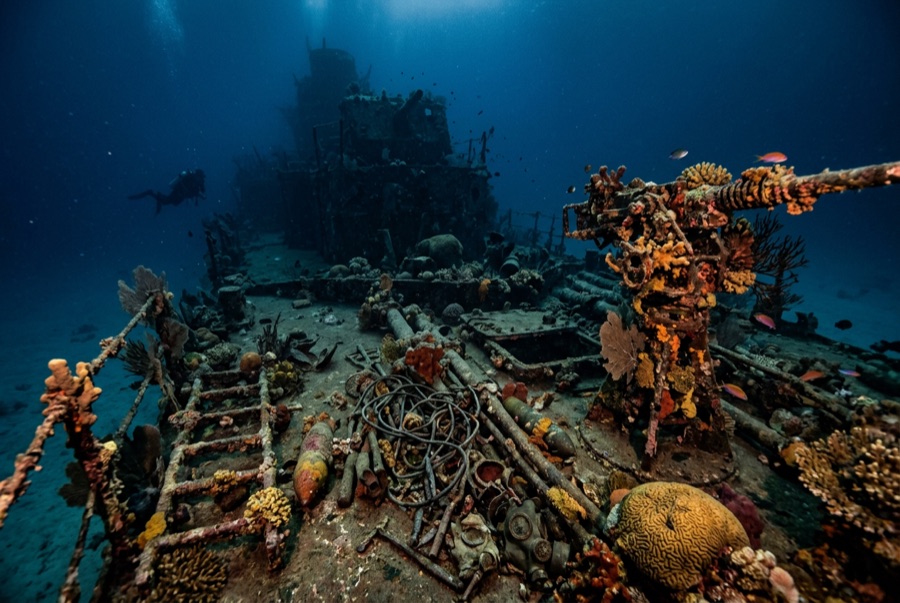
Kogyo Maru
스토리
The Kogyo Maru went down carrying an airfield. When the 24 September 1944 strike caught the auxiliary fleet sheltering in Coron Bay, her holds were stacked with construction cargo bound for Japanese island garrisons: bags of cement gone to stone, structural steel, a small bulldozer, and a tractor still on its treads, along with an air compressor and drums of supplies. She rolled onto her starboard side as she sank and came to rest on a sandy bottom in the mid-thirties of meters, where the cargo has stayed exactly where the stevedores lashed it. That freeze-frame quality is her appeal. Divers drop through a hold hatch and hover over machinery that was meant to build runways for a war already lost, then follow light-shafted spaces along the tilted deck to the masts, now horizontal and furred with soft coral. She is usually paired with the nearby Olympia Maru for a two-tank morning, and many divers leave calling her the better dive.
침몰 경위: Sunk by US carrier aircraft in the Coron Bay raid, 24 September 1944.
오늘 다이빙 중
컨디션: Intact hull with cargo undisturbed; corrosion is advancing quietly in the warm bay water.
침투 다이빙: Limited. Hold entries are broad, with light usually in view; the engine room is a trained-divers-only space that silts in seconds. 오버헤드 환경에 진입하려면 최소 렉 자격증 이상의 전문 교육이 필요하며, 완전 관통 다이빙에는 테크니컬 렉 교육이 필요합니다.
권장 자격증: Advanced Open Water
조류: Mild · 시야: 5–15 m
해양 생물: Snapper and fusilier schools over the hull, nudibranchs and shrimp among the cement bags, lionfish and scorpionfish in the machinery shadows.
위험 요소: Silt inside the holds, monofilament across the rails, and visibility that can drop sharply after weather.
보호 & 법규
Protected wartime wreck; Coron local dive fees apply.
The construction cargo is the exhibit: nothing leaves the ship.
시청하기
공식 채널에서 제공

Deep-Sea Coral Fireworks

Camera 2: 2026 American Samoa ROV + Mapping Exploration (EX2606)
영상은 크리에이터 본인 채널에 대한 임베드 링크입니다. 저희는 아무것도 직접 호스팅하지 않으며, 모든 출처를 표기합니다.