Kogyo Maru
我们的故事
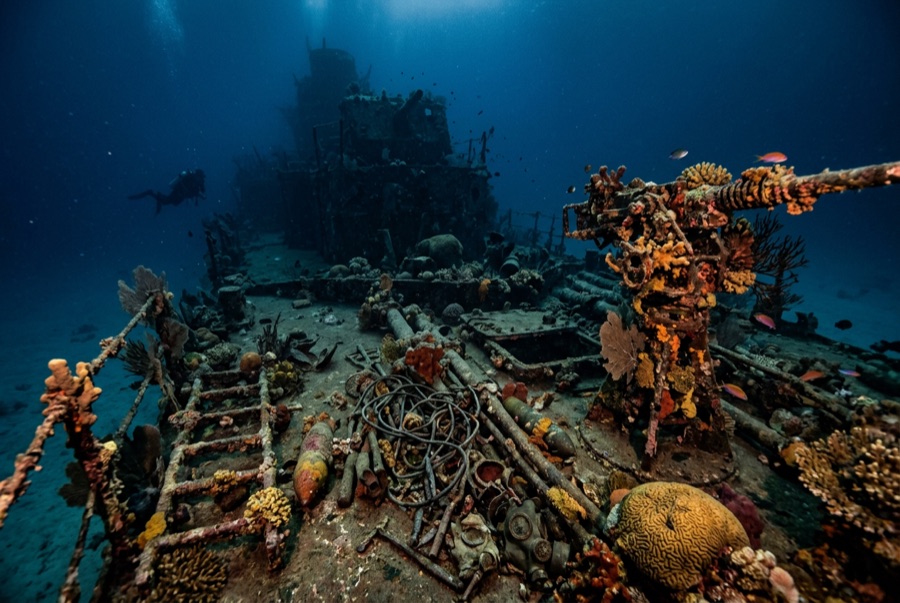
The Kogyo Maru went down carrying an airfield. When the 24 September 1944 strike caught the auxiliary fleet sheltering in Coron Bay, her holds were stacked with construction cargo bound for Japanese island garrisons: bags of cement gone to stone, structural steel, a small bulldozer, and a tractor still on its treads, along with an air compressor and drums of supplies. She rolled onto her starboard side as she sank and came to rest on a sandy bottom in the mid-thirties of meters, where the cargo has stayed exactly where the stevedores lashed it. That freeze-frame quality is her appeal. Divers drop through a hold hatch and hover over machinery that was meant to build runways for a war already lost, then follow light-shafted spaces along the tilted deck to the masts, now horizontal and furred with soft coral. She is usually paired with the nearby Olympia Maru for a two-tank morning, and many divers leave calling her the better dive.
她是如何沉没的: Sunk by US carrier aircraft in the Coron Bay raid, 24 September 1944.
今日潜水中
环境条件: Intact hull with cargo undisturbed; corrosion is advancing quietly in the warm bay water.
穿越式潜水: Limited. Hold entries are broad, with light usually in view; the engine room is a trained-divers-only space that silts in seconds. 进入任何封闭式环境都需要专项培训:至少需要沉船潜水认证,完整穿越则需要技术级沉船培训。
建议持有证书: Advanced Open Water
水流: Mild · 能见度: 5–15 m
海洋生物: Snapper and fusilier schools over the hull, nudibranchs and shrimp among the cement bags, lionfish and scorpionfish in the machinery shadows.
危险因素: Silt inside the holds, monofilament across the rails, and visibility that can drop sharply after weather.
保护与法规
Protected wartime wreck; Coron local dive fees apply.
The construction cargo is the exhibit: nothing leaves the ship.
观看
来自官方渠道

Deep-Sea Coral Fireworks

Camera 2: 2026 American Samoa ROV + Mapping Exploration (EX2606)
视频均为创作者自有频道的嵌入链接。我们不托管任何内容,所有来源均注明出处。