Okikawa Maru
我们的故事
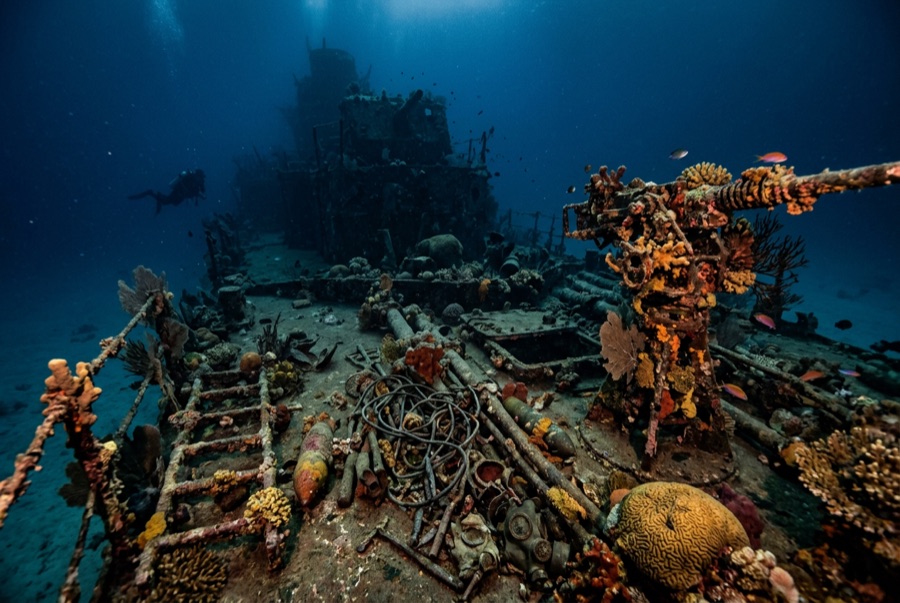
For decades dive guides called this ship the Taiei Maru, and the wrong name still surfaces in briefings. Wreck identification in Coron was untangled slowly, from rivet counts and archival manifests. She was the Okikawa Maru, a big civilian tanker of the late 1930s pressed into naval service to move the fuel that Japan's war ran on. Anchored off Concepcion when the September 1944 carrier raid swept Coron Bay, she was hit and left burning, and air attacks in early October put her on the bottom for good. She settled upright in comfortable depths, which is why she has become the most dived wreck in the bay: her main deck lies shallow enough for long, unhurried tours, and her pump rooms and long tunnel-like passages give wreck students their first taste of overhead. The bow section, wrenched by the attacks, drops away in a tangle that rewards a slow look. Corals have made a garden of her catwalks.
她是如何沉没的: Damaged in the 24 September 1944 Coron raid and finished by follow-up air attacks in October 1944.
今日潜水中
环境条件: Upright and diveable end to end, though the bow area is heavily broken and the hull is softening after eighty years.
穿越式潜水: Full With Training. The engine room and fore-and-aft passageways are Coron's classic guided penetrations; training and a guide are expected, and silt punishes poor trim. 进入任何封闭式环境都需要专项培训:至少需要沉船潜水认证,完整穿越则需要技术级沉船培训。
建议持有证书: Advanced Open Water; wreck training for interiors
水流: Mild · 能见度: 5–15 m
海洋生物: Hard and soft corals across the deck, sweetlips and batfish in the shade of the superstructure, banded sea kraits hunting the plating, turtles overhead.
危险因素: Visibility can fall to a few meters; interior silt; occasional current over the bow.
保护与法规
Protected wartime wreck; Coron local dive fees apply.
Portholes and fittings stay on the ship; removal is prohibited.
观看
来自官方渠道

Deep-Sea Coral Fireworks

Camera 2: 2026 American Samoa ROV + Mapping Exploration (EX2606)
视频均为创作者自有频道的嵌入链接。我们不托管任何内容,所有来源均注明出处。