Rio de Janeiro Maru
Die Geschichte dahinter
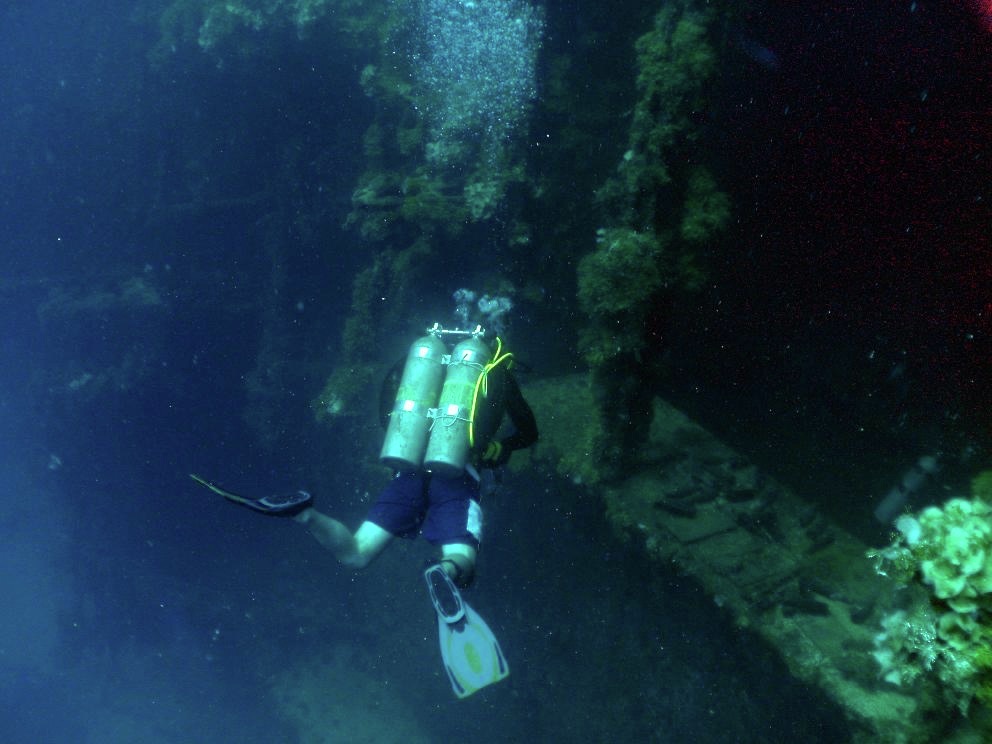
The Rio de Janeiro Maru was built in 1930 for the OSK line's emigrant route to South America, a motor liner named for her destination port. The navy took her in 1940, used her first as a submarine tender and then as a transport, and Hailstone's bombers found her at Truk in February 1944; she absorbed her damage slowly and went down quietly the next morning, rolling onto her starboard side on a sandy bottom. She is a dive of oversized details. Her port hull, now the wreck's upper surface, is a field of plating within easy reach of the surface; at the stern, her big twin screws stand in the blue like monuments; and in the aft holds sit crates of beer bottles by the thousand, stacked as the stevedores left them. A stern gun still points at nothing. Like every ship of the Hailstone fleet, she carried men who did not get off, and divers treat her accordingly.
Wie sie sank: Bombed on 17 February 1944 during Operation Hailstone; sank in the early hours of the following day.
Heute dort tauchen
Bedingung: Coherent and stable, with the gradual sagging of a large hull lying on its side for eighty years.
Wrackinnenraum-Tauchen: Full With Training. Hold entries are broad and forgiving by lagoon standards, but the rotated interior still calls for wreck training and a guide who knows the exits. Das Betreten von Überkopf-Umgebungen erfordert eine spezifische Ausbildung – mindestens ein Wrack-Zertifikat, für die vollständige Penetration eine technische Wrack-Ausbildung.
Empfohlene Zertifizierung: Advanced Open Water; wreck training for interiors
Strömung: Mild · Sichtweite: 15–30 m
Meeresleben: Hard corals pave the upturned hull, sweetlips and snappers gather at the stern, and turtles are regular visitors along the rail.
Gefahren: Silt in the holds, collapsing internal fittings, and glass and cargo that must be left undisturbed.
Schutz & Recht
Chuuk lagoon monument protection; state dive permit/fee applies.
A war grave of the February 1944 raid; conduct inside the hull should honor that.
The famous bottles stay in their crates; removal is illegal.
Ansehen
Aus den offiziellen Kanälen

Deep-Sea Coral Fireworks

Camera 2: 2026 American Samoa ROV + Mapping Exploration (EX2606)
Videos sind eingebettete Links zu den Kanälen der jeweiligen Ersteller – wir hosten nichts und geben für alles die Quelle an.