Rio de Janeiro Maru
我们的故事
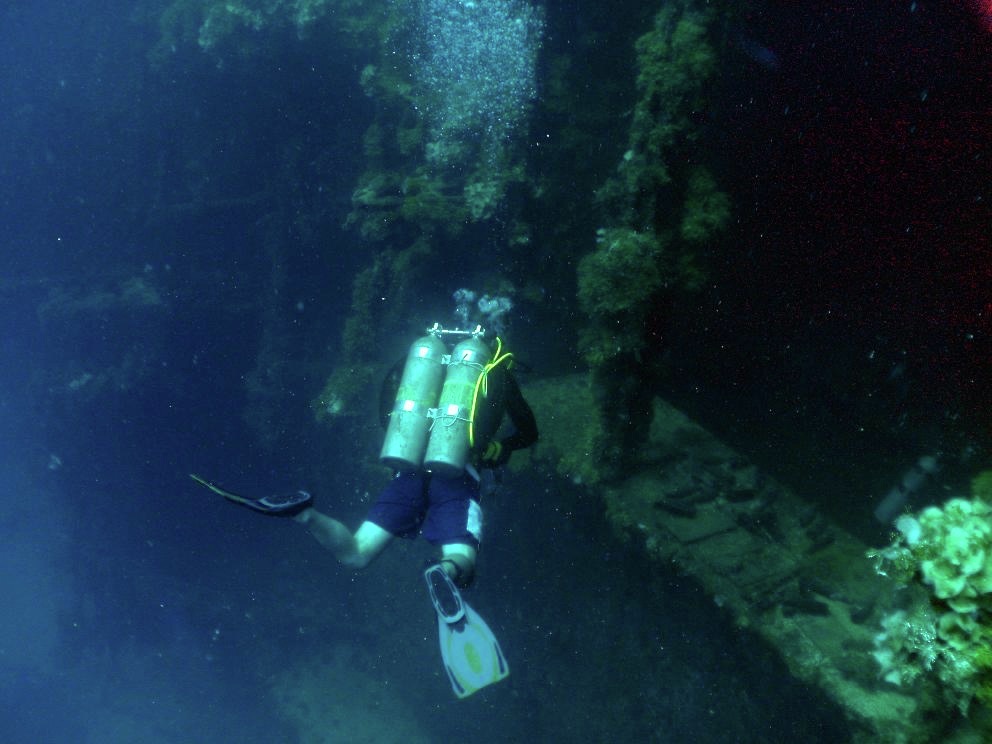
The Rio de Janeiro Maru was built in 1930 for the OSK line's emigrant route to South America, a motor liner named for her destination port. The navy took her in 1940, used her first as a submarine tender and then as a transport, and Hailstone's bombers found her at Truk in February 1944; she absorbed her damage slowly and went down quietly the next morning, rolling onto her starboard side on a sandy bottom. She is a dive of oversized details. Her port hull, now the wreck's upper surface, is a field of plating within easy reach of the surface; at the stern, her big twin screws stand in the blue like monuments; and in the aft holds sit crates of beer bottles by the thousand, stacked as the stevedores left them. A stern gun still points at nothing. Like every ship of the Hailstone fleet, she carried men who did not get off, and divers treat her accordingly.
她是如何沉没的: Bombed on 17 February 1944 during Operation Hailstone; sank in the early hours of the following day.
今日潜水中
环境条件: Coherent and stable, with the gradual sagging of a large hull lying on its side for eighty years.
穿越式潜水: Full With Training. Hold entries are broad and forgiving by lagoon standards, but the rotated interior still calls for wreck training and a guide who knows the exits. 进入任何封闭式环境都需要专项培训:至少需要沉船潜水认证,完整穿越则需要技术级沉船培训。
建议持有证书: Advanced Open Water; wreck training for interiors
水流: Mild · 能见度: 15–30 m
海洋生物: Hard corals pave the upturned hull, sweetlips and snappers gather at the stern, and turtles are regular visitors along the rail.
危险因素: Silt in the holds, collapsing internal fittings, and glass and cargo that must be left undisturbed.
保护与法规
Chuuk lagoon monument protection; state dive permit/fee applies.
A war grave of the February 1944 raid; conduct inside the hull should honor that.
The famous bottles stay in their crates; removal is illegal.
观看
来自官方渠道

Deep-Sea Coral Fireworks

Camera 2: 2026 American Samoa ROV + Mapping Exploration (EX2606)
视频均为创作者自有频道的嵌入链接。我们不托管任何内容,所有来源均注明出处。