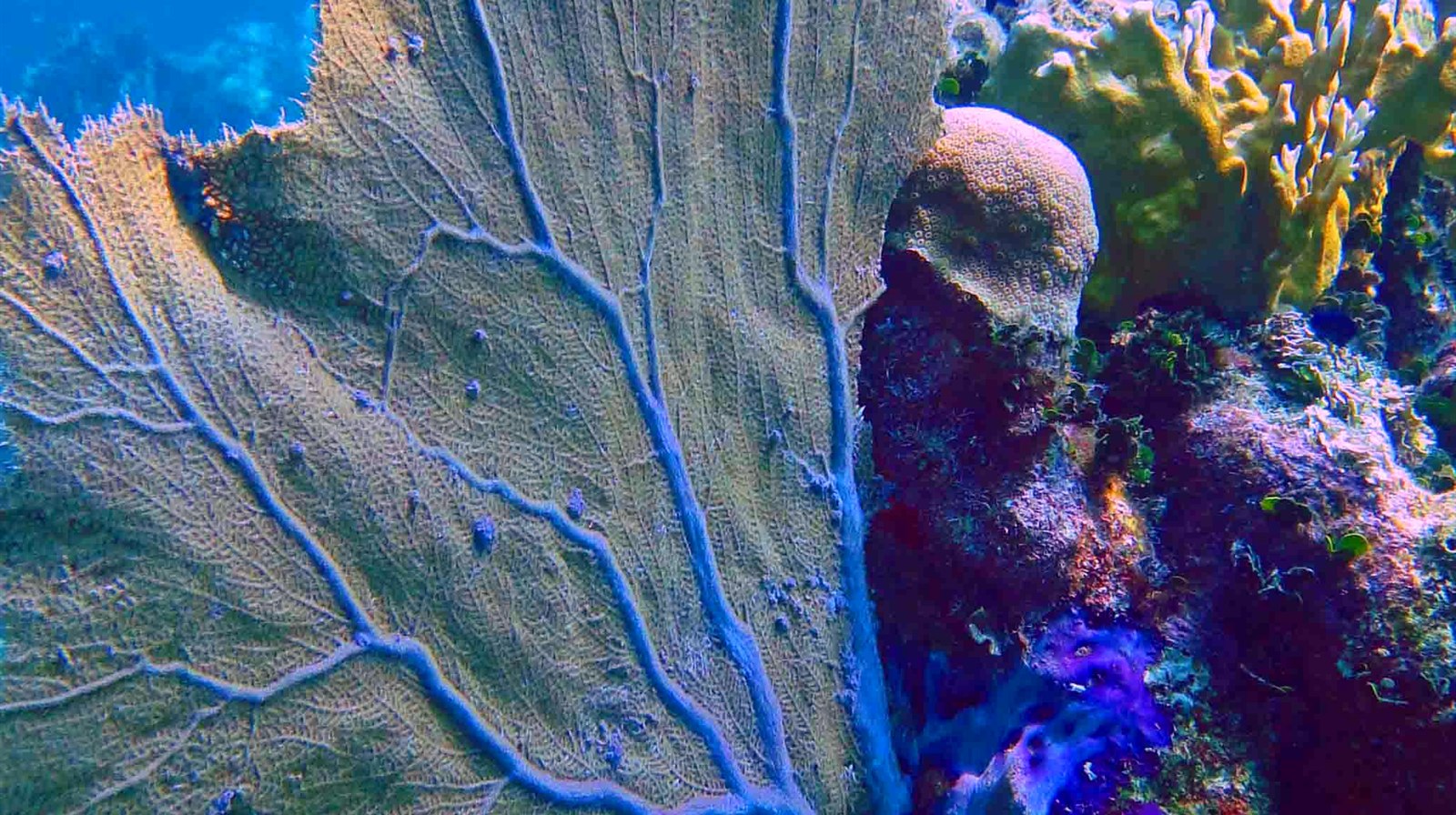
Utila
Utila is the small, flat, budget-minded sister of Roatan, a backpacker island that has certified generations of divers and still charges some of the lowest course prices in the hemisphere. The reef rewards staying: sheer north-side walls, a tidy wreck at 30 m, seamounts that pull in pelagics, and a genuine chance (never a promise) of whale sharks cruising the blue offshore.
Why dive here
Whale sharks made Utila's name. The island sits near deep water where tuna drive baitfish to the surface, and boats running the north side watch for the boils that sometimes carry a whale shark beneath them; encounters cluster around March–April and August–September but can happen any month. The everyday diving carries the trip regardless. The north coast drops fast into walls and cracks like CJ's Drop Off, the south side stays sheltered and easy, and the Halliburton wreck gives structure at depth for wreck and deep training. Black Hills, a seamount rising from open water, gathers barracuda, jacks, and eagle rays in one reliable fishbowl. Utila's dive culture is the other draw: a dozen schools within walking distance, evenings comparing logbooks on the dock, and prices that let new divers stack experience fast.
Month by month
March–April and August–September are the classic whale-shark windows and calm-sea months. October through January brings rain and northers that push boats to the south side. Encounters with whale sharks are opportunistic year-round, and no operator can guarantee them.
| Month | Water | Visibility | What it's like |
|---|---|---|---|
| January●●●○○ | 26–27 °C / 79–81 °F | 10–25 m | Northers; south-side diving. |
| February●●●●○ | 26–27 °C / 79–81 °F | 15–25 m | Settling; water coolest now. |
| March●●●●● | 26–28 °C / 79–82 °F | 15–30 m | Whale-shark window opens; calm seas. |
| April●●●●● | 27–28 °C / 81–82 °F | 15–30 m | Prime month; sightings most frequent. |
| May●●●●○ | 27–29 °C / 81–84 °F | 15–30 m | Warm and settled. |
| June●●●●○ | 28–29 °C / 82–84 °F | 15–30 m | Hot; showers pass through. |
| July●●●●○ | 28–30 °C / 82–86 °F | 15–30 m | Calm spells; occasional squalls. |
| August●●●●○ | 28–30 °C / 82–86 °F | 15–30 m | Second whale-shark window begins. |
| September●●●●○ | 28–30 °C / 82–86 °F | 15–30 m | Sightings continue; watch the tropics. |
| October●●●○○ | 28–29 °C / 82–84 °F | 10–25 m | Rains build. |
| November●●●○○ | 27–28 °C / 81–82 °F | 10–25 m | Wet season; lee-shore diving. |
| December●●●○○ | 26–28 °C / 79–82 °F | 10–25 m | Rain and wind between calm windows. |
Monthly figures confidence: Documented. Months without a row have no verified data. We would rather show a gap than invent one.
The dive sites (5)
| Site | Type | Depth | Level | Access | |
|---|---|---|---|---|---|
| Black Hills Swirling jack and baitfish schools, eagle rays on the current line, outside… | Seamount | 12–40 m | Intermediate | Boat | |
| CJ's Drop Off Chimney swim-throughs opening onto the wall, sharp shelf-to-abyss… | Wall | 5–40 m | Intermediate | Boat | |
| Duppy Waters Ghost-quiet north-shore atmosphere, sponge-heavy wall, uncrowded diving… | Wall | 8–35 m | Intermediate | Boat | |
| Halliburton Compact upright wreck, textbook deep and wreck training profiles, moody… | Wreck | 18–30 m | Advanced | Boat | |
| Ted's Point Minutes from the harbor, relaxed profiles at every level, regular small… | Reef | 6–30 m | Beginner | Boat |
Wrecks here
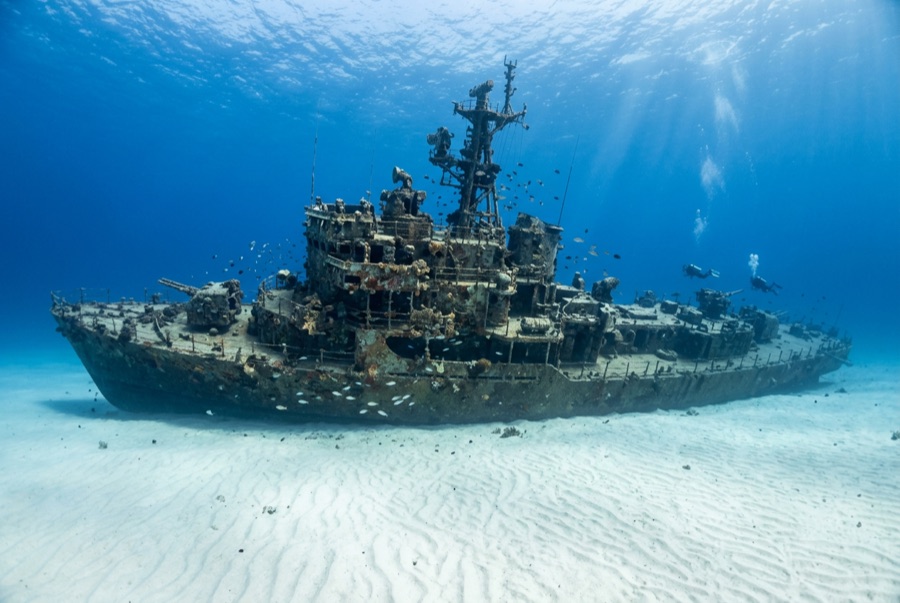
Halliburton 211
Getting there & staying
Getting there: Fly to Roatan or San Pedro Sula, connect to La Ceiba, then take the passenger ferry or a small plane across. Everything on the island is walkable from the dock.
Where to stay: Dive-school lodges and guesthouses line the single main street; a handful of quieter cays sit off the southwest tip.
Costs: Fun dives are among the cheapest anywhere, and Open Water courses famously undercut most of the world; accommodation is often bundled with training.
Between dives: Freediving courses, kayaking the mangrove lagoon, Pumpkin Hill beach, and a low-key bar scene that runs on dive stories.
Safety & practicalities
Hazards: Open-water whale-shark drops happen from moving boats in deep water; listen to the captain. North-side walls carry surge and occasional current; the Halliburton sits at the edge of recreational depth.
Whale-shark encounters here are snorkel-style surface drops with strict no-touch, no-chase etiquette; keep clear of the tail and the boat's prop. New divers should build depth experience gradually rather than rushing to the wreck.
Nearest recompression: A hyperbaric chamber has operated on Utila alongside the island's dive-medicine community; availability changes. Emergencies go through your operator, EMS, and DAN.