Uitrusting · Core
Regulators
The machine you breathe through: how first and second stages work, DIN versus yoke, cold-water sealing, and why service history matters more than model glamour.
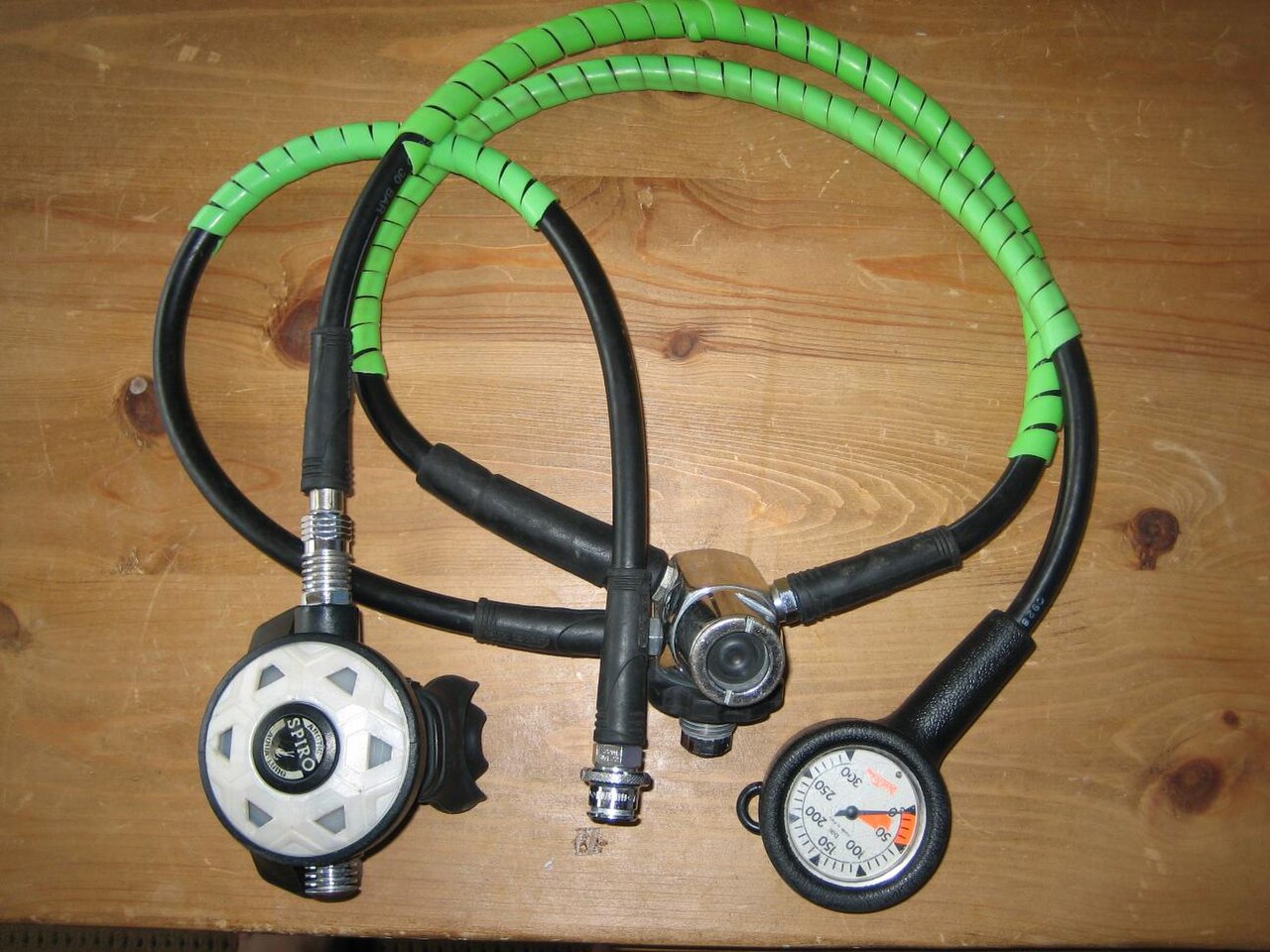
A regulator is a pressure translator. The first stage clamps to the cylinder valve and steps tank pressure - up to 200-300 bar - down to an intermediate pressure a few bar above ambient; the second stage in your mouth releases gas at exactly the surrounding pressure each time you inhale. A complete recreational set adds an alternate second stage for a buddy, a submersible pressure gauge or transmitter, and a low-pressure hose for the BCD. The engineering is mature and profoundly reliable: modern regulators fail rarely, and almost always toward free-flowing rather than shutting off - a design choice, not luck.
Choosing starts with your water. Balanced first stages deliver the same easy breath regardless of tank pressure and are the sensible default; unbalanced designs are simpler and cheaper and remain adequate for easy warm-water diving. Cold water is the real dividing line: below roughly 10-15 °C, and always under ice, you want environmentally sealed first stages designed to resist internal icing and free-flow, which agencies and manufacturers treat as standard equipment for those conditions. Then comes the fitting question - yoke (A-clamp) remains the rental-world standard in the Americas and much of the tropics, while DIN screws directly into the valve, holds higher pressures, and dominates in Europe and technical diving; convertible first stages and cheap adapters make this a preference rather than a dilemma, though travelers should carry the adapter their destination will not have.
Comfort details earn their keep across thousands of breaths: adjustable breathing-effort knobs, a mouthpiece that suits your jaw (replaceable for a few dollars), hose routing that does not tug, and a weight your neck stops noticing. Braided flex hoses and swivels are pleasant, not essential.
Money and priorities: a solid complete set - first stage, two seconds, gauge - starts around US$300-500, mid-range sealed sets run US$500-800, and premium or cold-water-focused sets reach US$800-1,200 and beyond. It is the piece of kit where buying used demands the most care: a bargain regulator without a documented service history is a bargain in need of an immediate overhaul, so price that in or walk away.
This is also the classic case for early ownership among traveling divers. Rental regulators are maintained to be safe, but they are also the most intimate rental in the shop and the one whose feel varies most; many divers buy their own regulator and computer before ever owning a BCD, then rent everything bulky at the destination. A regulator set packs small and flies carry-on easily - which is exactly where it should travel.
Maintenance is non-negotiable: soak and rinse after diving with the dust cap sealed, never soak a pressurized-free first stage with the cap open, keep it out of contact with sand, and service on the manufacturer's schedule - annually or biennially with inspections between, depending on the maker's program. Between services, breathe it briefly before every trip; the time to find a hesitating second stage is at home, not at the boat ladder.
Prijzen zijn eerlijke marktbandbreedtes, geen aanbiedingen; geen enkele fabrikant betaalt voor vermelding hier.