Reptiles
Banded Sea Krait
Laticauda colubrina · Reptile, family Elapidae, subfamily Laticaudinae; an amphibious sea snake, also called the yellow-lipped sea krait
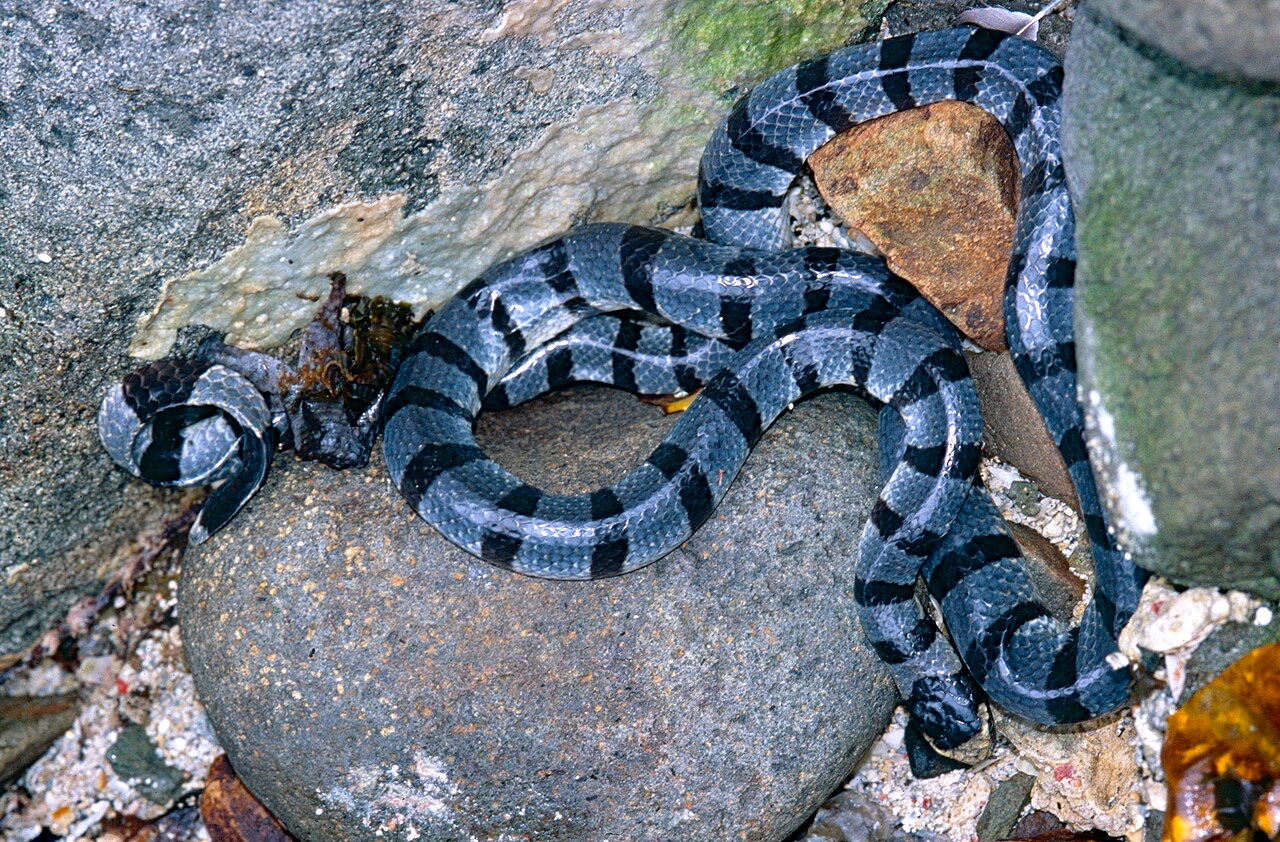
The banded sea krait commutes between worlds. It hunts eels in reef crevices on breath-holds that can pass half an hour, then hauls out on rocks and islets to digest, shed, drink fresh water, and lay eggs: a genuinely amphibious snake, paddle-tailed at one end and land-capable at the other. The venom is potently neurotoxic, and that fact sits beside another: unprovoked bites on divers are essentially unheard of. Kraits treat people as scenery, threading between fins and poking into holes mid-dive with total focus. The etiquette is correspondingly simple: never handle, never corner, and give a rising snake a clear lane to the surface, because it is on a breath just as you are. Females run far larger than males, and several look-alike kraits and true sea snakes share the range.
Wo und wann man eines sieht
„Resident" bedeutet, dass die meisten Tauchgänge am jeweiligen Tauchziel eine Begegnung erwarten lassen; „saisonal" bedeutet, dass die Art in den genannten Monaten zuverlässig anzutreffen ist; alles andere ist ein Bonus, keine Planungsgrundlage.
| Ziel | Zuverlässigkeit | Monate | Hinweise |
|---|---|---|---|
| Sipadan & MabulMalaysia | Resident: seen on most dives | Ganzjährig | |
| Dumaguete, Dauin & Apo IslandPhilippines | Resident: seen on most dives | Ganzjährig | |
| Banda Sea & AmbonIndonesia | Resident: seen on most dives | Ganzjährig | |
| Bunaken & ManadoIndonesia | Resident: seen on most dives | Ganzjährig | |
| Beqa Lagoon & Pacific HarbourFiji | Resident: seen on most dives | Ganzjährig |
Bester Monat auf einen Blick
Sie verstehen
Lebensraum: Coral reefs and adjacent shallows for hunting; rocks, islets, and shorelines for digesting, shedding, drinking, and egg-laying.
Verbreitung: Eastern Indian Ocean and western Pacific, from Sabah and the Philippines through Indonesia and New Guinea to Fiji and other Pacific islands.
Verhalten: A true amphibian commuter: forages underwater on breath-holds that can pass half an hour, then returns to land. Utterly indifferent to divers, often threading between fins mid-hunt.
Ernährung: Eels above all, hunted deep in reef crevices; large females take bigger conger and moray prey than males.
Größe: typischerweise rund 0.9 m; dokumentiert bis zu 1.5 m (total length; females run far larger than males).
Wie man sich in ihrer Nähe verhält
Give a hunting krait space to work and a rising one a clear lane to the surface: it is on a breath just as you are. Hands stay away, always.
Naturschutz
Listed Least Concern; localized pressure comes from coastal development of nesting shores and incidental capture in nets.
Bekannte Tauchplätze dafür
Hervorgehobene Tauchplätze wurden von unseren Redakteuren für diese Art kartiert; die Zahlen sind GBIF-Vorkommensdatensätze, die seit 1990 im Umkreis von etwa 5 km um einen Tauchplatz protokolliert wurden.
Ansehen
Aus den offiziellen Kanälen

Wildlife of Monterey | New film in our auditorium

Live Aviary Cam | Monterey Bay Aquarium

Live Aviary Cam | Monterey Bay Aquarium
Videos sind eingebettete Links zu den Kanälen der jeweiligen Ersteller – wir hosten nichts und geben für alles die Quelle an.