Dive sites, seasons and marine life — researched, mapped, planned.
Menu
Destinations Dive Sites Marine Life Wrecks News
Plan a trip Trip planner When to dive Cost calculator Comparisons Marine-life calendar Water temperature Liveaboards Operators & resorts Marine parks Hyperbaric chambers World map
Regions Australia, New Zealand & East AsiaCaribbean & Western AtlanticEurope, Atlantic & MediterraneanIndian Ocean & East AfricaPacific Islands & MicronesiaRed Sea & Middle EastSoutheast Asia & Coral TriangleThe Americas & Eastern Pacific Countries
Learn & Tools All guides Certifications Gear guides Videos Ask the Data AI Agents API
About About us Methodology Disclaimer Contact
Your view
★ Saved

Your starred destinations, sites and species — stored in this browser.

API GATEWAY

Free read-only JSON access to the atlas's cached data.

Dark mode

🧭 Guided View
New to diving — depths, currents, certification levels? We explain every term as you browse, in plain English. Same data, with the help built in.

⚡ Expert View
You already know the difference between a wall and a drift. Just the data — clean, fast and compact. This is the default view.

Interface language
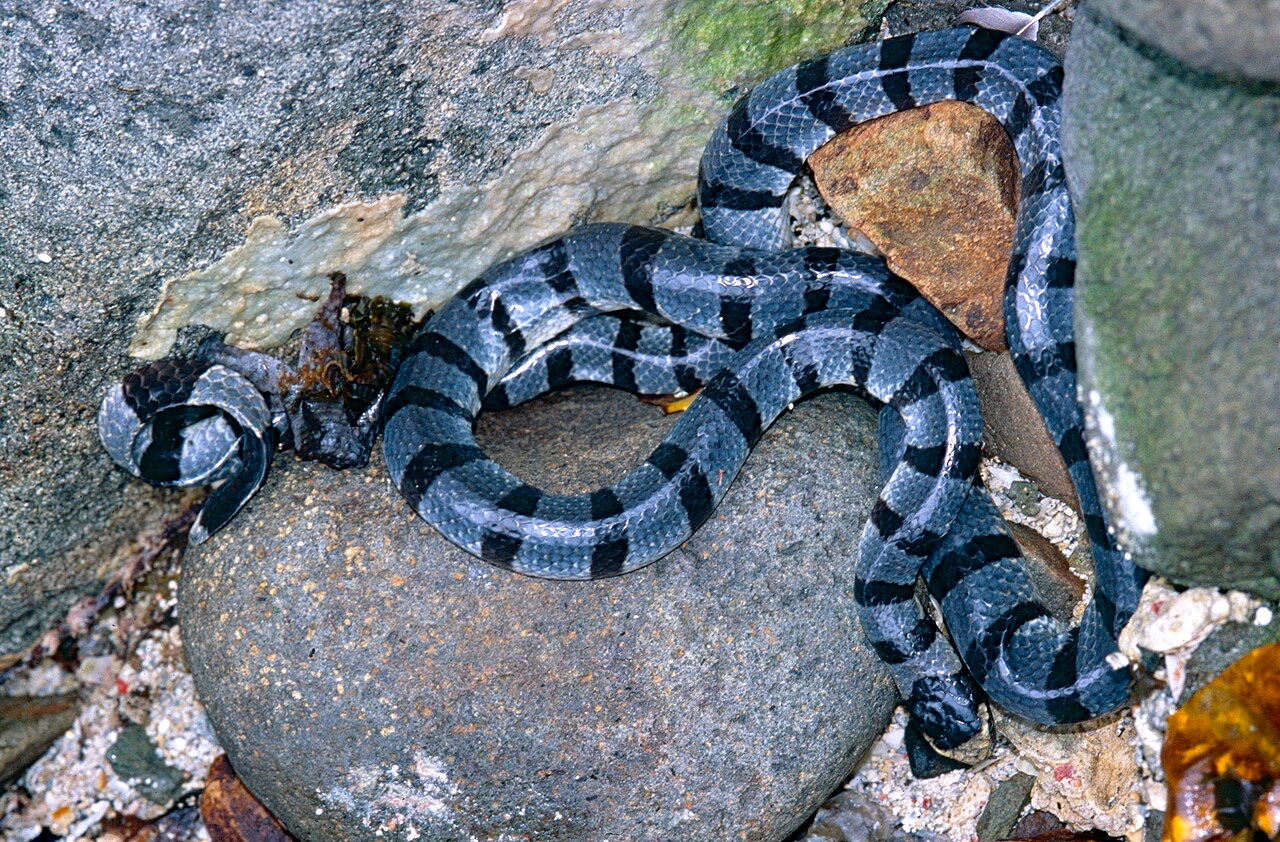
Banded Sea Krait — illustration
AI-generated illustration for The Scuba Atlas — illustrative, not a documentary photograph.

Reptiles

Banded Sea Krait

Laticauda colubrina · Reptile — family Elapidae, subfamily Laticaudinae; an amphibious sea snake, also called the yellow-lipped sea krait

IUCN: LC ~0.9 m total length; females run far larger than males 0–30 m depth band Well documented

The banded sea krait commutes between worlds. It hunts eels in reef crevices on breath-holds that can pass half an hour, then hauls out on rocks and islets to digest, shed, drink fresh water, and lay eggs — a genuinely amphibious snake, paddle-tailed at one end and land-capable at the other. The venom is potently neurotoxic, and that fact sits beside another: unprovoked bites on divers are essentially unheard of. Kraits treat people as scenery, threading between fins and poking into holes mid-dive with total focus. The etiquette is correspondingly simple — never handle, never corner, and give a rising snake a clear lane to the surface, because it is on a breath just as you are. Females run far larger than males, and several look-alike kraits and true sea snakes share the range.

Respect factor: Medically SignificantThe venom is potently neurotoxic, yet the species is placid and unprovoked bites on divers are all but unknown; recorded bites overwhelmingly involve fishers clearing nets. Never touch, corner, or block one.

Where and when to see one

"Resident" means most dives at that destination encounter them; "seasonal" means reliably present in the listed months; anything else is a bonus, not a plan.

DestinationReliabilityMonthsNotes
Sipadan & MabulMalaysia Resident — seen on most dives Year-round
Dumaguete, Dauin & Apo IslandPhilippines Resident — seen on most dives Year-round
Banda Sea & AmbonIndonesia Resident — seen on most dives Year-round
Bunaken & ManadoIndonesia Resident — seen on most dives Year-round
Beqa Lagoon & Pacific HarbourFiji Resident — seen on most dives Year-round

Best month, at a glance

MonthReliable destinations
January Sipadan & Mabul · Dumaguete, Dauin & Apo Island · Banda Sea & Ambon · Bunaken & Manado · Beqa Lagoon & Pacific Harbour
February Sipadan & Mabul · Dumaguete, Dauin & Apo Island · Banda Sea & Ambon · Bunaken & Manado · Beqa Lagoon & Pacific Harbour
March Sipadan & Mabul · Dumaguete, Dauin & Apo Island · Banda Sea & Ambon · Bunaken & Manado · Beqa Lagoon & Pacific Harbour
April Sipadan & Mabul · Dumaguete, Dauin & Apo Island · Banda Sea & Ambon · Bunaken & Manado · Beqa Lagoon & Pacific Harbour
May Sipadan & Mabul · Dumaguete, Dauin & Apo Island · Banda Sea & Ambon · Bunaken & Manado · Beqa Lagoon & Pacific Harbour
June Sipadan & Mabul · Dumaguete, Dauin & Apo Island · Banda Sea & Ambon · Bunaken & Manado · Beqa Lagoon & Pacific Harbour
July Sipadan & Mabul · Dumaguete, Dauin & Apo Island · Banda Sea & Ambon · Bunaken & Manado · Beqa Lagoon & Pacific Harbour
August Sipadan & Mabul · Dumaguete, Dauin & Apo Island · Banda Sea & Ambon · Bunaken & Manado · Beqa Lagoon & Pacific Harbour
September Sipadan & Mabul · Dumaguete, Dauin & Apo Island · Banda Sea & Ambon · Bunaken & Manado · Beqa Lagoon & Pacific Harbour
October Sipadan & Mabul · Dumaguete, Dauin & Apo Island · Banda Sea & Ambon · Bunaken & Manado · Beqa Lagoon & Pacific Harbour
November Sipadan & Mabul · Dumaguete, Dauin & Apo Island · Banda Sea & Ambon · Bunaken & Manado · Beqa Lagoon & Pacific Harbour
December Sipadan & Mabul · Dumaguete, Dauin & Apo Island · Banda Sea & Ambon · Bunaken & Manado · Beqa Lagoon & Pacific Harbour

Understanding them

Habitat: Coral reefs and adjacent shallows for hunting; rocks, islets, and shorelines for digesting, shedding, drinking, and egg-laying.

Range: Eastern Indian Ocean and western Pacific, from Sabah and the Philippines through Indonesia and New Guinea to Fiji and other Pacific islands.

Behavior: A true amphibian commuter — forages underwater on breath-holds that can pass half an hour, then returns to land. Utterly indifferent to divers, often threading between fins mid-hunt.

Diet: Eels above all, hunted deep in reef crevices; large females take bigger conger and moray prey than males.

Size: typically around 0.9 m; documented up to 1.5 m (total length; females run far larger than males).

How to behave around one

Give a hunting krait space to work and a rising one a clear lane to the surface — it is on a breath just as you are. Hands stay away, always.

Conservation

Listed Least Concern; localized pressure comes from coastal development of nesting shores and incidental capture in nets.

Charted sites known for them

Watch

From the official channels

All videos →

Videos are embedded links to their creators' own channels — we host nothing and credit everything.

Sources: Wikipedia ↗IUCN Red List ↗ · Facts verified against the sources above; fields without support are labeled not yet verified.

Australia, New Zealand & East Asia

Cairns & the Ribbon ReefsNingaloo ReefCoral Sea & Osprey ReefOkinawa & the Kerama IslandsPoor Knights IslandsTownsville & the YongalaGreen IslandIzu Peninsula

Caribbean & Western Atlantic

BonaireCozumelRiviera Maya & the CenotesBelize Barrier ReefGrand CaymanIsla Mujeres & CancúnRoatánTiger Beach & Grand Bahama

Europe, Atlantic & Mediterranean

Malta & GozoSilfra & IcelandThe AzoresCanary IslandsLarnaca & the ZenobiaScapa FlowArctic NorwayMadeira

Indian Ocean & East Africa

North & South Malé AtollsAri AtollBaa Atoll & Hanifaru BayAliwal Shoal & UmkomaasMafia IslandMauritiusSeychellesSodwana Bay

Pacific Islands & Micronesia

PalauChuuk (Truk) LagoonFakaravaKona, HawaiʻiRangiroaTaveuni & Rainbow ReefBeqa Lagoon & Pacific HarbourEspiritu Santo

Red Sea & Middle East

Sharm El Sheikh & Ras MohammedBrothers, Daedalus & St John'sDahabHurghada & El GounaMarsa Alam & the Deep SouthAqabaDaymaniyat IslandsMusandam Peninsula

Southeast Asia & Coral Triangle

Bali & Nusa PenidaKomodoRaja AmpatSipadan & MabulAnilaoCoronKoh TaoLembeh Strait

The Americas & Eastern Pacific

Galápagos IslandsCocos IslandFlorida KeysSea of Cortez & Cabo PulmoSocorro & the RevillagigedosBritish ColumbiaCalifornia Channel IslandsCosta Rica Pacific Coast