Puntos de buceo, temporadas y vida marina — investigados, cartografiados, planificados.
Menú
Destinos Puntos de buceo Vida marina Pecios Noticias
Planifica un viaje Planificador de viajes Cuándo bucear Calculadora de costes Comparativas Calendario de fauna marina Temperatura del agua Liveaboards Operadores y resorts Parques marinos Cámaras hiperbáricas Mapa mundial
Regiones Australia, Nueva Zelanda y Asia OrientalCaribe y Atlántico occidentalEuropa, Atlántico y MediterráneoOcéano Índico y África OrientalIslas del Pacífico y MicronesiaMar Rojo y Oriente MedioSudeste Asiático y el Triángulo del CoralLas Américas y el Pacífico Oriental Países
Aprender y herramientas Todas las guías Certificaciones Guías de equipo Vídeos Consulta los datos Agentes de IA API
Acerca de Quiénes somos Metodología Aviso legal Contacto
Tu vista
★ Guardado

Tus destinos, sitios y especies favoritos — guardados en este navegador.

API GATEWAY

Acceso JSON gratuito de solo lectura a los datos en caché del atlas.

Modo oscuro

🧭 Vista guiada
¿Nuevo en el buceo? ¿Profundidades, corrientes, niveles de certificación? Explicamos cada término mientras navegas, en un lenguaje claro. Los mismos datos, con la ayuda integrada.

⚡ Vista experta
Ya conoces la diferencia entre una pared y un drift dive. Solo los datos — claros, rápidos y concisos. Esta es la vista predeterminada.

Idioma de la interfaz
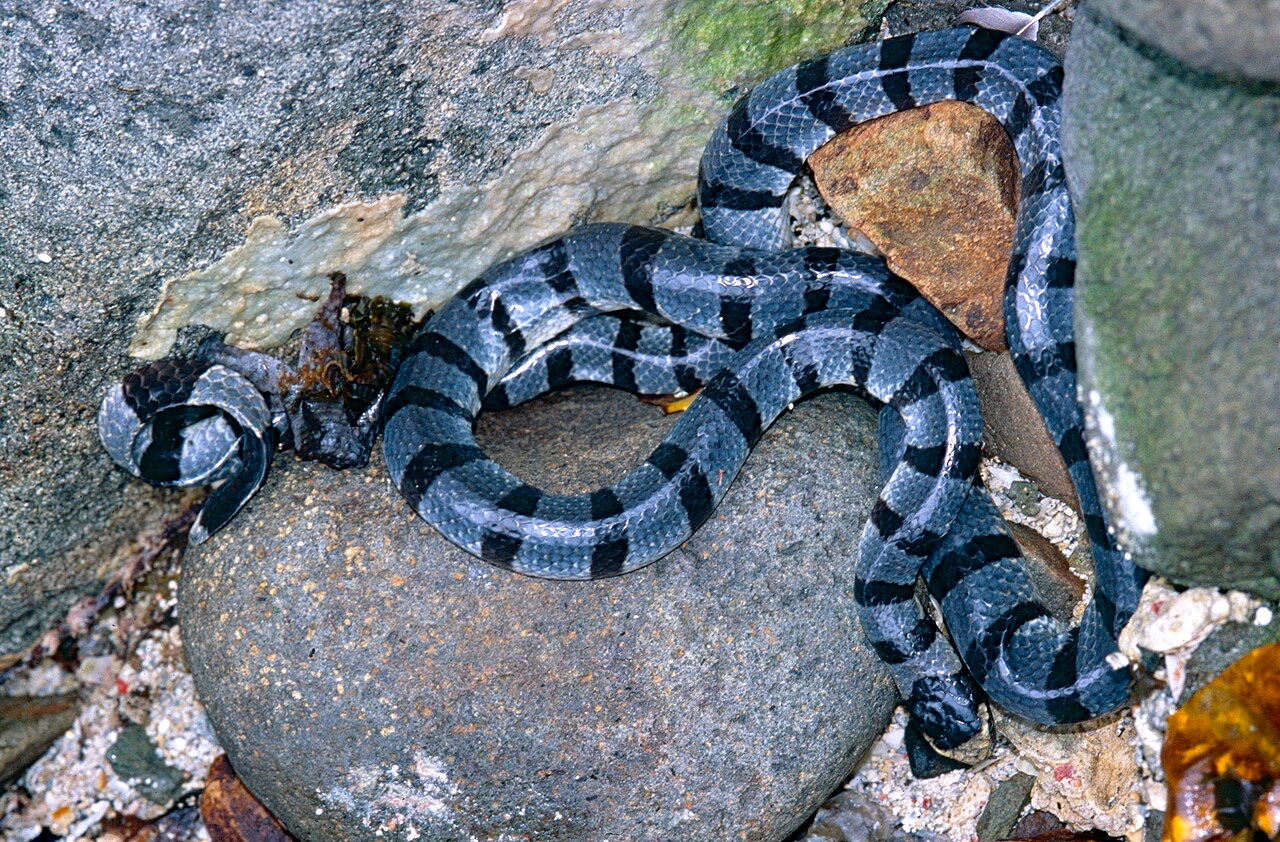
Banded Sea Krait — illustration
Ilustración generada por IA para The Scuba Atlas — ilustrativa, no una fotografía documental.

Reptiles

Banded Sea Krait

Laticauda colubrina · Reptile — family Elapidae, subfamily Laticaudinae; an amphibious sea snake, also called the yellow-lipped sea krait

IUCN: LC ~0.9 m total length; females run far larger than males 0–30 m rango de profundidad Bien documentado

The banded sea krait commutes between worlds. It hunts eels in reef crevices on breath-holds that can pass half an hour, then hauls out on rocks and islets to digest, shed, drink fresh water, and lay eggs — a genuinely amphibious snake, paddle-tailed at one end and land-capable at the other. The venom is potently neurotoxic, and that fact sits beside another: unprovoked bites on divers are essentially unheard of. Kraits treat people as scenery, threading between fins and poking into holes mid-dive with total focus. The etiquette is correspondingly simple — never handle, never corner, and give a rising snake a clear lane to the surface, because it is on a breath just as you are. Females run far larger than males, and several look-alike kraits and true sea snakes share the range.

Factor de respeto: Medically SignificantThe venom is potently neurotoxic, yet the species is placid and unprovoked bites on divers are all but unknown; recorded bites overwhelmingly involve fishers clearing nets. Never touch, corner, or block one.

Dónde y cuándo ver uno

"Residente" significa que la mayoría de las inmersiones en ese destino tienen encuentros con ellos; "estacional" significa que su presencia es fiable en los meses indicados; cualquier otra cosa es un extra, no algo con lo que contar.

DestinoFiabilidadMesesNotas
Sipadan & MabulMalaysia Resident — seen on most dives Todo el año
Dumaguete, Dauin & Apo IslandPhilippines Resident — seen on most dives Todo el año
Banda Sea & AmbonIndonesia Resident — seen on most dives Todo el año
Bunaken & ManadoIndonesia Resident — seen on most dives Todo el año
Beqa Lagoon & Pacific HarbourFiji Resident — seen on most dives Todo el año

El mejor mes, de un vistazo

MesDestinos fiables
January Sipadan & Mabul · Dumaguete, Dauin & Apo Island · Banda Sea & Ambon · Bunaken & Manado · Beqa Lagoon & Pacific Harbour
February Sipadan & Mabul · Dumaguete, Dauin & Apo Island · Banda Sea & Ambon · Bunaken & Manado · Beqa Lagoon & Pacific Harbour
March Sipadan & Mabul · Dumaguete, Dauin & Apo Island · Banda Sea & Ambon · Bunaken & Manado · Beqa Lagoon & Pacific Harbour
April Sipadan & Mabul · Dumaguete, Dauin & Apo Island · Banda Sea & Ambon · Bunaken & Manado · Beqa Lagoon & Pacific Harbour
May Sipadan & Mabul · Dumaguete, Dauin & Apo Island · Banda Sea & Ambon · Bunaken & Manado · Beqa Lagoon & Pacific Harbour
June Sipadan & Mabul · Dumaguete, Dauin & Apo Island · Banda Sea & Ambon · Bunaken & Manado · Beqa Lagoon & Pacific Harbour
July Sipadan & Mabul · Dumaguete, Dauin & Apo Island · Banda Sea & Ambon · Bunaken & Manado · Beqa Lagoon & Pacific Harbour
August Sipadan & Mabul · Dumaguete, Dauin & Apo Island · Banda Sea & Ambon · Bunaken & Manado · Beqa Lagoon & Pacific Harbour
September Sipadan & Mabul · Dumaguete, Dauin & Apo Island · Banda Sea & Ambon · Bunaken & Manado · Beqa Lagoon & Pacific Harbour
October Sipadan & Mabul · Dumaguete, Dauin & Apo Island · Banda Sea & Ambon · Bunaken & Manado · Beqa Lagoon & Pacific Harbour
November Sipadan & Mabul · Dumaguete, Dauin & Apo Island · Banda Sea & Ambon · Bunaken & Manado · Beqa Lagoon & Pacific Harbour
December Sipadan & Mabul · Dumaguete, Dauin & Apo Island · Banda Sea & Ambon · Bunaken & Manado · Beqa Lagoon & Pacific Harbour

Comprendiéndolos

Hábitat: Coral reefs and adjacent shallows for hunting; rocks, islets, and shorelines for digesting, shedding, drinking, and egg-laying.

Rango: Eastern Indian Ocean and western Pacific, from Sabah and the Philippines through Indonesia and New Guinea to Fiji and other Pacific islands.

Comportamiento: A true amphibian commuter — forages underwater on breath-holds that can pass half an hour, then returns to land. Utterly indifferent to divers, often threading between fins mid-hunt.

Dieta: Eels above all, hunted deep in reef crevices; large females take bigger conger and moray prey than males.

Tamaño: normalmente alrededor de 0.9 m; documentado hasta 1.5 m (total length; females run far larger than males).

Cómo comportarse cerca de uno

Give a hunting krait space to work and a rising one a clear lane to the surface — it is on a breath just as you are. Hands stay away, always.

Conservación

Listed Least Concern; localized pressure comes from coastal development of nesting shores and incidental capture in nets.

Puntos conocidos por avistamientos

Ver

Desde los canales oficiales

Todos los vídeos →

Los vídeos son enlaces incrustados a los canales propios de sus creadores — no alojamos nada y acreditamos todo.

Fuentes: Wikipedia ↗IUCN Red List ↗ · Datos verificados frente a las fuentes anteriores; los campos sin respaldo se marcan como aún no verificados.

Australia, Nueva Zelanda y Asia Oriental

Cairns & the Ribbon ReefsNingaloo ReefCoral Sea & Osprey ReefOkinawa & the Kerama IslandsPoor Knights IslandsTownsville & the YongalaGreen IslandIzu Peninsula

Caribe y Atlántico occidental

BonaireCozumelRiviera Maya & the CenotesBelize Barrier ReefGrand CaymanIsla Mujeres & CancúnRoatánTiger Beach & Grand Bahama

Europa, Atlántico y Mediterráneo

Malta & GozoSilfra & IcelandThe AzoresCanary IslandsLarnaca & the ZenobiaScapa FlowArctic NorwayMadeira

Océano Índico y África Oriental

North & South Malé AtollsAri AtollBaa Atoll & Hanifaru BayAliwal Shoal & UmkomaasMafia IslandMauritiusSeychellesSodwana Bay

Islas del Pacífico y Micronesia

PalauChuuk (Truk) LagoonFakaravaKona, HawaiʻiRangiroaTaveuni & Rainbow ReefBeqa Lagoon & Pacific HarbourEspiritu Santo

Mar Rojo y Oriente Medio

Sharm El Sheikh & Ras MohammedBrothers, Daedalus & St John'sDahabHurghada & El GounaMarsa Alam & the Deep SouthAqabaDaymaniyat IslandsMusandam Peninsula

Sudeste Asiático y el Triángulo del Coral

Bali & Nusa PenidaKomodoRaja AmpatSipadan & MabulAnilaoCoronKoh TaoLembeh Strait

Las Américas y el Pacífico Oriental

Galápagos IslandsCocos IslandFlorida KeysSea of Cortez & Cabo PulmoSocorro & the RevillagigedosBritish ColumbiaCalifornia Channel IslandsCosta Rica Pacific Coast