Reptiles
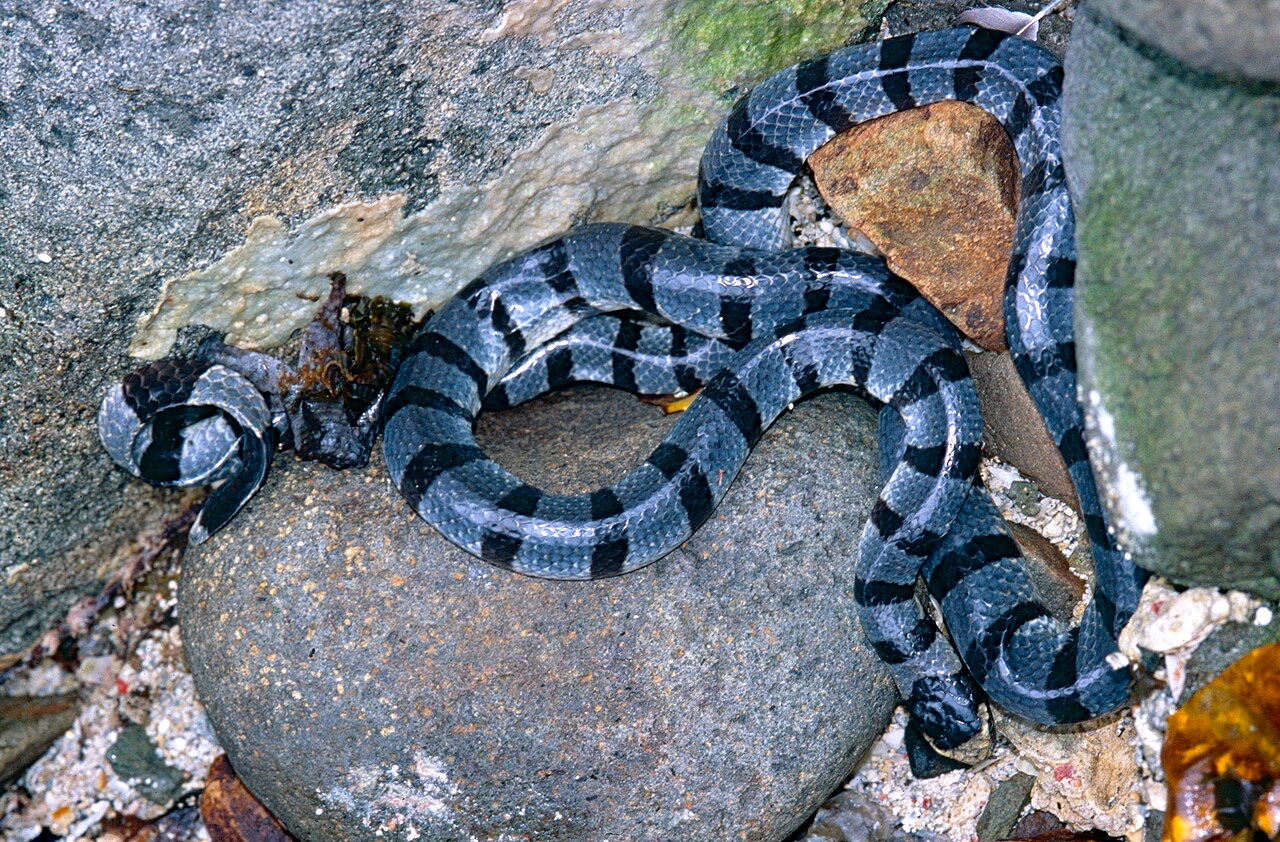
Banded Sea Krait
Laticauda colubrina · Reptile, family Elapidae, subfamily Laticaudinae; an amphibious sea snake, also called the yellow-lipped sea krait
The banded sea krait commutes between worlds. It hunts eels in reef crevices on breath-holds that can pass half an hour, then hauls out on rocks and islets to digest, shed, drink fresh water, and lay eggs: a genuinely amphibious snake, paddle-tailed at one end and land-capable at the other. The venom is potently neurotoxic, and that fact sits beside another: unprovoked bites on divers are essentially unheard of. Kraits treat people as scenery, threading between fins and poking into holes mid-dive with total focus. The etiquette is correspondingly simple: never handle, never corner, and give a rising snake a clear lane to the surface, because it is on a breath just as you are. Females run far larger than males, and several look-alike kraits and true sea snakes share the range.
Où et quand en observer un
« Résident » signifie que la plupart des plongées sur ce site permettent de les observer ; « saisonnier » signifie qu'ils sont présents de manière fiable durant les mois indiqués ; tout le reste est un bonus, pas une certitude.
| Destination | Fiabilité | Mois | Notes |
|---|---|---|---|
| Sipadan & MabulMalaysia | Resident: seen on most dives | Toute l'année | |
| Dumaguete, Dauin & Apo IslandPhilippines | Resident: seen on most dives | Toute l'année | |
| Banda Sea & AmbonIndonesia | Resident: seen on most dives | Toute l'année | |
| Bunaken & ManadoIndonesia | Resident: seen on most dives | Toute l'année | |
| Beqa Lagoon & Pacific HarbourFiji | Resident: seen on most dives | Toute l'année |
Meilleur mois, en un coup d'œil
Les comprendre
Habitat: Coral reefs and adjacent shallows for hunting; rocks, islets, and shorelines for digesting, shedding, drinking, and egg-laying.
Aire de répartition: Eastern Indian Ocean and western Pacific, from Sabah and the Philippines through Indonesia and New Guinea to Fiji and other Pacific islands.
Comportement: A true amphibian commuter: forages underwater on breath-holds that can pass half an hour, then returns to land. Utterly indifferent to divers, often threading between fins mid-hunt.
Régime alimentaire: Eels above all, hunted deep in reef crevices; large females take bigger conger and moray prey than males.
Taille: généralement autour de 0.9 m; documenté jusqu'à 1.5 m (total length; females run far larger than males).
Comment se comporter avec lui
Give a hunting krait space to work and a rising one a clear lane to the surface: it is on a breath just as you are. Hands stay away, always.
Conservation
Listed Least Concern; localized pressure comes from coastal development of nesting shores and incidental capture in nets.
Sites répertoriés connus pour leur présence
Les sites mis en évidence ont été cartographiés pour cette espèce par nos éditeurs ; les chiffres correspondent aux occurrences GBIF enregistrées dans un rayon d'environ 5 km d'un site depuis 1990.
Regarder
Depuis les canaux officiels

Wildlife of Monterey | New film in our auditorium

Live Aviary Cam | Monterey Bay Aquarium

Live Aviary Cam | Monterey Bay Aquarium
Les vidéos sont des liens intégrés vers les chaînes de leurs créateurs. Nous n'hébergeons rien et créditons tout.