Tauchplätze, Saisons und Meereslebewesen – recherchiert, kartiert, geplant.
Menü
Reiseziele Tauchplätze Meeresleben Wracks News
Eine Reise planen Tauchtrip-Planer Wann tauchen Kostenrechner Vergleiche Meereslebewesen-Kalender Wassertemperatur Liveaboards Tauchbetriebe & Resorts Meeresschutzgebiete Druckkammern Weltkarte
Regionen Australien, Neuseeland & OstasienKaribik & WestatlantikEuropa, Atlantik & MittelmeerIndischer Ozean & OstafrikaPazifikinseln & MikronesienRotes Meer & Naher OstenSüdostasien & Korallen-DreieckAmerika & Östlicher Pazifik Länder
Lernen & Tools Alle Guides Zertifizierungen Ausrüstungsratgeber Videos Daten abfragen KI-Agenten API
Über uns Über uns Methodik Haftungsausschluss Kontakt
Deine Ansicht
★ Gespeichert

Deine gespeicherten Reiseziele, Tauchplätze und Tierarten — im Browser gespeichert.

API-GATEWAY

Kostenloser, schreibgeschützter JSON-Zugriff auf die gecachten Daten des Atlas.

Dunkelmodus

🧭 Geführte Ansicht
Neu beim Tauchen — Tiefen, Strömungen, Zertifizierungsstufen? Wir erklären jeden Begriff beim Stöbern in verständlicher Sprache. Dieselben Daten, mit integrierter Hilfe.

⚡ Expertenansicht
Du kennst den Unterschied zwischen einem Wall und einem Drift Dive. Nur die Daten – klar, schnell und kompakt. Das ist die Standardansicht.

Oberflächensprache
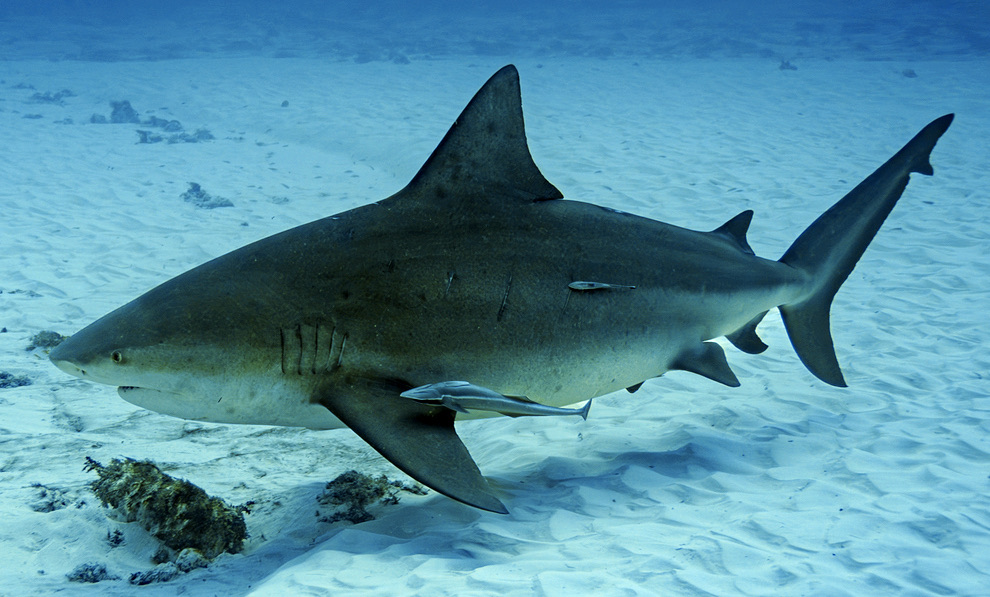
Bull Shark — illustration
KI-generierte Illustration für The Scuba Atlas – illustrativ, kein Dokumentarfoto.

Sharks

Bull Shark

Carcharhinus leucas · Cartilaginous fish — family Carcharhinidae

IUCN: VU (decreasing) ~2.4 m total length; females are distinctly bulkier and longer than males 1–60 m Tiefenbereich Gut dokumentiert

The bull shark's reputation precedes it unfairly into the water. What divers actually meet is a thickset, cautious animal that circles wide, sizes up the scene, and commits only when comfortable — the swagger is in the physique, not the behavior. Females gather seasonally off Playa del Carmen, dozens strong in Fiji's Beqa Lagoon, and around Cabo Pulmo's reefs, giving structured, repeatable encounters with a shark that thrives where visibility fails other predators. Its party trick is physiological: bulls osmoregulate well enough to swim far up rivers, which puts them near people more often than any other large shark.

Respektfaktor: Treat With RespectStatistically among the species involved in serious coastal incidents, mostly with swimmers and surfers in turbid water — conditions divers largely avoid. On managed dives in good visibility, thousands of encounters proceed without contact. Respect the animal's size, avoid murky solo swims in bull habitat, and follow feed protocols exactly.

Wo und wann man eines sieht

„Resident" bedeutet, dass die meisten Tauchgänge am jeweiligen Tauchziel eine Begegnung erwarten lassen; „saisonal" bedeutet, dass die Art in den genannten Monaten zuverlässig anzutreffen ist; alles andere ist ein Bonus, keine Planungsgrundlage.

ZielZuverlässigkeitMonateHinweise
Sea of Cortez & Cabo PulmoMexico Resident — seen on most dives Ganzjährig
Beqa Lagoon & Pacific HarbourFiji Resident — seen on most dives Ganzjährig
Riviera Maya & the CenotesMexico Seasonal — reliable in season Nov–Mar
Costa Rica Pacific CoastCosta Rica Seasonal — reliable in season May–Nov
Aliwal Shoal & UmkomaasSouth Africa Occasional Ganzjährig

Bester Monat auf einen Blick

MonatZuverlässige Reiseziele
January Sea of Cortez & Cabo Pulmo · Beqa Lagoon & Pacific Harbour · Riviera Maya & the Cenotes · Aliwal Shoal & Umkomaas
February Sea of Cortez & Cabo Pulmo · Beqa Lagoon & Pacific Harbour · Riviera Maya & the Cenotes · Aliwal Shoal & Umkomaas
March Sea of Cortez & Cabo Pulmo · Beqa Lagoon & Pacific Harbour · Riviera Maya & the Cenotes · Aliwal Shoal & Umkomaas
April Sea of Cortez & Cabo Pulmo · Beqa Lagoon & Pacific Harbour · Aliwal Shoal & Umkomaas
May Sea of Cortez & Cabo Pulmo · Beqa Lagoon & Pacific Harbour · Costa Rica Pacific Coast · Aliwal Shoal & Umkomaas
June Sea of Cortez & Cabo Pulmo · Beqa Lagoon & Pacific Harbour · Costa Rica Pacific Coast · Aliwal Shoal & Umkomaas
July Sea of Cortez & Cabo Pulmo · Beqa Lagoon & Pacific Harbour · Costa Rica Pacific Coast · Aliwal Shoal & Umkomaas
August Sea of Cortez & Cabo Pulmo · Beqa Lagoon & Pacific Harbour · Costa Rica Pacific Coast · Aliwal Shoal & Umkomaas
September Sea of Cortez & Cabo Pulmo · Beqa Lagoon & Pacific Harbour · Costa Rica Pacific Coast · Aliwal Shoal & Umkomaas
October Sea of Cortez & Cabo Pulmo · Beqa Lagoon & Pacific Harbour · Costa Rica Pacific Coast · Aliwal Shoal & Umkomaas
November Sea of Cortez & Cabo Pulmo · Beqa Lagoon & Pacific Harbour · Riviera Maya & the Cenotes · Costa Rica Pacific Coast · Aliwal Shoal & Umkomaas
December Sea of Cortez & Cabo Pulmo · Beqa Lagoon & Pacific Harbour · Riviera Maya & the Cenotes · Aliwal Shoal & Umkomaas

Sie verstehen

Lebensraum: Murky coastal waters, river mouths, and reef slopes; uniquely tolerant of fresh water, recorded far up major rivers

Verbreitung: Worldwide in warm coastal seas — the Gulf of Mexico and Caribbean, West Africa, the Indian Ocean rim, Southeast Asia, Australia, and Pacific Central America

Verhalten: Heavy-bodied and low-slung, bulls patrol close to the bottom with short pectoral strokes and a wary, circling approach. At organized feeds they arrive in numbers and hold a respectful pattern around the bait; away from feeds they typically keep their distance from divers in clear water.

Ernährung: Fish including other sharks and rays, plus turtles, birds, and carrion; an unfussy ambush hunter suited to low visibility

Größe: typischerweise rund 2.4 m; dokumentiert bis zu 3.5 m (total length; females are distinctly bulkier and longer than males).

Wie man sich in ihrer Nähe verhält

Kneel or settle where the briefing puts you, keep hands close, no cameras thrust at approaching animals, and let the feeders manage the bait line. Skip dawn and dusk swims near river mouths in bull country.

Naturschutz

Assessed Vulnerable in 2020; slow reproduction and heavy inshore fishing pressure work against it, and its river-mouth habitat overlaps the most degraded coastal zones.

Bekannte Tauchplätze dafür

Ansehen

Aus den offiziellen Kanälen

Alle Videos →

Videos sind eingebettete Links zu den Kanälen der jeweiligen Ersteller – wir hosten nichts und geben für alles die Quelle an.

Quellen: Wikipedia ↗IUCN Red List ↗ · Fakten wurden anhand der oben genannten Quellen verifiziert; Felder ohne Quellenbeleg sind als noch nicht verifiziert gekennzeichnet.

Australien, Neuseeland & Ostasien

Cairns & the Ribbon ReefsNingaloo ReefCoral Sea & Osprey ReefOkinawa & the Kerama IslandsPoor Knights IslandsTownsville & the YongalaGreen IslandIzu Peninsula

Karibik & Westatlantik

BonaireCozumelRiviera Maya & the CenotesBelize Barrier ReefGrand CaymanIsla Mujeres & CancúnRoatánTiger Beach & Grand Bahama

Europa, Atlantik & Mittelmeer

Malta & GozoSilfra & IcelandThe AzoresCanary IslandsLarnaca & the ZenobiaScapa FlowArctic NorwayMadeira

Indischer Ozean & Ostafrika

North & South Malé AtollsAri AtollBaa Atoll & Hanifaru BayAliwal Shoal & UmkomaasMafia IslandMauritiusSeychellesSodwana Bay

Pazifikinseln & Mikronesien

PalauChuuk (Truk) LagoonFakaravaKona, HawaiʻiRangiroaTaveuni & Rainbow ReefBeqa Lagoon & Pacific HarbourEspiritu Santo

Rotes Meer & Naher Osten

Sharm El Sheikh & Ras MohammedBrothers, Daedalus & St John'sDahabHurghada & El GounaMarsa Alam & the Deep SouthAqabaDaymaniyat IslandsMusandam Peninsula

Südostasien & Korallen-Dreieck

Bali & Nusa PenidaKomodoRaja AmpatSipadan & MabulAnilaoCoronKoh TaoLembeh Strait

Amerika & Östlicher Pazifik

Galápagos IslandsCocos IslandFlorida KeysSea of Cortez & Cabo PulmoSocorro & the RevillagigedosBritish ColumbiaCalifornia Channel IslandsCosta Rica Pacific Coast