Sites de plongée, saisons et vie marine — recherchés, cartographiés, planifiés.
Menu
Destinations Sites de plongée Vie marine Épaves Actualités
Planifier un voyage Planificateur de séjour Quand plonger Calculateur de coût Comparaisons Calendrier de la faune marine Température de l'eau Liveaboards Opérateurs & resorts Parcs marins Caissons hyperbares Carte du monde
Régions Australie, Nouvelle-Zélande & Asie de l'EstCaraïbes & Atlantique occidentalEurope, Atlantique & MéditerranéeOcéan Indien & Afrique de l'EstÎles du Pacifique & MicronésieMer Rouge & Moyen-OrientAsie du Sud-Est et Triangle de CorailLes Amériques et Pacifique Est Pays
Apprendre & Outils Tous les guides Certifications Guides d'équipement Vidéos Interroger les données Agents IA API
À propos À propos de nous Méthodologie Avertissement Contact
Votre vue
★ Enregistré

Vos destinations, sites et espèces favoris — enregistrés dans ce navigateur.

API GATEWAY

Accès JSON gratuit en lecture seule aux données en cache de l'atlas.

Mode sombre

🧭 Vue Guidée
Nouveau dans la plongée — profondeurs, courants, niveaux de certification ? Nous expliquons chaque terme au fil de votre navigation, en langage clair. Les mêmes données, avec l'aide intégrée.

⚡ Vue Expert
Vous connaissez déjà la différence entre un tombant et un drift. Juste les données — claires, rapides et compactes. C'est la vue par défaut.

Langue de l'interface
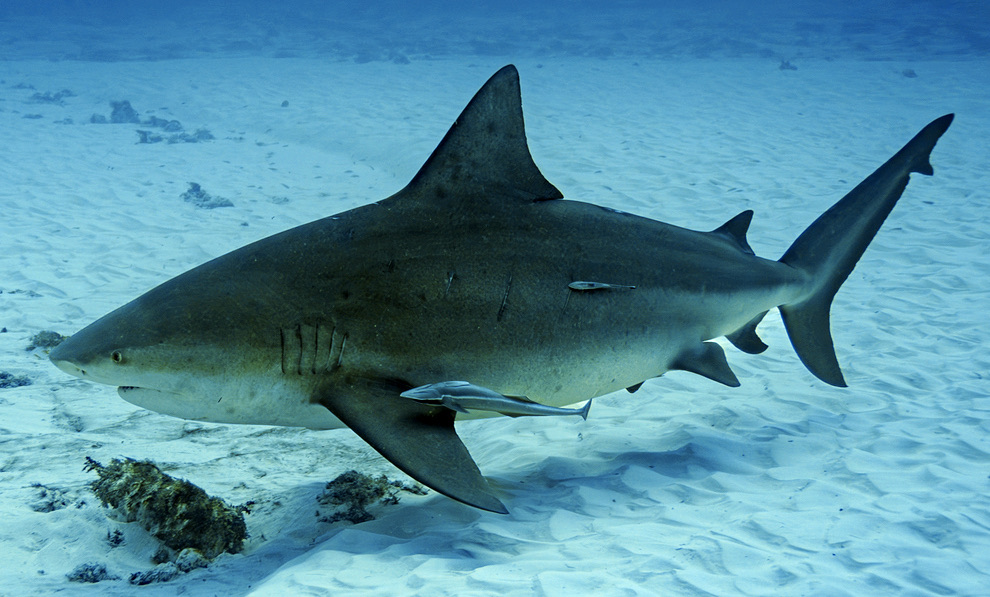
Bull Shark — illustration
Illustration générée par IA pour The Scuba Atlas — illustrative, et non une photographie documentaire.

Sharks

Bull Shark

Carcharhinus leucas · Cartilaginous fish — family Carcharhinidae

IUCN: VU (decreasing) ~2.4 m total length; females are distinctly bulkier and longer than males 1–60 m tranche de profondeur Bien documenté

The bull shark's reputation precedes it unfairly into the water. What divers actually meet is a thickset, cautious animal that circles wide, sizes up the scene, and commits only when comfortable — the swagger is in the physique, not the behavior. Females gather seasonally off Playa del Carmen, dozens strong in Fiji's Beqa Lagoon, and around Cabo Pulmo's reefs, giving structured, repeatable encounters with a shark that thrives where visibility fails other predators. Its party trick is physiological: bulls osmoregulate well enough to swim far up rivers, which puts them near people more often than any other large shark.

Facteur de respect: Treat With RespectStatistically among the species involved in serious coastal incidents, mostly with swimmers and surfers in turbid water — conditions divers largely avoid. On managed dives in good visibility, thousands of encounters proceed without contact. Respect the animal's size, avoid murky solo swims in bull habitat, and follow feed protocols exactly.

Où et quand en observer un

« Résident » signifie que la plupart des plongées sur ce site permettent de les observer ; « saisonnier » signifie qu'ils sont présents de manière fiable durant les mois indiqués ; tout le reste est un bonus, pas une certitude.

DestinationFiabilitéMoisNotes
Sea of Cortez & Cabo PulmoMexico Resident — seen on most dives Toute l'année
Beqa Lagoon & Pacific HarbourFiji Resident — seen on most dives Toute l'année
Riviera Maya & the CenotesMexico Seasonal — reliable in season Nov–Mar
Costa Rica Pacific CoastCosta Rica Seasonal — reliable in season May–Nov
Aliwal Shoal & UmkomaasSouth Africa Occasional Toute l'année

Meilleur mois, en un coup d'œil

MoisDestinations fiables
January Sea of Cortez & Cabo Pulmo · Beqa Lagoon & Pacific Harbour · Riviera Maya & the Cenotes · Aliwal Shoal & Umkomaas
February Sea of Cortez & Cabo Pulmo · Beqa Lagoon & Pacific Harbour · Riviera Maya & the Cenotes · Aliwal Shoal & Umkomaas
March Sea of Cortez & Cabo Pulmo · Beqa Lagoon & Pacific Harbour · Riviera Maya & the Cenotes · Aliwal Shoal & Umkomaas
April Sea of Cortez & Cabo Pulmo · Beqa Lagoon & Pacific Harbour · Aliwal Shoal & Umkomaas
May Sea of Cortez & Cabo Pulmo · Beqa Lagoon & Pacific Harbour · Costa Rica Pacific Coast · Aliwal Shoal & Umkomaas
June Sea of Cortez & Cabo Pulmo · Beqa Lagoon & Pacific Harbour · Costa Rica Pacific Coast · Aliwal Shoal & Umkomaas
July Sea of Cortez & Cabo Pulmo · Beqa Lagoon & Pacific Harbour · Costa Rica Pacific Coast · Aliwal Shoal & Umkomaas
August Sea of Cortez & Cabo Pulmo · Beqa Lagoon & Pacific Harbour · Costa Rica Pacific Coast · Aliwal Shoal & Umkomaas
September Sea of Cortez & Cabo Pulmo · Beqa Lagoon & Pacific Harbour · Costa Rica Pacific Coast · Aliwal Shoal & Umkomaas
October Sea of Cortez & Cabo Pulmo · Beqa Lagoon & Pacific Harbour · Costa Rica Pacific Coast · Aliwal Shoal & Umkomaas
November Sea of Cortez & Cabo Pulmo · Beqa Lagoon & Pacific Harbour · Riviera Maya & the Cenotes · Costa Rica Pacific Coast · Aliwal Shoal & Umkomaas
December Sea of Cortez & Cabo Pulmo · Beqa Lagoon & Pacific Harbour · Riviera Maya & the Cenotes · Aliwal Shoal & Umkomaas

Les comprendre

Habitat: Murky coastal waters, river mouths, and reef slopes; uniquely tolerant of fresh water, recorded far up major rivers

Aire de répartition: Worldwide in warm coastal seas — the Gulf of Mexico and Caribbean, West Africa, the Indian Ocean rim, Southeast Asia, Australia, and Pacific Central America

Comportement: Heavy-bodied and low-slung, bulls patrol close to the bottom with short pectoral strokes and a wary, circling approach. At organized feeds they arrive in numbers and hold a respectful pattern around the bait; away from feeds they typically keep their distance from divers in clear water.

Régime alimentaire: Fish including other sharks and rays, plus turtles, birds, and carrion; an unfussy ambush hunter suited to low visibility

Taille: généralement autour de 2.4 m; documenté jusqu'à 3.5 m (total length; females are distinctly bulkier and longer than males).

Comment se comporter avec lui

Kneel or settle where the briefing puts you, keep hands close, no cameras thrust at approaching animals, and let the feeders manage the bait line. Skip dawn and dusk swims near river mouths in bull country.

Conservation

Assessed Vulnerable in 2020; slow reproduction and heavy inshore fishing pressure work against it, and its river-mouth habitat overlaps the most degraded coastal zones.

Sites répertoriés connus pour leur présence

Regarder

Depuis les canaux officiels

Toutes les vidéos →

Les vidéos sont des liens intégrés vers les chaînes de leurs créateurs — nous n'hébergeons rien et créditons tout.

Sources: Wikipedia ↗IUCN Red List ↗ · Informations vérifiées par rapport aux sources ci-dessus ; les champs sans référence sont marqués non encore vérifiés.

Australie, Nouvelle-Zélande & Asie de l'Est

Cairns & the Ribbon ReefsNingaloo ReefCoral Sea & Osprey ReefOkinawa & the Kerama IslandsPoor Knights IslandsTownsville & the YongalaGreen IslandIzu Peninsula

Caraïbes & Atlantique occidental

BonaireCozumelRiviera Maya & the CenotesBelize Barrier ReefGrand CaymanIsla Mujeres & CancúnRoatánTiger Beach & Grand Bahama

Europe, Atlantique & Méditerranée

Malta & GozoSilfra & IcelandThe AzoresCanary IslandsLarnaca & the ZenobiaScapa FlowArctic NorwayMadeira

Océan Indien & Afrique de l'Est

North & South Malé AtollsAri AtollBaa Atoll & Hanifaru BayAliwal Shoal & UmkomaasMafia IslandMauritiusSeychellesSodwana Bay

Îles du Pacifique & Micronésie

PalauChuuk (Truk) LagoonFakaravaKona, HawaiʻiRangiroaTaveuni & Rainbow ReefBeqa Lagoon & Pacific HarbourEspiritu Santo

Mer Rouge & Moyen-Orient

Sharm El Sheikh & Ras MohammedBrothers, Daedalus & St John'sDahabHurghada & El GounaMarsa Alam & the Deep SouthAqabaDaymaniyat IslandsMusandam Peninsula

Asie du Sud-Est et Triangle de Corail

Bali & Nusa PenidaKomodoRaja AmpatSipadan & MabulAnilaoCoronKoh TaoLembeh Strait

Les Amériques et Pacifique Est

Galápagos IslandsCocos IslandFlorida KeysSea of Cortez & Cabo PulmoSocorro & the RevillagigedosBritish ColumbiaCalifornia Channel IslandsCosta Rica Pacific Coast