Cephalopods
Common Reef (Day) Octopus
Octopus cyanea · Cephalopod mollusk, family Octopodidae; the big day-active octopus of Indo-Pacific reefs, called he'e in Hawaii
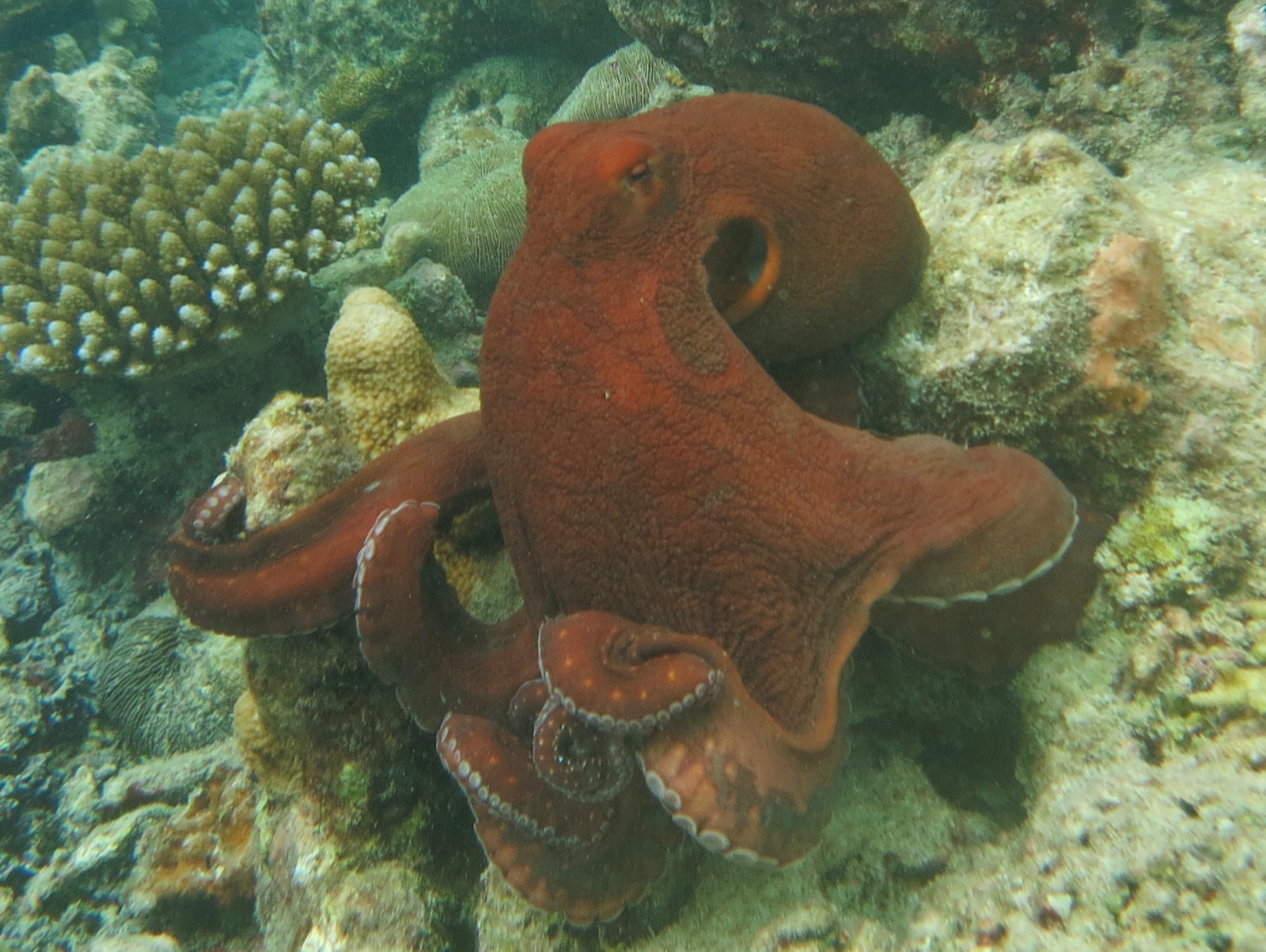
This is the octopus most tropical divers actually meet, because it breaks the family rule and hunts by day. A big day octopus flows across the reef as a self-editing special effect: skin texture spiking into algae tufts, color rippling from mottled brown to bone white in under a second, a passing-wave pattern flickering as it moves. Watch a hunt: the animal balloons its web over a coral head and flushes whatever bolts, while jacks or a grouper often shadow it to pick off escapees, one of the reef's neatest hunting partnerships. Dens are readable by the midden of emptied crab shells at the door. Sit still three meters out and curiosity frequently wins, an arm tip arriving to inspect a strobe arm. Let it explore; snatching gear back teaches the animal that divers end hunts.
Wo und wann man eines sieht
„Resident" bedeutet, dass die meisten Tauchgänge am jeweiligen Tauchziel eine Begegnung erwarten lassen; „saisonal" bedeutet, dass die Art in den genannten Monaten zuverlässig anzutreffen ist; alles andere ist ein Bonus, keine Planungsgrundlage.
| Ziel | Zuverlässigkeit | Monate | Hinweise |
|---|---|---|---|
| Sharm El Sheikh & Ras MohammedEgypt | Resident: seen on most dives | Ganzjährig | |
| North & South Malé AtollsMaldives | Resident: seen on most dives | Ganzjährig | |
| Sipadan & MabulMalaysia | Resident: seen on most dives | Ganzjährig | |
| Kona, HawaiʻiUnited States | Resident: seen on most dives | Ganzjährig | |
| MoalboalPhilippines | Resident: seen on most dives | Ganzjährig | |
| Zanzibar & MnembaTanzania | Resident: seen on most dives | Ganzjährig |
Bester Monat auf einen Blick
Sie verstehen
Lebensraum: Coral reef and reef flat, denning in holes marked by middens of emptied crab shells.
Verbreitung: Indo-Pacific and Red Sea, from East Africa to Hawaii and French Polynesia.
Verhalten: Hunts by day (rare among octopuses), flowing between coral heads and ballooning its web over them; jacks and groupers often shadow the hunt to pick off escapees.
Ernährung: Crabs above all, plus shrimp, mollusks, and small fishes trapped under the flared web.
Größe: typischerweise rund 0.6 m; dokumentiert bis zu 1.0 m (arm-span; mantle to about 16 cm, large animals several kilograms).
Wie man sich in ihrer Nähe verhält
Settle a few meters out and hold still; curiosity often brings an arm tip to you. Never grab, pry at a den, or block the animal's line of retreat.
Naturschutz
Least Concern and fast-growing, though heavily fished for food across much of its range; healthy reef populations rebound quickly.
Bekannte Tauchplätze dafür
Hervorgehobene Tauchplätze wurden von unseren Redakteuren für diese Art kartiert; die Zahlen sind GBIF-Vorkommensdatensätze, die seit 1990 im Umkreis von etwa 5 km um einen Tauchplatz protokolliert wurden.
Ansehen
Aus den offiziellen Kanälen

Wildlife of Monterey | New film in our auditorium

Live Aviary Cam | Monterey Bay Aquarium

Live Aviary Cam | Monterey Bay Aquarium
Videos sind eingebettete Links zu den Kanälen der jeweiligen Ersteller – wir hosten nichts und geben für alles die Quelle an.