Sites de plongée, saisons et vie marine — recherchés, cartographiés, planifiés.
Menu
Destinations Sites de plongée Vie marine Épaves Actualités
Planifier un voyage Planificateur de séjour Quand plonger Calculateur de coût Comparaisons Calendrier de la faune marine Température de l'eau Liveaboards Opérateurs & resorts Parcs marins Caissons hyperbares Carte du monde
Régions Australie, Nouvelle-Zélande & Asie de l'EstCaraïbes & Atlantique occidentalEurope, Atlantique & MéditerranéeOcéan Indien & Afrique de l'EstÎles du Pacifique & MicronésieMer Rouge & Moyen-OrientAsie du Sud-Est et Triangle de CorailLes Amériques et Pacifique Est Pays
Apprendre & Outils Tous les guides Certifications Guides d'équipement Vidéos Interroger les données Agents IA API
À propos À propos de nous Méthodologie Avertissement Contact
Votre vue
★ Enregistré

Vos destinations, sites et espèces favoris — enregistrés dans ce navigateur.

API GATEWAY

Accès JSON gratuit en lecture seule aux données en cache de l'atlas.

Mode sombre

🧭 Vue Guidée
Nouveau dans la plongée — profondeurs, courants, niveaux de certification ? Nous expliquons chaque terme au fil de votre navigation, en langage clair. Les mêmes données, avec l'aide intégrée.

⚡ Vue Expert
Vous connaissez déjà la différence entre un tombant et un drift. Juste les données — claires, rapides et compactes. C'est la vue par défaut.

Langue de l'interface
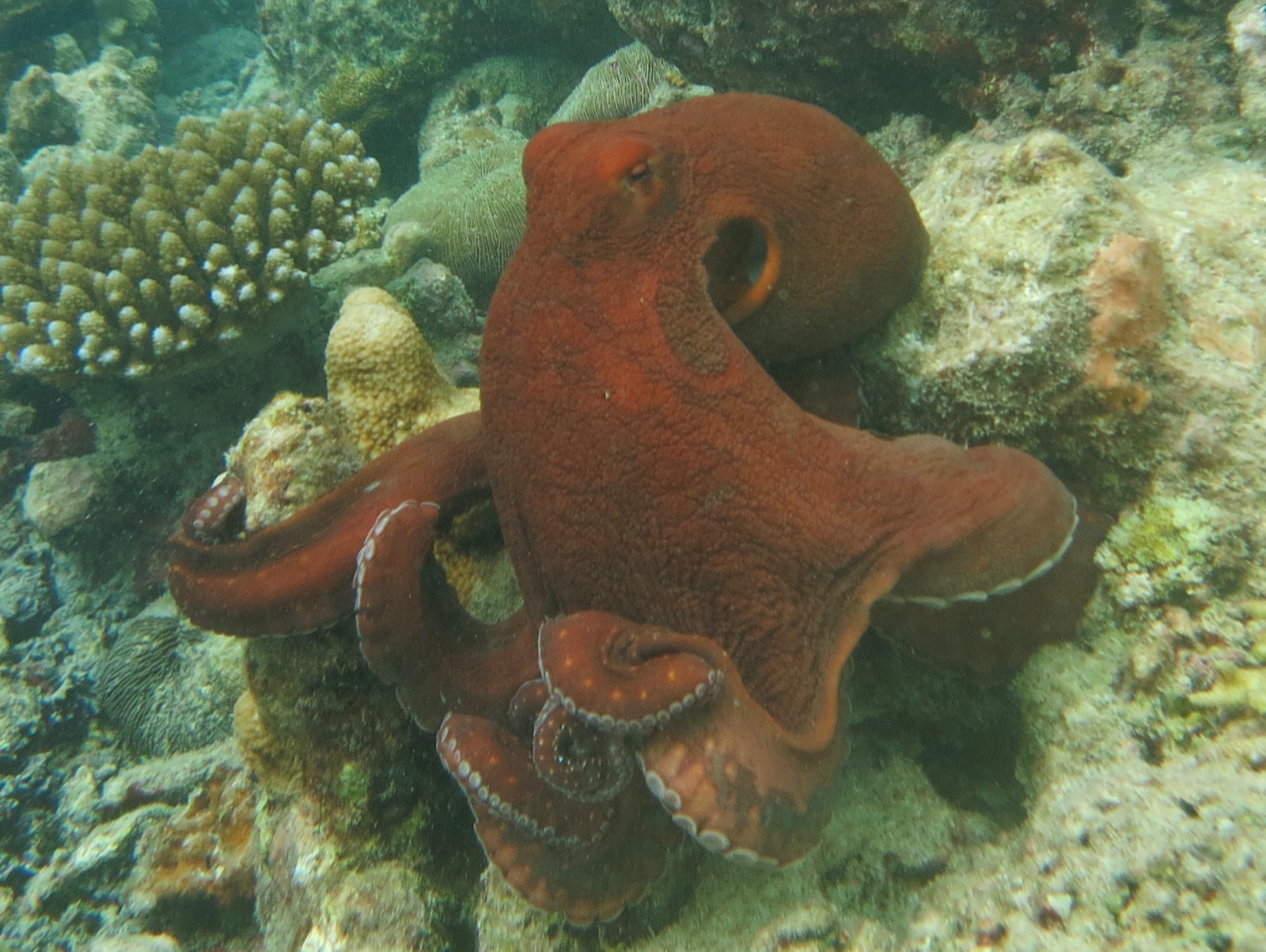
Common Reef (Day) Octopus — illustration
Illustration générée par IA pour The Scuba Atlas — illustrative, et non une photographie documentaire.

Cephalopods

Common Reef (Day) Octopus

Octopus cyanea · Cephalopod mollusk — family Octopodidae; the big day-active octopus of Indo-Pacific reefs, called he'e in Hawaii

IUCN: LC ~0.6 m arm-span; mantle to about 16 cm, large animals several kilograms 1–45 m tranche de profondeur Bien documenté

This is the octopus most tropical divers actually meet, because it breaks the family rule and hunts by day. A big day octopus flows across the reef as a self-editing special effect — skin texture spiking into algae tufts, color rippling from mottled brown to bone white in under a second, a passing-wave pattern flickering as it moves. Watch a hunt: the animal balloons its web over a coral head and flushes whatever bolts, while jacks or a grouper often shadow it to pick off escapees, one of the reef's neatest hunting partnerships. Dens are readable by the midden of emptied crab shells at the door. Sit still three meters out and curiosity frequently wins, an arm tip arriving to inspect a strobe arm. Let it explore; snatching gear back teaches the animal that divers end hunts.

Où et quand en observer un

« Résident » signifie que la plupart des plongées sur ce site permettent de les observer ; « saisonnier » signifie qu'ils sont présents de manière fiable durant les mois indiqués ; tout le reste est un bonus, pas une certitude.

DestinationFiabilitéMoisNotes
Sharm El Sheikh & Ras MohammedEgypt Resident — seen on most dives Toute l'année
North & South Malé AtollsMaldives Resident — seen on most dives Toute l'année
Sipadan & MabulMalaysia Resident — seen on most dives Toute l'année
Kona, HawaiʻiUnited States Resident — seen on most dives Toute l'année
MoalboalPhilippines Resident — seen on most dives Toute l'année
Zanzibar & MnembaTanzania Resident — seen on most dives Toute l'année

Meilleur mois, en un coup d'œil

MoisDestinations fiables
January Sharm El Sheikh & Ras Mohammed · North & South Malé Atolls · Sipadan & Mabul · Kona, Hawaiʻi · Moalboal · Zanzibar & Mnemba
February Sharm El Sheikh & Ras Mohammed · North & South Malé Atolls · Sipadan & Mabul · Kona, Hawaiʻi · Moalboal · Zanzibar & Mnemba
March Sharm El Sheikh & Ras Mohammed · North & South Malé Atolls · Sipadan & Mabul · Kona, Hawaiʻi · Moalboal · Zanzibar & Mnemba
April Sharm El Sheikh & Ras Mohammed · North & South Malé Atolls · Sipadan & Mabul · Kona, Hawaiʻi · Moalboal · Zanzibar & Mnemba
May Sharm El Sheikh & Ras Mohammed · North & South Malé Atolls · Sipadan & Mabul · Kona, Hawaiʻi · Moalboal · Zanzibar & Mnemba
June Sharm El Sheikh & Ras Mohammed · North & South Malé Atolls · Sipadan & Mabul · Kona, Hawaiʻi · Moalboal · Zanzibar & Mnemba
July Sharm El Sheikh & Ras Mohammed · North & South Malé Atolls · Sipadan & Mabul · Kona, Hawaiʻi · Moalboal · Zanzibar & Mnemba
August Sharm El Sheikh & Ras Mohammed · North & South Malé Atolls · Sipadan & Mabul · Kona, Hawaiʻi · Moalboal · Zanzibar & Mnemba
September Sharm El Sheikh & Ras Mohammed · North & South Malé Atolls · Sipadan & Mabul · Kona, Hawaiʻi · Moalboal · Zanzibar & Mnemba
October Sharm El Sheikh & Ras Mohammed · North & South Malé Atolls · Sipadan & Mabul · Kona, Hawaiʻi · Moalboal · Zanzibar & Mnemba
November Sharm El Sheikh & Ras Mohammed · North & South Malé Atolls · Sipadan & Mabul · Kona, Hawaiʻi · Moalboal · Zanzibar & Mnemba
December Sharm El Sheikh & Ras Mohammed · North & South Malé Atolls · Sipadan & Mabul · Kona, Hawaiʻi · Moalboal · Zanzibar & Mnemba

Les comprendre

Habitat: Coral reef and reef flat, denning in holes marked by middens of emptied crab shells.

Aire de répartition: Indo-Pacific and Red Sea, from East Africa to Hawaii and French Polynesia.

Comportement: Hunts by day — rare among octopuses — flowing between coral heads and ballooning its web over them; jacks and groupers often shadow the hunt to pick off escapees.

Régime alimentaire: Crabs above all, plus shrimp, mollusks, and small fishes trapped under the flared web.

Taille: généralement autour de 0.6 m; documenté jusqu'à 1.0 m (arm-span; mantle to about 16 cm, large animals several kilograms).

Comment se comporter avec lui

Settle a few meters out and hold still; curiosity often brings an arm tip to you. Never grab, pry at a den, or block the animal's line of retreat.

Conservation

Least Concern and fast-growing, though heavily fished for food across much of its range; healthy reef populations rebound quickly.

Sites répertoriés connus pour leur présence

Regarder

Depuis les canaux officiels

Toutes les vidéos →

Les vidéos sont des liens intégrés vers les chaînes de leurs créateurs — nous n'hébergeons rien et créditons tout.

Sources: Wikipedia ↗IUCN Red List ↗ · Informations vérifiées par rapport aux sources ci-dessus ; les champs sans référence sont marqués non encore vérifiés.

Australie, Nouvelle-Zélande & Asie de l'Est

Cairns & the Ribbon ReefsNingaloo ReefCoral Sea & Osprey ReefOkinawa & the Kerama IslandsPoor Knights IslandsTownsville & the YongalaGreen IslandIzu Peninsula

Caraïbes & Atlantique occidental

BonaireCozumelRiviera Maya & the CenotesBelize Barrier ReefGrand CaymanIsla Mujeres & CancúnRoatánTiger Beach & Grand Bahama

Europe, Atlantique & Méditerranée

Malta & GozoSilfra & IcelandThe AzoresCanary IslandsLarnaca & the ZenobiaScapa FlowArctic NorwayMadeira

Océan Indien & Afrique de l'Est

North & South Malé AtollsAri AtollBaa Atoll & Hanifaru BayAliwal Shoal & UmkomaasMafia IslandMauritiusSeychellesSodwana Bay

Îles du Pacifique & Micronésie

PalauChuuk (Truk) LagoonFakaravaKona, HawaiʻiRangiroaTaveuni & Rainbow ReefBeqa Lagoon & Pacific HarbourEspiritu Santo

Mer Rouge & Moyen-Orient

Sharm El Sheikh & Ras MohammedBrothers, Daedalus & St John'sDahabHurghada & El GounaMarsa Alam & the Deep SouthAqabaDaymaniyat IslandsMusandam Peninsula

Asie du Sud-Est et Triangle de Corail

Bali & Nusa PenidaKomodoRaja AmpatSipadan & MabulAnilaoCoronKoh TaoLembeh Strait

Les Amériques et Pacifique Est

Galápagos IslandsCocos IslandFlorida KeysSea of Cortez & Cabo PulmoSocorro & the RevillagigedosBritish ColumbiaCalifornia Channel IslandsCosta Rica Pacific Coast