Siti di immersione, stagioni e fauna marina — ricercati, mappati, pianificati.
Menu
Destinazioni Siti di immersione Vita marina Relitti Notizie
Pianifica un viaggio Pianificatore di viaggi Quando immergersi Calcolatore dei costi Confronti Calendario della fauna marina Temperatura dell'acqua Liveaboard Operatori & resort Parchi marini Camere iperbariche Mappa del mondo
Regioni Australia, Nuova Zelanda e Asia OrientaleCaraibi e Atlantico occidentaleEuropa, Atlantico e MediterraneoOceano Indiano e Africa OrientaleIsole del Pacifico & MicronesiaMar Rosso & Medio OrienteAsia meridionale e Triangolo dei CoralliLe Americhe e il Pacifico orientale Paesi
Impara e strumenti Tutte le guide Brevetti Guide all'attrezzatura Video Interroga i dati AI Agent API
Informazioni Chi siamo Metodologia Disclaimer Contatti
La tua vista
★ Salvato

Le tue destinazioni, siti e specie preferiti — salvati in questo browser.

API GATEWAY

Accesso JSON gratuito in sola lettura ai dati in cache dell'atlante.

Modalità scura

🧭 Visualizzazione Guidata
Sei nuovo alle immersioni — profondità, correnti, livelli di brevetto? Spieghiamo ogni termine mentre navighi, in modo semplice e chiaro. Gli stessi dati, con il supporto integrato.

⚡ Visualizzazione Esperta
Conosci già la differenza tra una parete e una drift dive. Solo i dati — chiari, rapidi e compatti. Questa è la visualizzazione predefinita.

Lingua dell'interfaccia
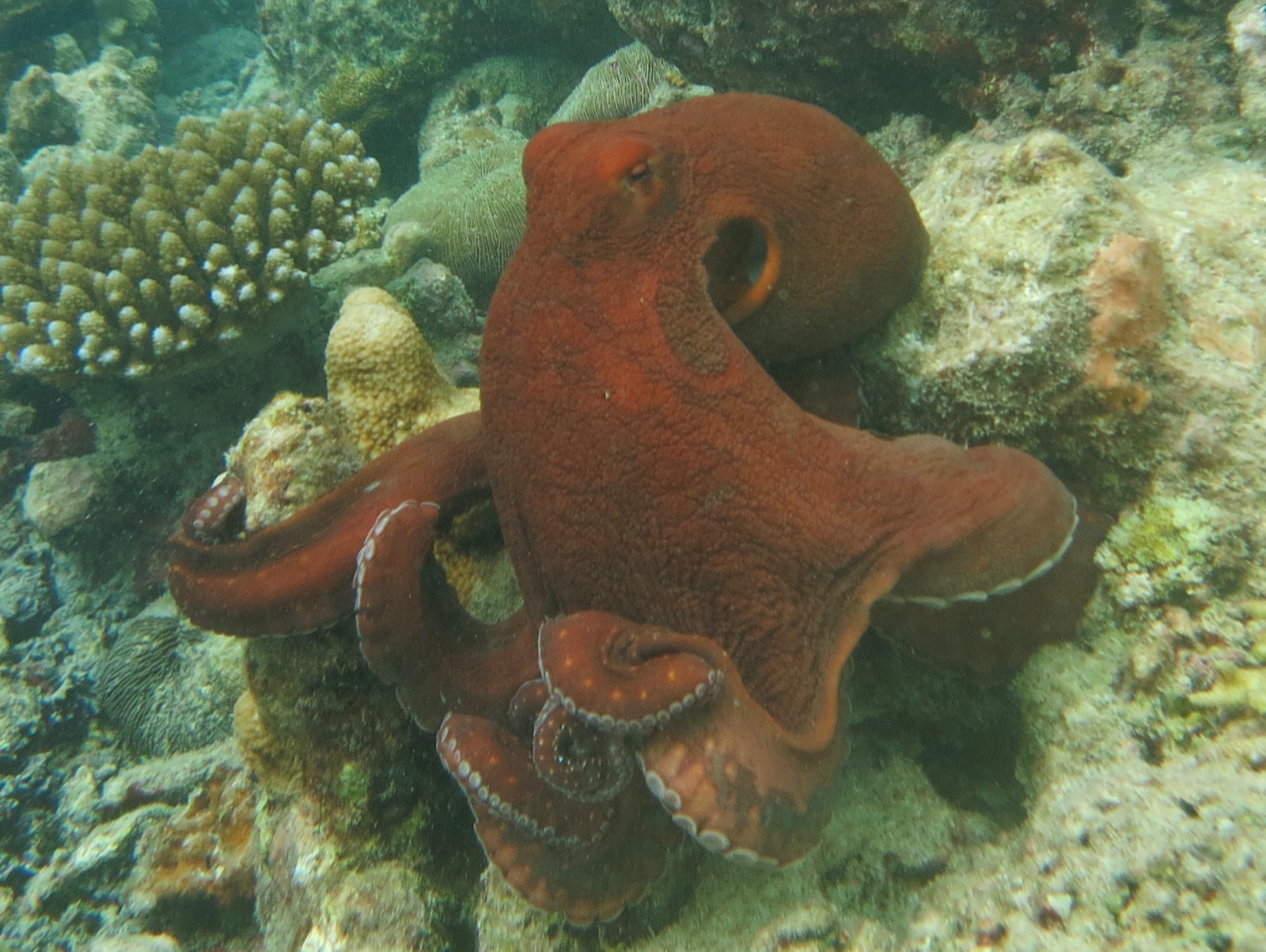
Common Reef (Day) Octopus — illustration
Illustrazione generata dall'AI per The Scuba Atlas — a scopo illustrativo, non fotografia documentaria.

Cephalopods

Common Reef (Day) Octopus

Octopus cyanea · Cephalopod mollusk — family Octopodidae; the big day-active octopus of Indo-Pacific reefs, called he'e in Hawaii

IUCN: LC ~0.6 m arm-span; mantle to about 16 cm, large animals several kilograms 1–45 m fascia di profondità Ben documentato

This is the octopus most tropical divers actually meet, because it breaks the family rule and hunts by day. A big day octopus flows across the reef as a self-editing special effect — skin texture spiking into algae tufts, color rippling from mottled brown to bone white in under a second, a passing-wave pattern flickering as it moves. Watch a hunt: the animal balloons its web over a coral head and flushes whatever bolts, while jacks or a grouper often shadow it to pick off escapees, one of the reef's neatest hunting partnerships. Dens are readable by the midden of emptied crab shells at the door. Sit still three meters out and curiosity frequently wins, an arm tip arriving to inspect a strobe arm. Let it explore; snatching gear back teaches the animal that divers end hunts.

Dove e quando avvistarne uno

"Residente" significa che la maggior parte delle immersioni in quella destinazione li incontra; "stagionale" significa che sono presenti in modo affidabile nei mesi indicati; qualsiasi altra cosa è un bonus, non un piano.

DestinazioneAffidabilitàMesiNote
Sharm El Sheikh & Ras MohammedEgypt Resident — seen on most dives Tutto l'anno
North & South Malé AtollsMaldives Resident — seen on most dives Tutto l'anno
Sipadan & MabulMalaysia Resident — seen on most dives Tutto l'anno
Kona, HawaiʻiUnited States Resident — seen on most dives Tutto l'anno
MoalboalPhilippines Resident — seen on most dives Tutto l'anno
Zanzibar & MnembaTanzania Resident — seen on most dives Tutto l'anno

Il mese migliore, a colpo d'occhio

MeseDestinazioni affidabili
January Sharm El Sheikh & Ras Mohammed · North & South Malé Atolls · Sipadan & Mabul · Kona, Hawaiʻi · Moalboal · Zanzibar & Mnemba
February Sharm El Sheikh & Ras Mohammed · North & South Malé Atolls · Sipadan & Mabul · Kona, Hawaiʻi · Moalboal · Zanzibar & Mnemba
March Sharm El Sheikh & Ras Mohammed · North & South Malé Atolls · Sipadan & Mabul · Kona, Hawaiʻi · Moalboal · Zanzibar & Mnemba
April Sharm El Sheikh & Ras Mohammed · North & South Malé Atolls · Sipadan & Mabul · Kona, Hawaiʻi · Moalboal · Zanzibar & Mnemba
May Sharm El Sheikh & Ras Mohammed · North & South Malé Atolls · Sipadan & Mabul · Kona, Hawaiʻi · Moalboal · Zanzibar & Mnemba
June Sharm El Sheikh & Ras Mohammed · North & South Malé Atolls · Sipadan & Mabul · Kona, Hawaiʻi · Moalboal · Zanzibar & Mnemba
July Sharm El Sheikh & Ras Mohammed · North & South Malé Atolls · Sipadan & Mabul · Kona, Hawaiʻi · Moalboal · Zanzibar & Mnemba
August Sharm El Sheikh & Ras Mohammed · North & South Malé Atolls · Sipadan & Mabul · Kona, Hawaiʻi · Moalboal · Zanzibar & Mnemba
September Sharm El Sheikh & Ras Mohammed · North & South Malé Atolls · Sipadan & Mabul · Kona, Hawaiʻi · Moalboal · Zanzibar & Mnemba
October Sharm El Sheikh & Ras Mohammed · North & South Malé Atolls · Sipadan & Mabul · Kona, Hawaiʻi · Moalboal · Zanzibar & Mnemba
November Sharm El Sheikh & Ras Mohammed · North & South Malé Atolls · Sipadan & Mabul · Kona, Hawaiʻi · Moalboal · Zanzibar & Mnemba
December Sharm El Sheikh & Ras Mohammed · North & South Malé Atolls · Sipadan & Mabul · Kona, Hawaiʻi · Moalboal · Zanzibar & Mnemba

Capirle

Habitat: Coral reef and reef flat, denning in holes marked by middens of emptied crab shells.

Distribuzione: Indo-Pacific and Red Sea, from East Africa to Hawaii and French Polynesia.

Comportamento: Hunts by day — rare among octopuses — flowing between coral heads and ballooning its web over them; jacks and groupers often shadow the hunt to pick off escapees.

Dieta: Crabs above all, plus shrimp, mollusks, and small fishes trapped under the flared web.

Dimensioni: tipicamente intorno a 0.6 m; documentato fino a 1.0 m (arm-span; mantle to about 16 cm, large animals several kilograms).

Come comportarsi in sua presenza

Settle a few meters out and hold still; curiosity often brings an arm tip to you. Never grab, pry at a den, or block the animal's line of retreat.

Conservazione

Least Concern and fast-growing, though heavily fished for food across much of its range; healthy reef populations rebound quickly.

Siti mappati noti per avvistamenti

Guarda

Dai canali ufficiali

Tutti i video →

I video sono link incorporati ai canali dei rispettivi autori — non ospitiamo nulla e diamo sempre credito a tutti.

Fonti: Wikipedia ↗IUCN Red List ↗ · Dati verificati rispetto alle fonti indicate; i campi privi di riscontro sono contrassegnati come non ancora verificati.

Australia, Nuova Zelanda e Asia Orientale

Cairns & the Ribbon ReefsNingaloo ReefCoral Sea & Osprey ReefOkinawa & the Kerama IslandsPoor Knights IslandsTownsville & the YongalaGreen IslandIzu Peninsula

Caraibi e Atlantico occidentale

BonaireCozumelRiviera Maya & the CenotesBelize Barrier ReefGrand CaymanIsla Mujeres & CancúnRoatánTiger Beach & Grand Bahama

Europa, Atlantico e Mediterraneo

Malta & GozoSilfra & IcelandThe AzoresCanary IslandsLarnaca & the ZenobiaScapa FlowArctic NorwayMadeira

Oceano Indiano e Africa Orientale

North & South Malé AtollsAri AtollBaa Atoll & Hanifaru BayAliwal Shoal & UmkomaasMafia IslandMauritiusSeychellesSodwana Bay

Isole del Pacifico & Micronesia

PalauChuuk (Truk) LagoonFakaravaKona, HawaiʻiRangiroaTaveuni & Rainbow ReefBeqa Lagoon & Pacific HarbourEspiritu Santo

Mar Rosso & Medio Oriente

Sharm El Sheikh & Ras MohammedBrothers, Daedalus & St John'sDahabHurghada & El GounaMarsa Alam & the Deep SouthAqabaDaymaniyat IslandsMusandam Peninsula

Asia meridionale e Triangolo dei Coralli

Bali & Nusa PenidaKomodoRaja AmpatSipadan & MabulAnilaoCoronKoh TaoLembeh Strait

Le Americhe e il Pacifico orientale

Galápagos IslandsCocos IslandFlorida KeysSea of Cortez & Cabo PulmoSocorro & the RevillagigedosBritish ColumbiaCalifornia Channel IslandsCosta Rica Pacific Coast