Invertebrates
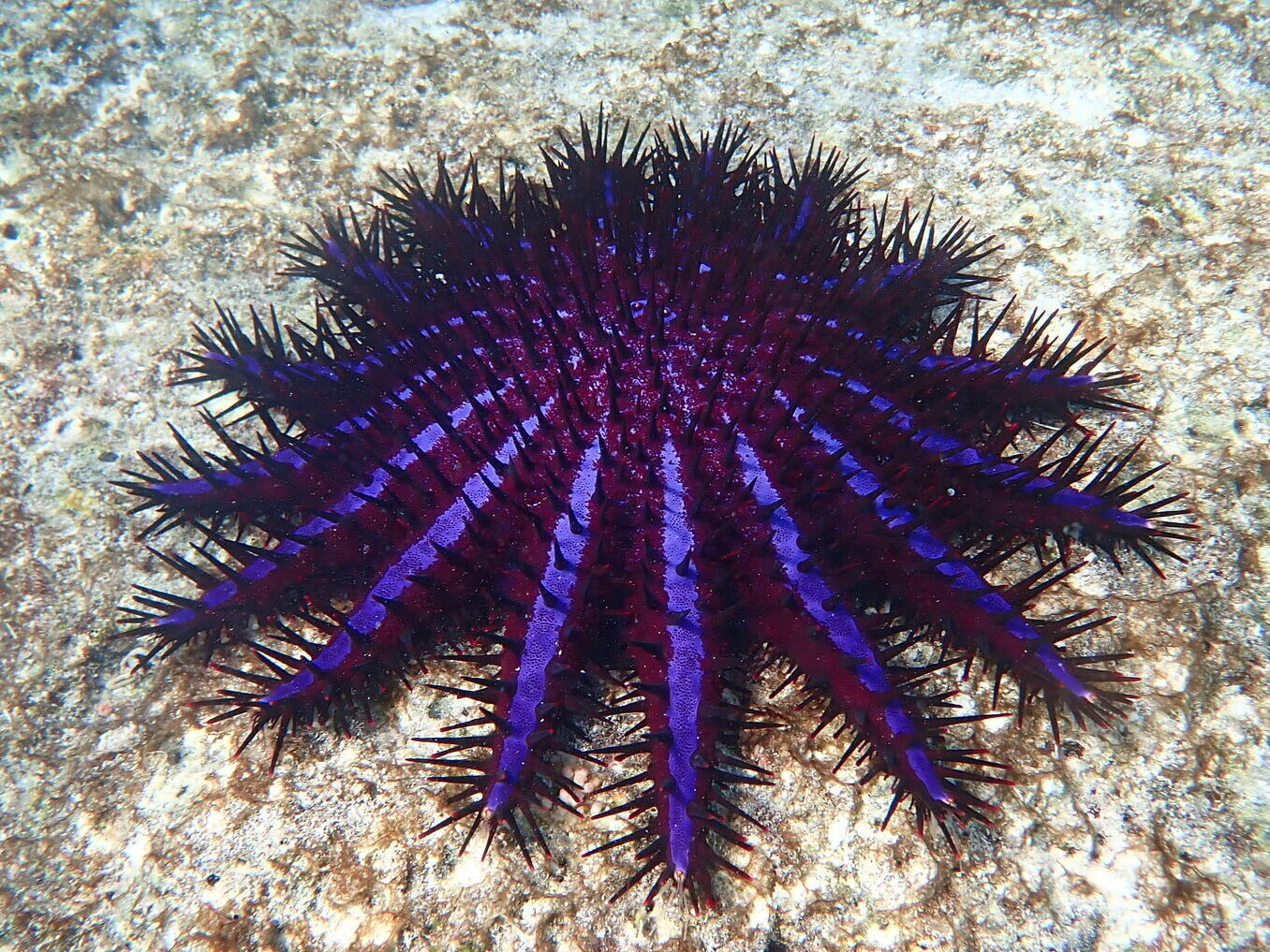
Crown-of-Thorns Starfish
Acanthaster planci · Echinoderm, family Acanthasteridae; a coral-eating sea star, often abbreviated COTS
The crown-of-thorns starfish is the reef predator whose appetite makes headlines. A large adult (half a meter of spine-armored arms, often twenty of them) everts its stomach over living coral and digests the tissue straight off the skeleton, leaving stark white feeding scars. At natural densities it is a normal member of Indo-Pacific reefs; in outbreak years populations explode to thousands per reef and can strip kilometers of coral, and repeated outbreak waves rank among the largest single causes of coral loss on the Great Barrier Reef. Divers are often asked to report sightings, and licensed cull teams inject stars on managed reefs. Leave removal to them, since a mishandled star is dangerous and crude methods can spread the problem. The spines mean business: punctures bring strong pain, swelling, and occasionally embedded tips.
Où et quand en observer un
« Résident » signifie que la plupart des plongées sur ce site permettent de les observer ; « saisonnier » signifie qu'ils sont présents de manière fiable durant les mois indiqués ; tout le reste est un bonus, pas une certitude.
| Destination | Fiabilité | Mois | Notes |
|---|---|---|---|
| Cairns & the Ribbon ReefsAustralia | Occasional | Toute l'année | |
| North & South Malé AtollsMaldives | Occasional | Toute l'année | |
| Okinawa & the Kerama IslandsJapan | Occasional | Toute l'année |
Meilleur mois, en un coup d'œil
Les comprendre
Habitat: Coral reefs wherever live hard coral grows, sheltering by day and feeding openly during outbreaks.
Aire de répartition: Indo-Pacific and Red Sea, from East Africa to the eastern Pacific fringe.
Comportement: Naturally sparse and mostly nocturnal; in outbreak years densities explode and stars feed in daylight en masse, leaving white feeding scars across whole reef tracts.
Régime alimentaire: Living hard-coral tissue, digested externally by everting the stomach over the colony; a large adult can clear several square meters a month.
Taille: généralement autour de 0.3 m; documenté jusqu'à 0.7 m (total diameter including arms; large adults carry up to about 20 arms).
Comment se comporter avec lui
Report sightings where reef managers ask for them and leave removal to licensed cull teams: improvised chopping can spread damage, and the spines punish bare-handed heroics.
Conservation
The species itself is not threatened. The management story is protecting coral from outbreaks, whose causes are debated but linked in part to nutrient runoff and loss of predators such as the giant triton.
Sites répertoriés connus pour leur présence
Les sites mis en évidence ont été cartographiés pour cette espèce par nos éditeurs ; les chiffres correspondent aux occurrences GBIF enregistrées dans un rayon d'environ 5 km d'un site depuis 1990.
Regarder
Depuis les canaux officiels

Wildlife of Monterey | New film in our auditorium

Live Aviary Cam | Monterey Bay Aquarium

Live Aviary Cam | Monterey Bay Aquarium
Les vidéos sont des liens intégrés vers les chaînes de leurs créateurs. Nous n'hébergeons rien et créditons tout.