Invertebrates
Crown-of-Thorns Starfish
Acanthaster planci · Echinoderm, family Acanthasteridae; a coral-eating sea star, often abbreviated COTS
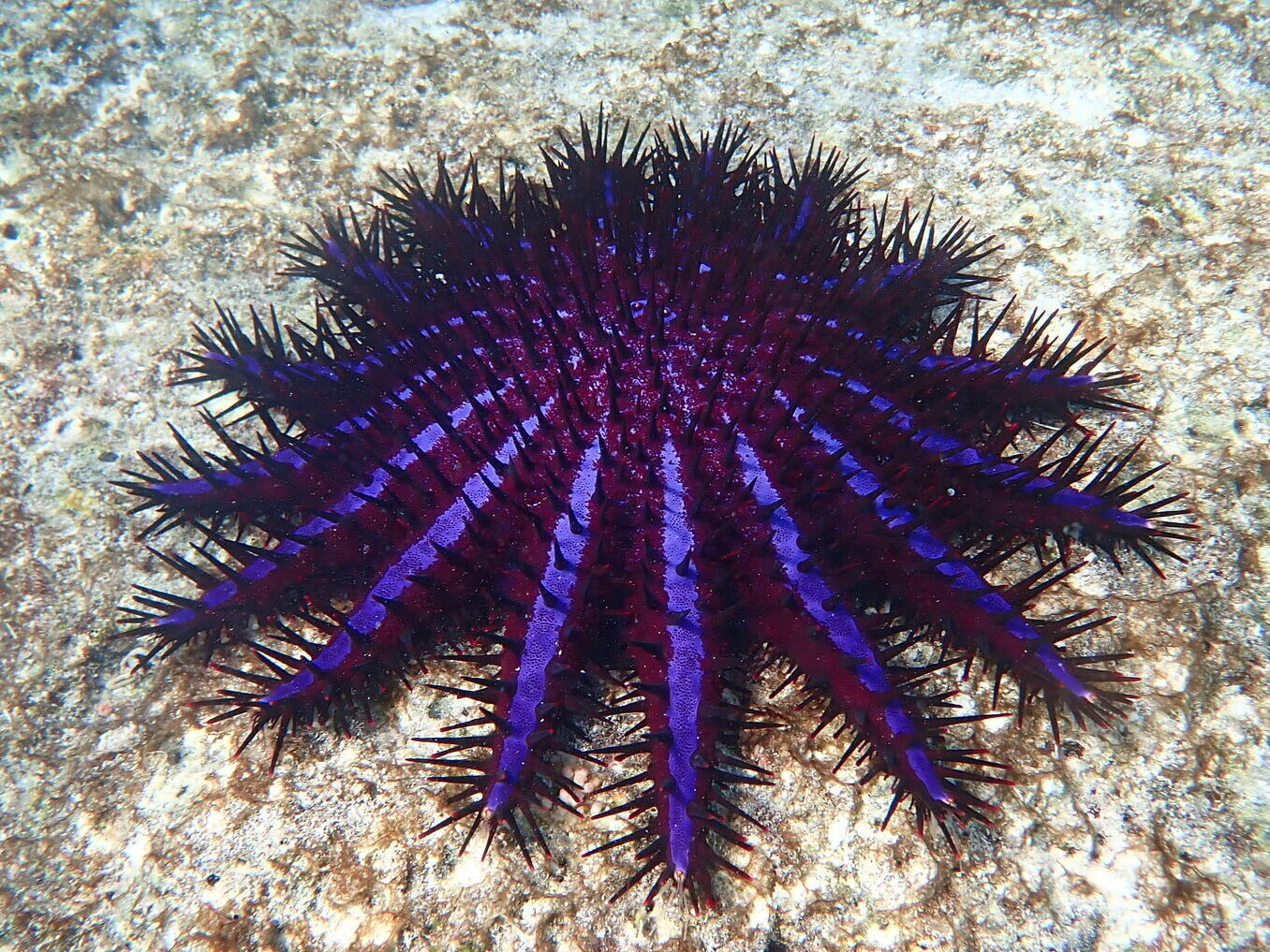
The crown-of-thorns starfish is the reef predator whose appetite makes headlines. A large adult (half a meter of spine-armored arms, often twenty of them) everts its stomach over living coral and digests the tissue straight off the skeleton, leaving stark white feeding scars. At natural densities it is a normal member of Indo-Pacific reefs; in outbreak years populations explode to thousands per reef and can strip kilometers of coral, and repeated outbreak waves rank among the largest single causes of coral loss on the Great Barrier Reef. Divers are often asked to report sightings, and licensed cull teams inject stars on managed reefs. Leave removal to them, since a mishandled star is dangerous and crude methods can spread the problem. The spines mean business: punctures bring strong pain, swelling, and occasionally embedded tips.
Nơi và thời điểm có thể gặp
"Thường trú" nghĩa là hầu hết các lần lặn tại điểm đó đều gặp được chúng; "theo mùa" nghĩa là chúng xuất hiện đáng tin cậy trong các tháng được liệt kê; bất kỳ điều gì ngoài ra là điểm thưởng, không phải kế hoạch.
| Điểm đến | Độ tin cậy | Các tháng | Ghi chú |
|---|---|---|---|
| Cairns & the Ribbon ReefsAustralia | Occasional | Quanh năm | |
| North & South Malé AtollsMaldives | Occasional | Quanh năm | |
| Okinawa & the Kerama IslandsJapan | Occasional | Quanh năm |
Tháng tốt nhất, nhìn tổng quan
Tìm hiểu về chúng
Môi trường sống: Coral reefs wherever live hard coral grows, sheltering by day and feeding openly during outbreaks.
Phạm vi phân bố: Indo-Pacific and Red Sea, from East Africa to the eastern Pacific fringe.
Hành vi: Naturally sparse and mostly nocturnal; in outbreak years densities explode and stars feed in daylight en masse, leaving white feeding scars across whole reef tracts.
Chế độ ăn: Living hard-coral tissue, digested externally by everting the stomach over the colony; a large adult can clear several square meters a month.
Kích thước: thường vào khoảng 0.3 m; ghi nhận đến độ sâu 0.7 m (total diameter including arms; large adults carry up to about 20 arms).
Cách ứng xử khi ở gần loài này
Report sightings where reef managers ask for them and leave removal to licensed cull teams: improvised chopping can spread damage, and the spines punish bare-handed heroics.
Bảo tồn
The species itself is not threatened. The management story is protecting coral from outbreaks, whose causes are debated but linked in part to nutrient runoff and loss of predators such as the giant triton.
Các điểm lặn đã ghi nhận có loài này
Các điểm được làm nổi bật là những điểm đã được ban biên tập ghi chép cho loài này; các con số là bản ghi xuất hiện từ GBIF được ghi nhận trong phạm vi khoảng 5 km của điểm lặn kể từ năm 1990.
Xem
Từ kênh chính thức

Wildlife of Monterey | New film in our auditorium

Live Aviary Cam | Monterey Bay Aquarium

Live Aviary Cam | Monterey Bay Aquarium
Video là các liên kết nhúng dẫn đến kênh của chính tác giả. Chúng tôi không lưu trữ gì và ghi công đầy đủ.