Big Fish
Giant Trevally
Caranx ignobilis · Bony fish, family Carangidae
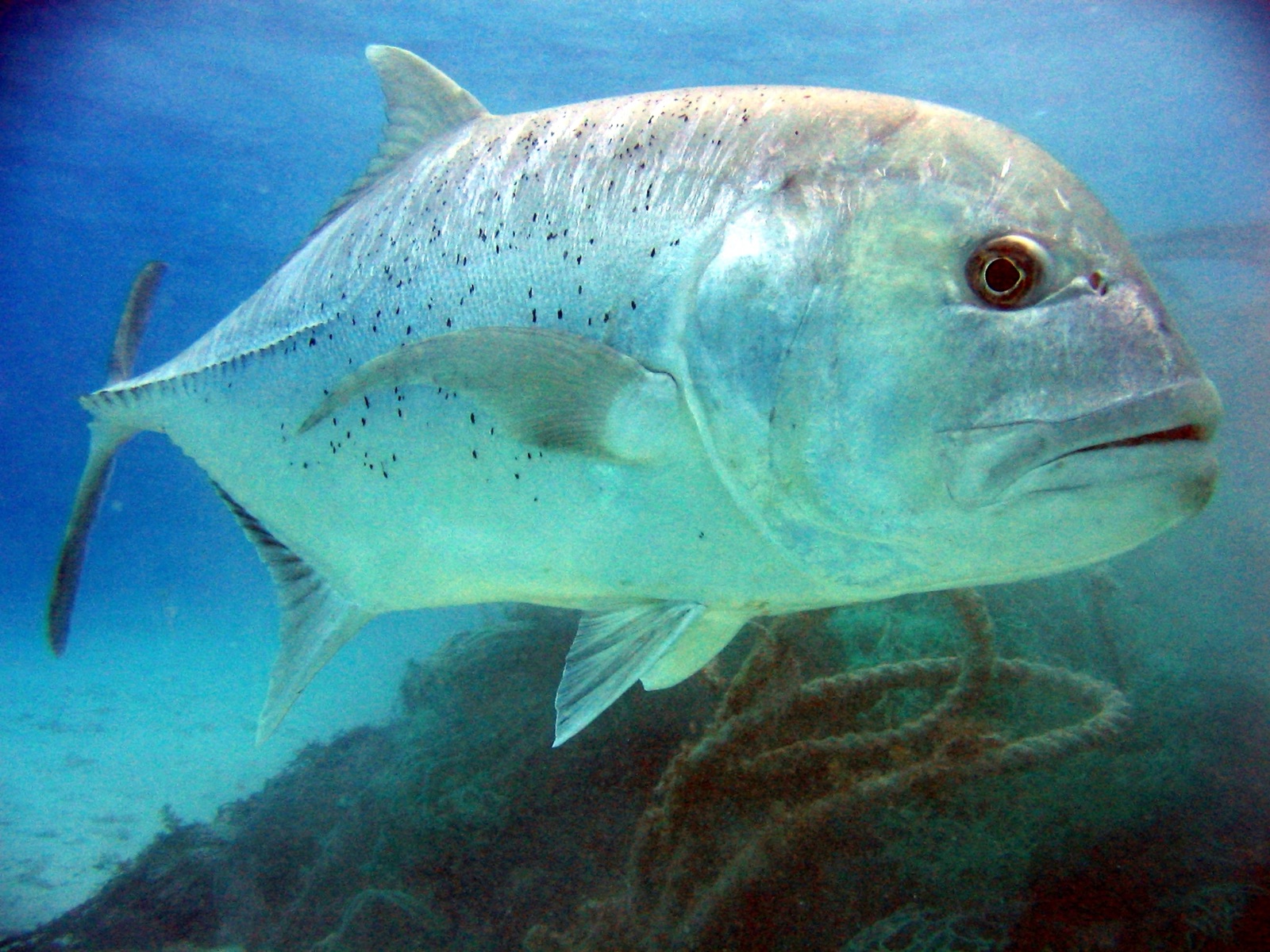
A big GT reads as pure intent. The build is all shoulders (a steep silver forehead, scythe fins, a tail built for zero-to-full-speed), and the demeanor alternates between idling menace and detonations of speed that scatter fusilier schools like shrapnel. Divers in Polynesian and Maldivian passes watch them use every trick in the book: shadowing sharks, hiding in exhaled bubbles, timing runs to the panic of the school. Old males turn coal black and patrol alone like site security. For fly fishermen the species is a grail; for divers it is the reef's reminder that predation is mostly geometry and timing, performed at a pace nothing else on the reef can match.
Où et quand en observer un
« Résident » signifie que la plupart des plongées sur ce site permettent de les observer ; « saisonnier » signifie qu'ils sont présents de manière fiable durant les mois indiqués ; tout le reste est un bonus, pas une certitude.
| Destination | Fiabilité | Mois | Notes |
|---|---|---|---|
| Cairns & the Ribbon ReefsAustralia | Resident: seen on most dives | Toute l'année | |
| North & South Malé AtollsMaldives | Resident: seen on most dives | Toute l'année | |
| PalauPalau | Resident: seen on most dives | Toute l'année | |
| FakaravaFrench Polynesia | Resident: seen on most dives | Toute l'année | |
| Sipadan & MabulMalaysia | Occasional | Toute l'année |
Meilleur mois, en un coup d'œil
Les comprendre
Habitat: Reef passes, drop-offs, lagoons, and surge zones, anywhere baitfish can be pinned against structure or surface
Aire de répartition: Tropical Indo-Pacific from South Africa and the Red Sea to Hawaii and the central Pacific atolls
Comportement: The reef's linebacker: a deep-bodied silver-black predator that hunts in blitzing runs, alone or in packs, using divers' bubbles and even sharks as cover for ambushes. In passes it stacks into current with the grey reef sharks, waiting on the tide; around spawns it gathers in agitated hundreds.
Régime alimentaire: Fish, crustaceans, and cephalopods; documented snatching seabirds off the surface at some atolls
Taille: généralement autour de 0.9 m; documenté jusqu'à 1.7 m (total length; big adults exceed 60 kg, exceptional fish 80).
Comment se comporter avec lui
No feeding, keep catch well away from your body where spearfishing is practiced, and enjoy the ambush behavior without trying to herd baitfish toward the hunters.
Conservation
Least Concern overall but locally depleted near population centers, where its size and boldness make it an easy spear and line target; atoll reserves hold the great concentrations.
Sites répertoriés connus pour leur présence
Les sites mis en évidence ont été cartographiés pour cette espèce par nos éditeurs ; les chiffres correspondent aux occurrences GBIF enregistrées dans un rayon d'environ 5 km d'un site depuis 1990.
Regarder
Depuis les canaux officiels

Wildlife of Monterey | New film in our auditorium

Live Aviary Cam | Monterey Bay Aquarium

Live Aviary Cam | Monterey Bay Aquarium
Les vidéos sont des liens intégrés vers les chaînes de leurs créateurs. Nous n'hébergeons rien et créditons tout.