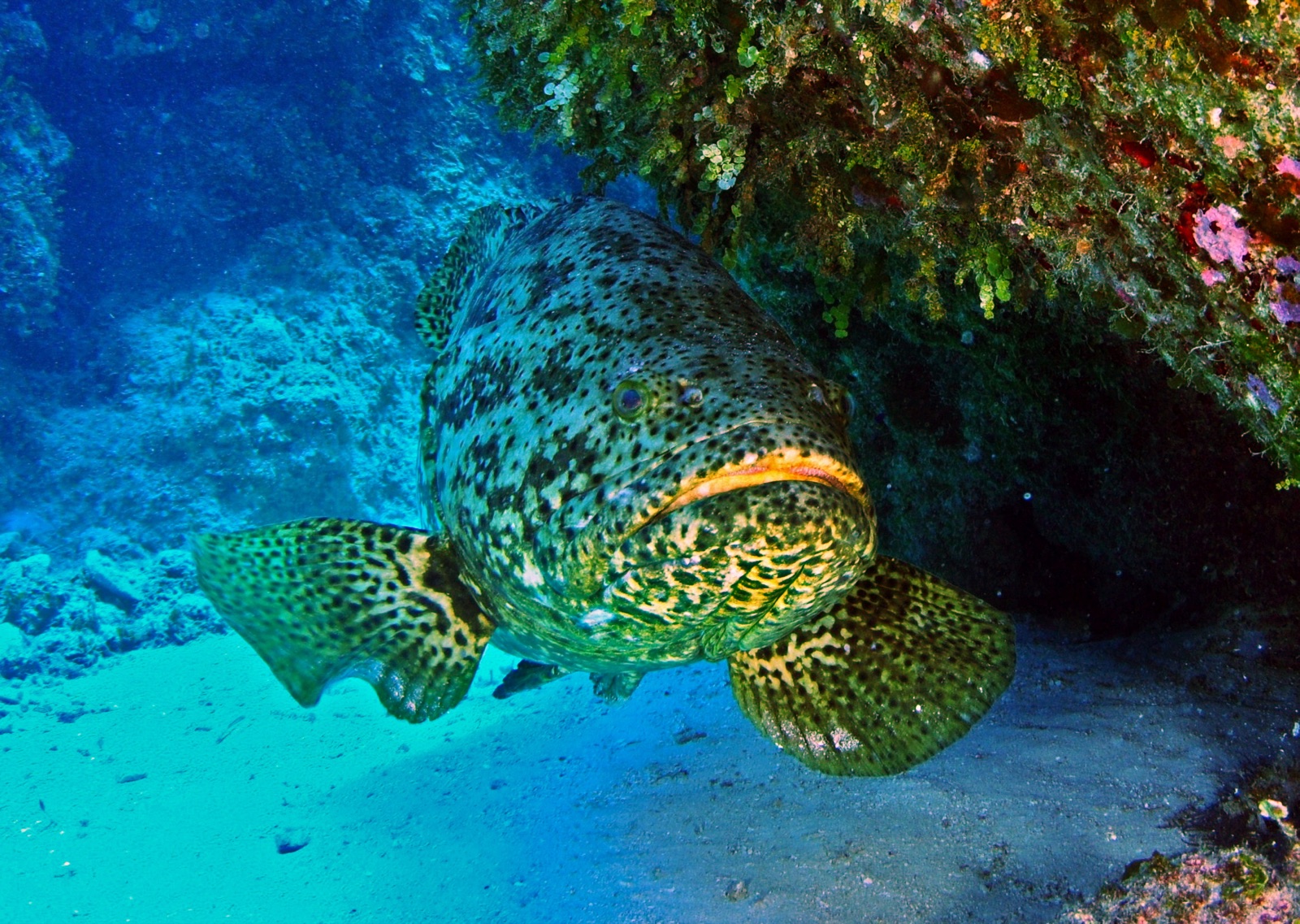
Big Fish
Atlantic Goliath Grouper
Epinephelus itajara · Bony fish, family Epinephelidae
Meeting a goliath grouper is the closest diving comes to encountering furniture with opinions. The fish is a van-sized wedge of mottled brown, fins like barn doors, hanging under a wreck deck with a retinue of cigar minnows around its head. It watches you approach with a boulder's patience. Then the boom hits, a bass drum in your chest cavity, and the negotiation is over. Wiped out across the Caribbean by the 1980s, the species rebuilt itself in Florida under a fishing ban into one of conservation's loudest comebacks, literally: on late-summer wrecks off the state's coasts, aggregations of giants drum through the gloom like war drums. Cuba's protected gardens shelter the other great survivors.
Dove e quando avvistarne uno
"Residente" significa che la maggior parte delle immersioni in quella destinazione li incontra; "stagionale" significa che sono presenti in modo affidabile nei mesi indicati; qualsiasi altra cosa è un bonus, non un piano.
| Destinazione | Affidabilità | Mesi | Note |
|---|---|---|---|
| Florida KeysUnited States | Resident: seen on most dives | Jul–Sep | |
| Jardines de la ReinaCuba | Resident: seen on most dives | Tutto l'anno | |
| Belize Barrier ReefBelize | Rare | Tutto l'anno |
Il mese migliore, a colpo d'occhio
| Mese | Destinazioni affidabili |
|---|---|
| January | Jardines de la Reina · Belize Barrier Reef |
| February | Jardines de la Reina · Belize Barrier Reef |
| March | Jardines de la Reina · Belize Barrier Reef |
| April | Jardines de la Reina · Belize Barrier Reef |
| May | Jardines de la Reina · Belize Barrier Reef |
| June | Jardines de la Reina · Belize Barrier Reef |
| July | Florida Keys · Jardines de la Reina · Belize Barrier Reef |
| August | Florida Keys · Jardines de la Reina · Belize Barrier Reef |
| September | Florida Keys · Jardines de la Reina · Belize Barrier Reef |
| October | Jardines de la Reina · Belize Barrier Reef |
| November | Jardines de la Reina · Belize Barrier Reef |
| December | Jardines de la Reina · Belize Barrier Reef |
Capirle
Habitat: Wrecks, ledges, and high-relief reef; juveniles rear for years in mangrove creeks
Distribuzione: Tropical western Atlantic from Florida and the Gulf of Mexico through the Caribbean to Brazil, plus a West African population
Comportamento: A sedentary ambush giant that holds tight to structure, defending a favored wreck for years. Famously unafraid, it approaches divers closely and produces a concussive boom (audible and physical) by drumming its swim bladder, both threat display and courtship call. Late-summer spawning gathers dozens of giants on Florida wrecks.
Dieta: Crustaceans (spiny lobster above all), slow fish, octopus, and juvenile sea turtles, inhaled whole with a vacuum gulp
Dimensioni: tipicamente intorno a 1.8 m; documentato fino a 2.5 m (total length; the Atlantic's largest grouper, with big fish past 300 kg).
Come comportarsi in sua presenza
No feeding or touching, keep speared fish sealed away, and during Florida's spawning season follow the state's guidance on distance and lights at aggregation sites. The gatherings are the species' whole future.
Conservazione
Downlisted from Critically Endangered to Vulnerable in 2021 after Florida's decades-long harvest ban rebuilt the population; a limited, contested Florida harvest reopened in the 2020s, and Caribbean recovery remains thin.
Siti mappati noti per avvistamenti
I siti evidenziati sono stati schedati per questa specie dai nostri redattori; i numeri sono record di occorrenza GBIF registrati entro circa 5 km dal sito a partire dal 1990.
Guarda
Dai canali ufficiali

Wildlife of Monterey | New film in our auditorium

Live Aviary Cam | Monterey Bay Aquarium

Live Aviary Cam | Monterey Bay Aquarium
I video sono link incorporati ai canali dei rispettivi autori. Non ospitiamo nulla e accreditiamo tutto.