Sharks
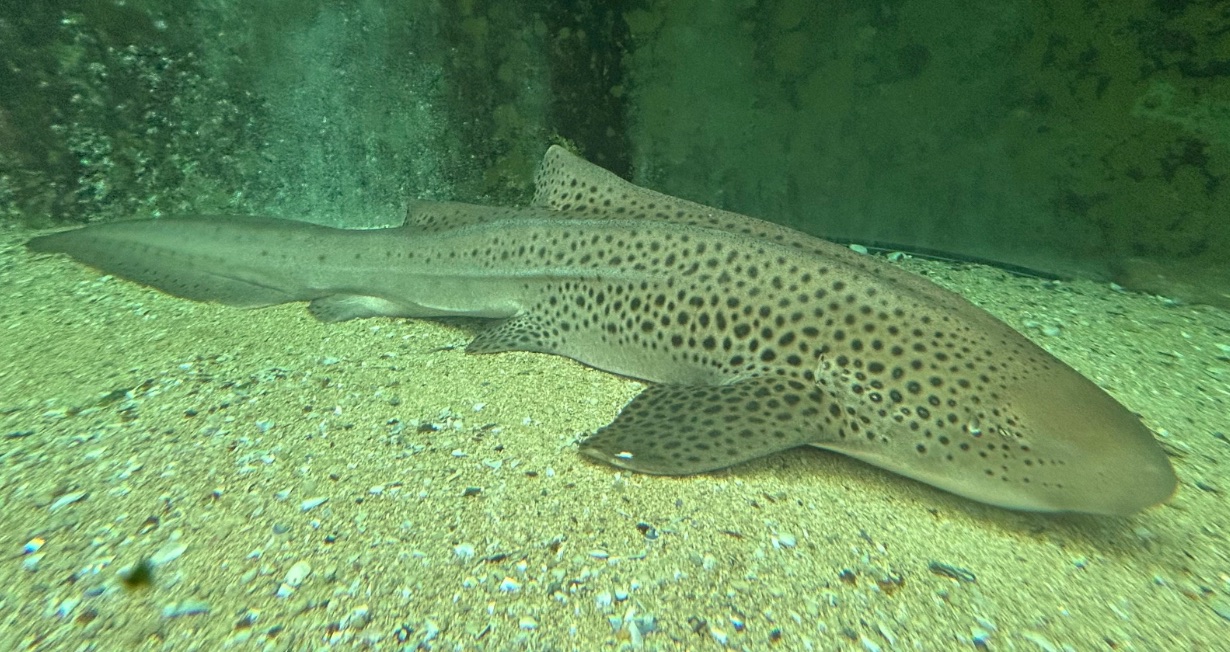
Leopard (Zebra) Shark
Stegostoma tigrinum · Cartilaginous fish, family Stegostomatidae
Finding a zebra shark on a sand flat feels like a gift: two meters of pale gold scattered with dark leopard rosettes, ridged like carved wood, motionless but wide awake, gills pulsing. It tolerates a careful diver at close range longer than almost any large shark, which made it a photographic staple across Thailand and the Coral Triangle, and made its decline conspicuous when nets emptied region after region. Thailand's Similans remain a stronghold, and Australia's east coast hosts famous seasonal gatherings. Watching one finally lift off, tail rippling like a ribbon in wind, is the quiet highlight of many trips.
Where and when to see one
"Resident" means most dives at that destination encounter them; "seasonal" means reliably present in the listed months; anything else is a bonus, not a plan.
| Destination | Reliability | Months | Notes |
|---|---|---|---|
| Similan Islands & Richelieu RockThailand | Resident: seen on most dives | Oct–May | |
| Cairns & the Ribbon ReefsAustralia | Occasional | Year-round | |
| Raja AmpatIndonesia | Occasional | Year-round | |
| Koh TaoThailand | Occasional | Year-round |
Best month, at a glance
| Month | Reliable destinations |
|---|---|
| January | Similan Islands & Richelieu Rock · Cairns & the Ribbon Reefs · Raja Ampat · Koh Tao |
| February | Similan Islands & Richelieu Rock · Cairns & the Ribbon Reefs · Raja Ampat · Koh Tao |
| March | Similan Islands & Richelieu Rock · Cairns & the Ribbon Reefs · Raja Ampat · Koh Tao |
| April | Similan Islands & Richelieu Rock · Cairns & the Ribbon Reefs · Raja Ampat · Koh Tao |
| May | Similan Islands & Richelieu Rock · Cairns & the Ribbon Reefs · Raja Ampat · Koh Tao |
| June | Cairns & the Ribbon Reefs · Raja Ampat · Koh Tao |
| July | Cairns & the Ribbon Reefs · Raja Ampat · Koh Tao |
| August | Cairns & the Ribbon Reefs · Raja Ampat · Koh Tao |
| September | Cairns & the Ribbon Reefs · Raja Ampat · Koh Tao |
| October | Similan Islands & Richelieu Rock · Cairns & the Ribbon Reefs · Raja Ampat · Koh Tao |
| November | Similan Islands & Richelieu Rock · Cairns & the Ribbon Reefs · Raja Ampat · Koh Tao |
| December | Similan Islands & Richelieu Rock · Cairns & the Ribbon Reefs · Raja Ampat · Koh Tao |
Understanding them
Habitat: Sandy patches beside coral reefs; rests on the bottom by day facing into current, hunts the reef at night
Range: Tropical Indo-Pacific from East Africa and the Red Sea through Southeast Asia to northern Australia and the western Pacific
Behavior: A gentle, torpid daytime resident, propped on its pectorals on sand with its ridged, spotted body in plain view. Adults wear leopard spots but hatch as striped 'zebras', the source of the naming muddle between Indo-Pacific 'leopard' usage and Australia's 'zebra shark'. Swims with an eel-like wriggle when disturbed.
Diet: Mollusks, crustaceans, small fish, and sea snakes, extracted from crevices with a flexible, wriggling body
Size: typically around 2.0 m; documented up to 2.5 m (total length, nearly half of it a long, low tail).
How to behave around one
Approach a resting shark low and from the front-side, stop outside touching distance, and leave before it bolts. Repeated flushing burns the animal's energy and empties the site for everyone after you.
Conservation
Endangered: inshore gillnetting has emptied much of Southeast Asia's habitat. A coalition of aquariums and scientists is now rewilding captive-bred pups in Raja Ampat, one of the first shark reintroduction programs anywhere.
Charted sites known for them
Highlighted sites were charted for this species by our editors; numbers are GBIF occurrence records logged within about 5 km of a site since 1990.
Watch
From the official channels

Wildlife of Monterey | New film in our auditorium

Live Aviary Cam | Monterey Bay Aquarium

Live Aviary Cam | Monterey Bay Aquarium
Videos are embedded links to their creators' own channels. We host nothing and credit everything.