Rays
Marbled Ray
Taeniurops meyeni · Cartilaginous fish, family Dasyatidae
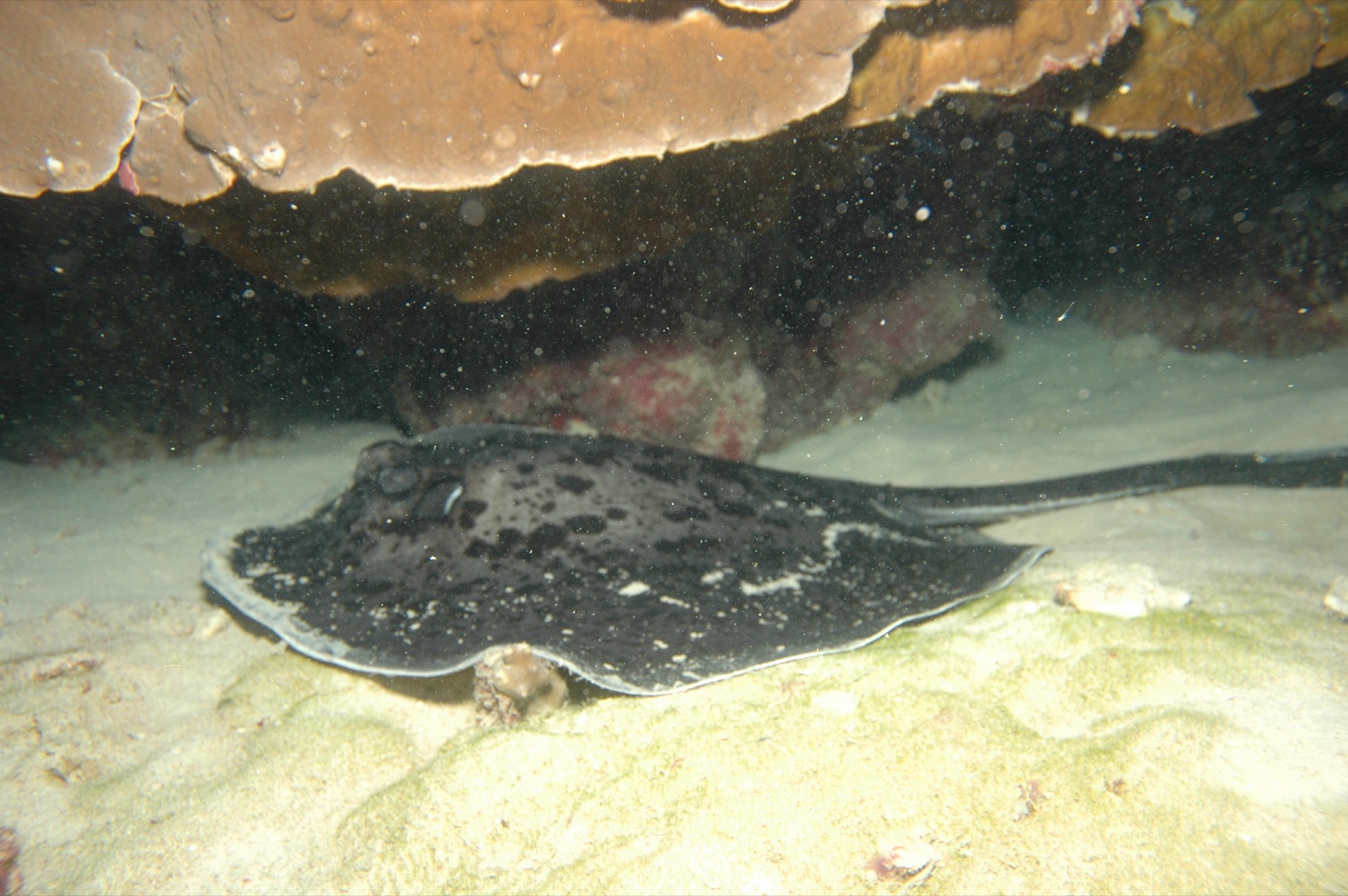
The marbled ray is the stingray built to seamount scale: a smoky, mottled disc nearly two meters across, so heavy it seems to settle into the reef rather than rest on it. At Cocos Island they are everywhere: layered on cleaning ledges, flapping ponderously between coral heads, shadowing the hammerhead schools like gray moons. The marbling that names it ranges from salt-and-pepper speckle to black storm-cloud blotches, no two alike. Divers who know only the skittish smaller dasyatids are startled by its composure; it will hold its patch of sand while an entire group files past, eye swiveling, tail undisturbed.
Wo und wann man eines sieht
„Resident" bedeutet, dass die meisten Tauchgänge am jeweiligen Tauchziel eine Begegnung erwarten lassen; „saisonal" bedeutet, dass die Art in den genannten Monaten zuverlässig anzutreffen ist; alles andere ist ein Bonus, keine Planungsgrundlage.
| Ziel | Zuverlässigkeit | Monate | Hinweise |
|---|---|---|---|
| Galápagos IslandsEcuador | Resident: seen on most dives | Ganzjährig | |
| Cocos IslandCosta Rica | Resident: seen on most dives | Ganzjährig | |
| MalpeloColombia | Resident: seen on most dives | Ganzjährig | |
| Socorro & the RevillagigedosMexico | Occasional | Ganzjährig |
Bester Monat auf einen Blick
Sie verstehen
Lebensraum: Rocky and coral reefs, seamount plateaus, and adjacent sand; often at cleaning stations
Verbreitung: Tropical Indo-Pacific from the Red Sea and East Africa to Japan and Australia, plus Eastern Pacific outposts, famously abundant at Cocos Island and the Galápagos
Verhalten: A ponderous, dignified giant that drapes itself over rocks and sand like a thrown blanket, mottled black-and-gray above with a fringe of rippling disc edge. At Cocos they pile onto cleaning stations several deep and trail hunting hammerheads and jacks scavenging behind them.
Ernährung: Bottom fish, crabs, and shrimp pinned beneath the disc
Größe: typischerweise rund 1.4 m; dokumentiert bis zu 1.8 m (disc width; a genuinely massive stingray, thick-bodied and round).
Wie man sich in ihrer Nähe verhält
Do not settle on sand without scanning it first, keep off cleaning stations, and never swim low over a resting ray's back. Approach from the side where it can see you.
Naturschutz
Assessed Vulnerable; taken widely in inshore and trawl fisheries across the Indo-Pacific, with reserves in the Eastern Pacific protecting its most visible populations.
Bekannte Tauchplätze dafür
Hervorgehobene Tauchplätze wurden von unseren Redakteuren für diese Art kartiert; die Zahlen sind GBIF-Vorkommensdatensätze, die seit 1990 im Umkreis von etwa 5 km um einen Tauchplatz protokolliert wurden.
Ansehen
Aus den offiziellen Kanälen

Wildlife of Monterey | New film in our auditorium

Live Aviary Cam | Monterey Bay Aquarium

Live Aviary Cam | Monterey Bay Aquarium
Videos sind eingebettete Links zu den Kanälen der jeweiligen Ersteller – wir hosten nichts und geben für alles die Quelle an.