Rays
Marbled Ray
Taeniurops meyeni · Cartilaginous fish, family Dasyatidae
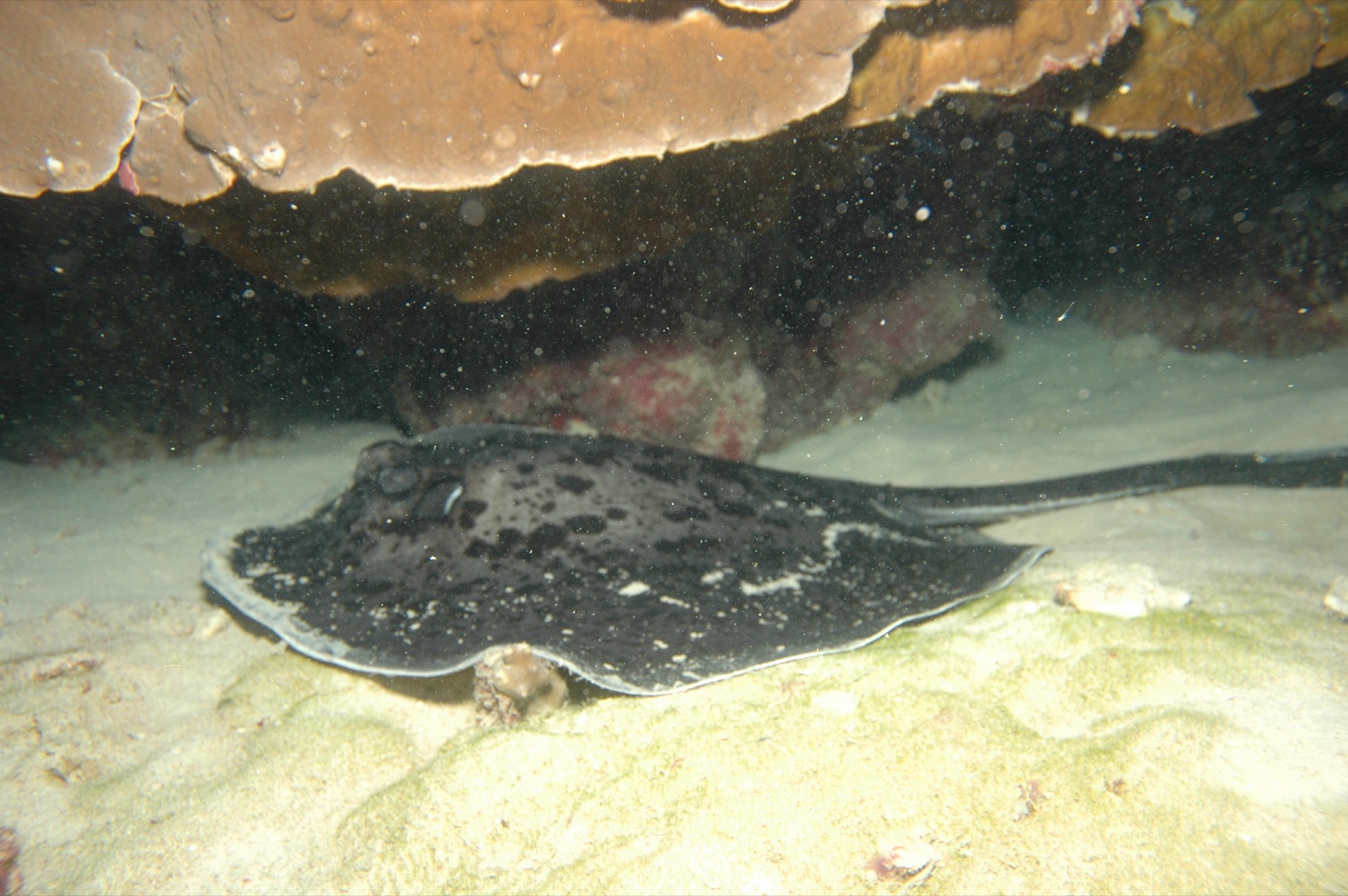
The marbled ray is the stingray built to seamount scale: a smoky, mottled disc nearly two meters across, so heavy it seems to settle into the reef rather than rest on it. At Cocos Island they are everywhere: layered on cleaning ledges, flapping ponderously between coral heads, shadowing the hammerhead schools like gray moons. The marbling that names it ranges from salt-and-pepper speckle to black storm-cloud blotches, no two alike. Divers who know only the skittish smaller dasyatids are startled by its composure; it will hold its patch of sand while an entire group files past, eye swiveling, tail undisturbed.
Where and when to see one
"Resident" means most dives at that destination encounter them; "seasonal" means reliably present in the listed months; anything else is a bonus, not a plan.
| Destination | Reliability | Months | Notes |
|---|---|---|---|
| Galápagos IslandsEcuador | Resident: seen on most dives | Year-round | |
| Cocos IslandCosta Rica | Resident: seen on most dives | Year-round | |
| MalpeloColombia | Resident: seen on most dives | Year-round | |
| Socorro & the RevillagigedosMexico | Occasional | Year-round |
Best month, at a glance
Understanding them
Habitat: Rocky and coral reefs, seamount plateaus, and adjacent sand; often at cleaning stations
Range: Tropical Indo-Pacific from the Red Sea and East Africa to Japan and Australia, plus Eastern Pacific outposts, famously abundant at Cocos Island and the Galápagos
Behavior: A ponderous, dignified giant that drapes itself over rocks and sand like a thrown blanket, mottled black-and-gray above with a fringe of rippling disc edge. At Cocos they pile onto cleaning stations several deep and trail hunting hammerheads and jacks scavenging behind them.
Diet: Bottom fish, crabs, and shrimp pinned beneath the disc
Size: typically around 1.4 m; documented up to 1.8 m (disc width; a genuinely massive stingray, thick-bodied and round).
How to behave around one
Do not settle on sand without scanning it first, keep off cleaning stations, and never swim low over a resting ray's back. Approach from the side where it can see you.
Conservation
Assessed Vulnerable; taken widely in inshore and trawl fisheries across the Indo-Pacific, with reserves in the Eastern Pacific protecting its most visible populations.
Charted sites known for them
Highlighted sites were charted for this species by our editors; numbers are GBIF occurrence records logged within about 5 km of a site since 1990.
Watch
From the official channels

Wildlife of Monterey | New film in our auditorium

Live Aviary Cam | Monterey Bay Aquarium

Live Aviary Cam | Monterey Bay Aquarium
Videos are embedded links to their creators' own channels. We host nothing and credit everything.