Rays
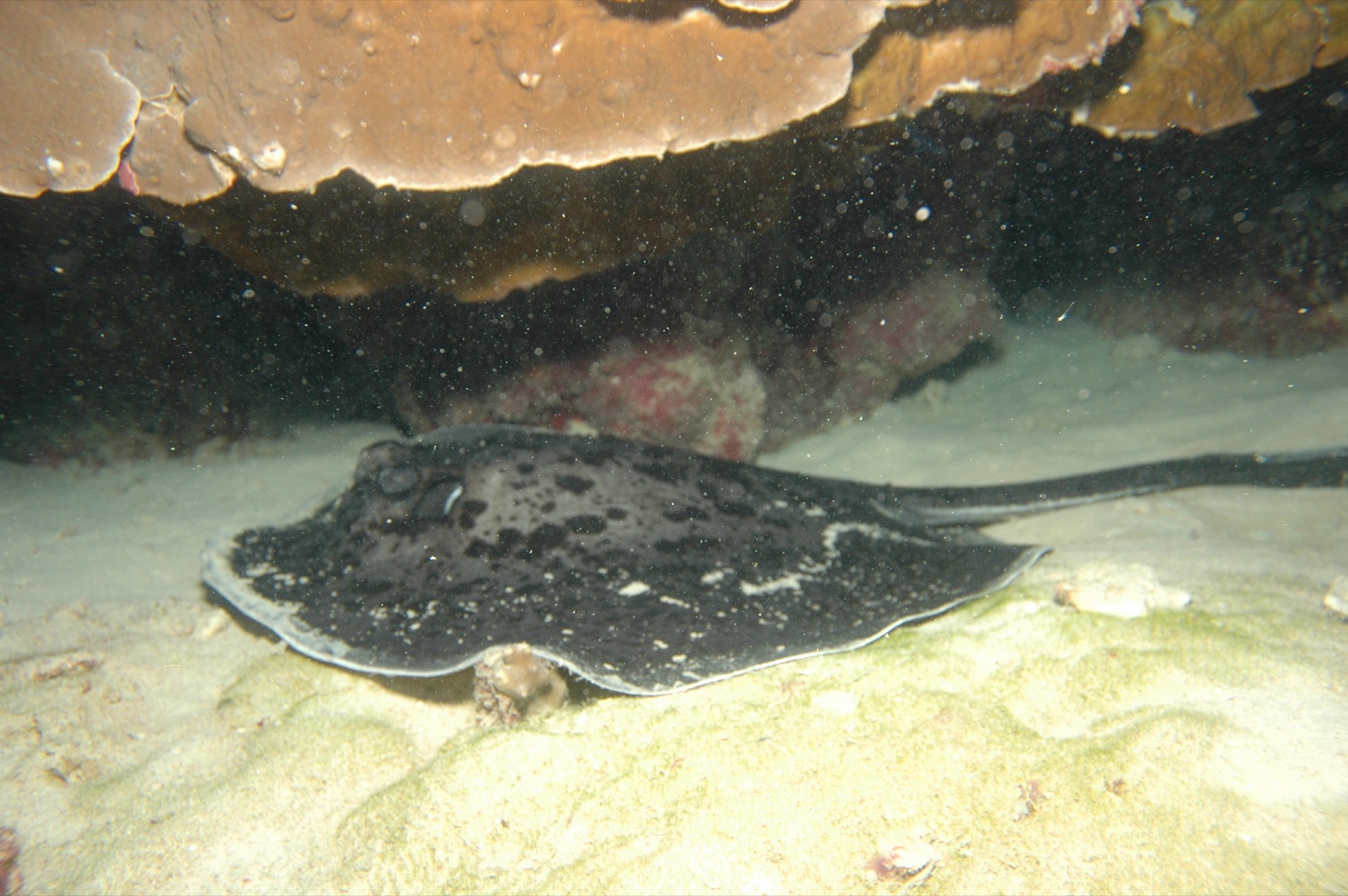
Marbled Ray
Taeniurops meyeni · Cartilaginous fish, family Dasyatidae
The marbled ray is the stingray built to seamount scale: a smoky, mottled disc nearly two meters across, so heavy it seems to settle into the reef rather than rest on it. At Cocos Island they are everywhere: layered on cleaning ledges, flapping ponderously between coral heads, shadowing the hammerhead schools like gray moons. The marbling that names it ranges from salt-and-pepper speckle to black storm-cloud blotches, no two alike. Divers who know only the skittish smaller dasyatids are startled by its composure; it will hold its patch of sand while an entire group files past, eye swiveling, tail undisturbed.
Dónde y cuándo ver uno
"Residente" significa que la mayoría de las inmersiones en ese destino tienen encuentros con ellos; "estacional" significa que su presencia es fiable en los meses indicados; cualquier otra cosa es un extra, no algo con lo que contar.
| Destino | Fiabilidad | Meses | Notas |
|---|---|---|---|
| Galápagos IslandsEcuador | Resident: seen on most dives | Todo el año | |
| Cocos IslandCosta Rica | Resident: seen on most dives | Todo el año | |
| MalpeloColombia | Resident: seen on most dives | Todo el año | |
| Socorro & the RevillagigedosMexico | Occasional | Todo el año |
El mejor mes, de un vistazo
| Mes | Destinos fiables |
|---|---|
| January | Galápagos Islands · Cocos Island · Malpelo · Socorro & the Revillagigedos |
| February | Galápagos Islands · Cocos Island · Malpelo · Socorro & the Revillagigedos |
| March | Galápagos Islands · Cocos Island · Malpelo · Socorro & the Revillagigedos |
| April | Galápagos Islands · Cocos Island · Malpelo · Socorro & the Revillagigedos |
| May | Galápagos Islands · Cocos Island · Malpelo · Socorro & the Revillagigedos |
| June | Galápagos Islands · Cocos Island · Malpelo · Socorro & the Revillagigedos |
| July | Galápagos Islands · Cocos Island · Malpelo · Socorro & the Revillagigedos |
| August | Galápagos Islands · Cocos Island · Malpelo · Socorro & the Revillagigedos |
| September | Galápagos Islands · Cocos Island · Malpelo · Socorro & the Revillagigedos |
| October | Galápagos Islands · Cocos Island · Malpelo · Socorro & the Revillagigedos |
| November | Galápagos Islands · Cocos Island · Malpelo · Socorro & the Revillagigedos |
| December | Galápagos Islands · Cocos Island · Malpelo · Socorro & the Revillagigedos |
Comprendiéndolos
Hábitat: Rocky and coral reefs, seamount plateaus, and adjacent sand; often at cleaning stations
Rango: Tropical Indo-Pacific from the Red Sea and East Africa to Japan and Australia, plus Eastern Pacific outposts, famously abundant at Cocos Island and the Galápagos
Comportamiento: A ponderous, dignified giant that drapes itself over rocks and sand like a thrown blanket, mottled black-and-gray above with a fringe of rippling disc edge. At Cocos they pile onto cleaning stations several deep and trail hunting hammerheads and jacks scavenging behind them.
Dieta: Bottom fish, crabs, and shrimp pinned beneath the disc
Tamaño: normalmente alrededor de 1.4 m; documentado hasta 1.8 m (disc width; a genuinely massive stingray, thick-bodied and round).
Cómo comportarse cerca de uno
Do not settle on sand without scanning it first, keep off cleaning stations, and never swim low over a resting ray's back. Approach from the side where it can see you.
Conservación
Assessed Vulnerable; taken widely in inshore and trawl fisheries across the Indo-Pacific, with reserves in the Eastern Pacific protecting its most visible populations.
Puntos conocidos por avistamientos
Los puntos destacados fueron registrados para esta especie por nuestros editores; los números son registros de ocurrencia de GBIF anotados en un radio de unos 5 km de un punto desde 1990.
Ver
Desde los canales oficiales

Wildlife of Monterey | New film in our auditorium

Live Aviary Cam | Monterey Bay Aquarium

Live Aviary Cam | Monterey Bay Aquarium
Los vídeos son enlaces insertados a los canales de sus propios creadores. No alojamos nada y acreditamos todo.