Big Fish
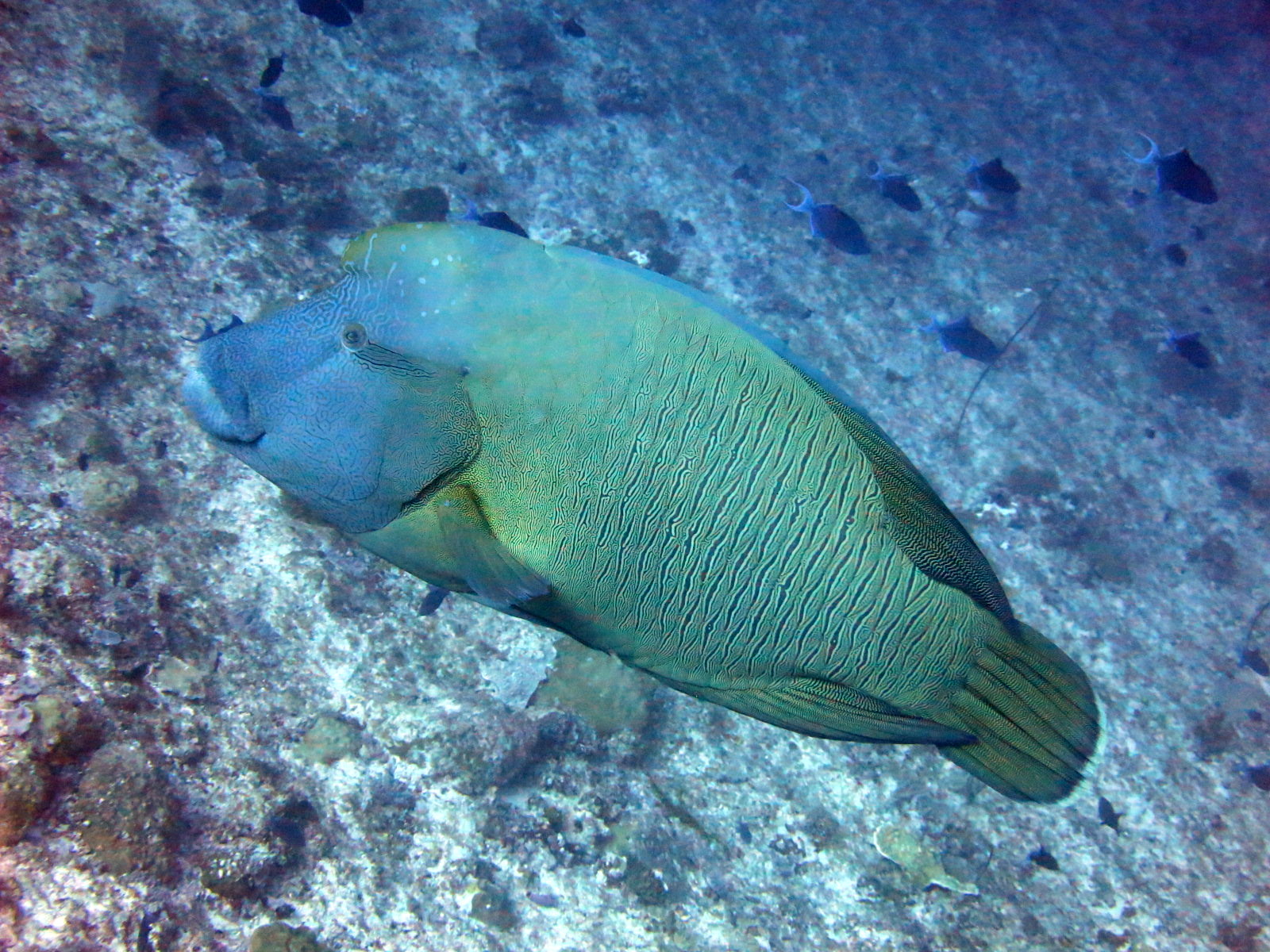
Napoleon (Humphead) Wrasse
Cheilinus undulatus · Bony fish, family Labridae
Every great Indo-Pacific reef has its Napoleon, and divers learn them by name. The fish is unmistakable: a wardrobe-sized wrasse in chalkboard green scribbled with maze lines, thick lips set in permanent diplomacy, the adult's forehead hump rising like a bicorne hat. It ambles rather than swims, pausing to crunch an urchin or turn a heavy eye on the dive group. Old individuals at Blue Corner or Shark Reef treat humans as familiar furniture. The species pays for that trusting bulk: prized as a luxury live-reef food fish, it has been stripped from much of Southeast Asia, and the big tame residents of protected reefs are now among its safest populations.
Où et quand en observer un
« Résident » signifie que la plupart des plongées sur ce site permettent de les observer ; « saisonnier » signifie qu'ils sont présents de manière fiable durant les mois indiqués ; tout le reste est un bonus, pas une certitude.
| Destination | Fiabilité | Mois | Notes |
|---|---|---|---|
| Sharm El Sheikh & Ras MohammedEgypt | Resident: seen on most dives | Toute l'année | |
| PalauPalau | Resident: seen on most dives | Toute l'année | |
| Sipadan & MabulMalaysia | Resident: seen on most dives | Toute l'année | |
| Cairns & the Ribbon ReefsAustralia | Resident: seen on most dives | Toute l'année | |
| North & South Malé AtollsMaldives | Resident: seen on most dives | Toute l'année |
Meilleur mois, en un coup d'œil
Les comprendre
Habitat: Outer reef slopes, channels, and lagoon passes; sleeps in caves and returns to favored ranges for decades
Aire de répartition: Indo-Pacific coral reefs from the Red Sea and East Africa through Southeast Asia and Micronesia to the central Pacific
Comportement: A slow-cruising reef monarch, usually solitary, patrolling with pectoral-fin rowing strokes and an air of proprietorship. Naturally wary where fished; at protected sites like Ras Mohammed and Palau's channels, individuals become famously tame, inspecting divers eye to eye. Born mostly female, with dominant animals changing sex to male.
Régime alimentaire: Mollusks, crustaceans, urchins, and toxic prey few others touch, crown-of-thorns starfish and boxfish included
Taille: généralement autour de 1.2 m; documenté jusqu'à 2.0 m (total length; the largest wrasse, with old males approaching 200 kg).
Comment se comporter avec lui
No feeding (it distorted behavior badly at several famous sites), no touching, and let a curious fish make the approach. Report obviously missing 'resident' Napoleons to operators; they are individually known.
Conservation
Endangered and CITES-listed; the live reef-fish trade drove collapses across Southeast Asia, and enforcement plus site protection now underpin the strongholds divers visit.
Sites répertoriés connus pour leur présence
Les sites mis en évidence ont été cartographiés pour cette espèce par nos éditeurs ; les chiffres correspondent aux occurrences GBIF enregistrées dans un rayon d'environ 5 km d'un site depuis 1990.
Regarder
Depuis les canaux officiels

Wildlife of Monterey | New film in our auditorium

Live Aviary Cam | Monterey Bay Aquarium

Live Aviary Cam | Monterey Bay Aquarium
Les vidéos sont des liens intégrés vers les chaînes de leurs créateurs. Nous n'hébergeons rien et créditons tout.