Big Fish
Napoleon (Humphead) Wrasse
Cheilinus undulatus · Bony fish, family Labridae
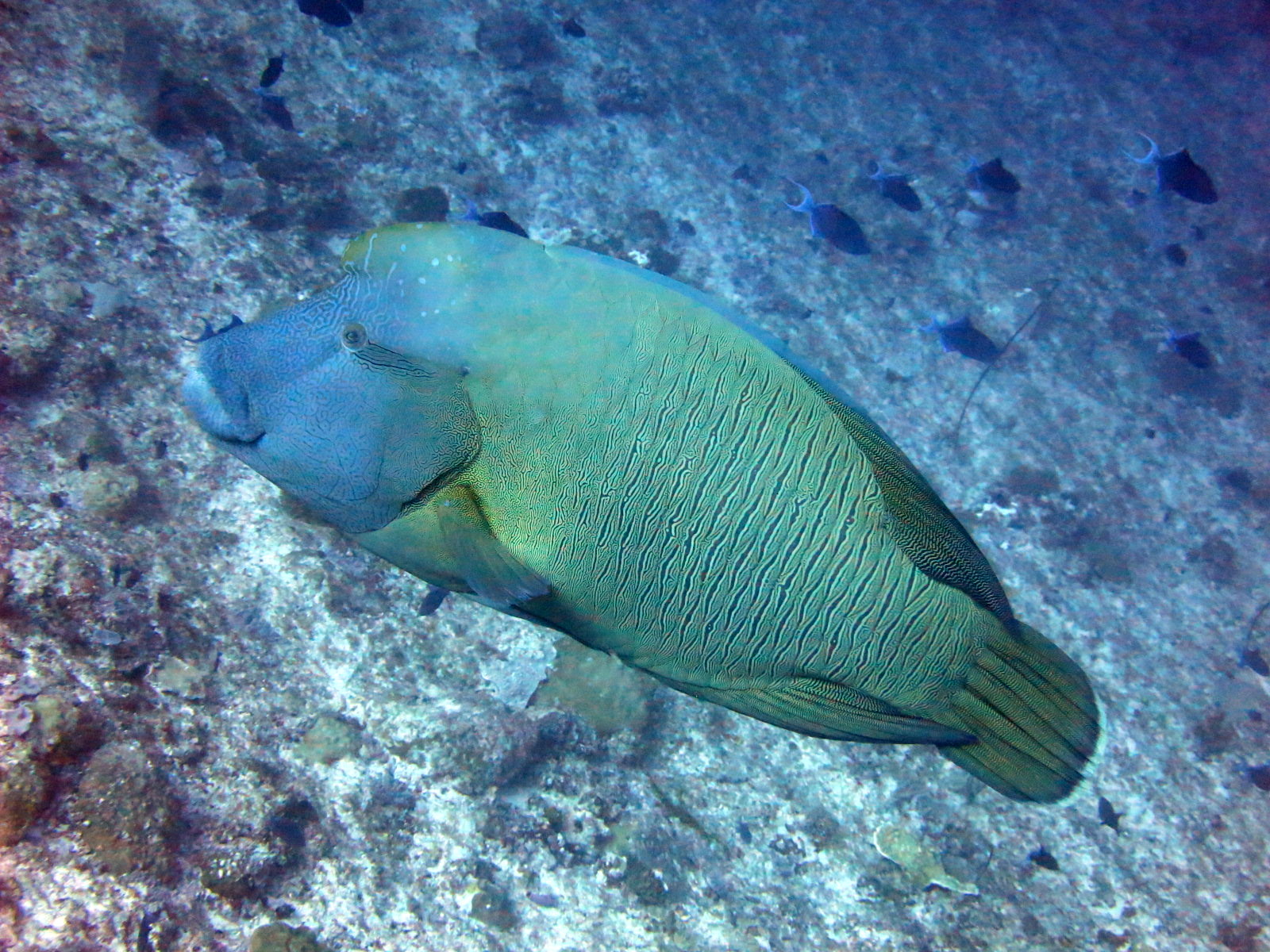
Every great Indo-Pacific reef has its Napoleon, and divers learn them by name. The fish is unmistakable: a wardrobe-sized wrasse in chalkboard green scribbled with maze lines, thick lips set in permanent diplomacy, the adult's forehead hump rising like a bicorne hat. It ambles rather than swims, pausing to crunch an urchin or turn a heavy eye on the dive group. Old individuals at Blue Corner or Shark Reef treat humans as familiar furniture. The species pays for that trusting bulk: prized as a luxury live-reef food fish, it has been stripped from much of Southeast Asia, and the big tame residents of protected reefs are now among its safest populations.
Dove e quando avvistarne uno
"Residente" significa che la maggior parte delle immersioni in quella destinazione li incontra; "stagionale" significa che sono presenti in modo affidabile nei mesi indicati; qualsiasi altra cosa è un bonus, non un piano.
| Destinazione | Affidabilità | Mesi | Note |
|---|---|---|---|
| Sharm El Sheikh & Ras MohammedEgypt | Resident: seen on most dives | Tutto l'anno | |
| PalauPalau | Resident: seen on most dives | Tutto l'anno | |
| Sipadan & MabulMalaysia | Resident: seen on most dives | Tutto l'anno | |
| Cairns & the Ribbon ReefsAustralia | Resident: seen on most dives | Tutto l'anno | |
| North & South Malé AtollsMaldives | Resident: seen on most dives | Tutto l'anno |
Il mese migliore, a colpo d'occhio
Capirle
Habitat: Outer reef slopes, channels, and lagoon passes; sleeps in caves and returns to favored ranges for decades
Distribuzione: Indo-Pacific coral reefs from the Red Sea and East Africa through Southeast Asia and Micronesia to the central Pacific
Comportamento: A slow-cruising reef monarch, usually solitary, patrolling with pectoral-fin rowing strokes and an air of proprietorship. Naturally wary where fished; at protected sites like Ras Mohammed and Palau's channels, individuals become famously tame, inspecting divers eye to eye. Born mostly female, with dominant animals changing sex to male.
Dieta: Mollusks, crustaceans, urchins, and toxic prey few others touch, crown-of-thorns starfish and boxfish included
Dimensioni: tipicamente intorno a 1.2 m; documentato fino a 2.0 m (total length; the largest wrasse, with old males approaching 200 kg).
Come comportarsi in sua presenza
No feeding (it distorted behavior badly at several famous sites), no touching, and let a curious fish make the approach. Report obviously missing 'resident' Napoleons to operators; they are individually known.
Conservazione
Endangered and CITES-listed; the live reef-fish trade drove collapses across Southeast Asia, and enforcement plus site protection now underpin the strongholds divers visit.
Siti mappati noti per avvistamenti
I siti evidenziati sono stati schedati per questa specie dai nostri redattori; i numeri sono record di occorrenza GBIF registrati entro circa 5 km dal sito a partire dal 1990.
Guarda
Dai canali ufficiali

Wildlife of Monterey | New film in our auditorium

Live Aviary Cam | Monterey Bay Aquarium

Live Aviary Cam | Monterey Bay Aquarium
I video sono link incorporati ai canali dei rispettivi autori. Non ospitiamo nulla e accreditiamo tutto.