Macro
Pygmy Seahorse
Hippocampus bargibanti · Bony fish, family Syngnathidae; Bargibant's pygmy seahorse, the classic gorgonian-dwelling pygmy
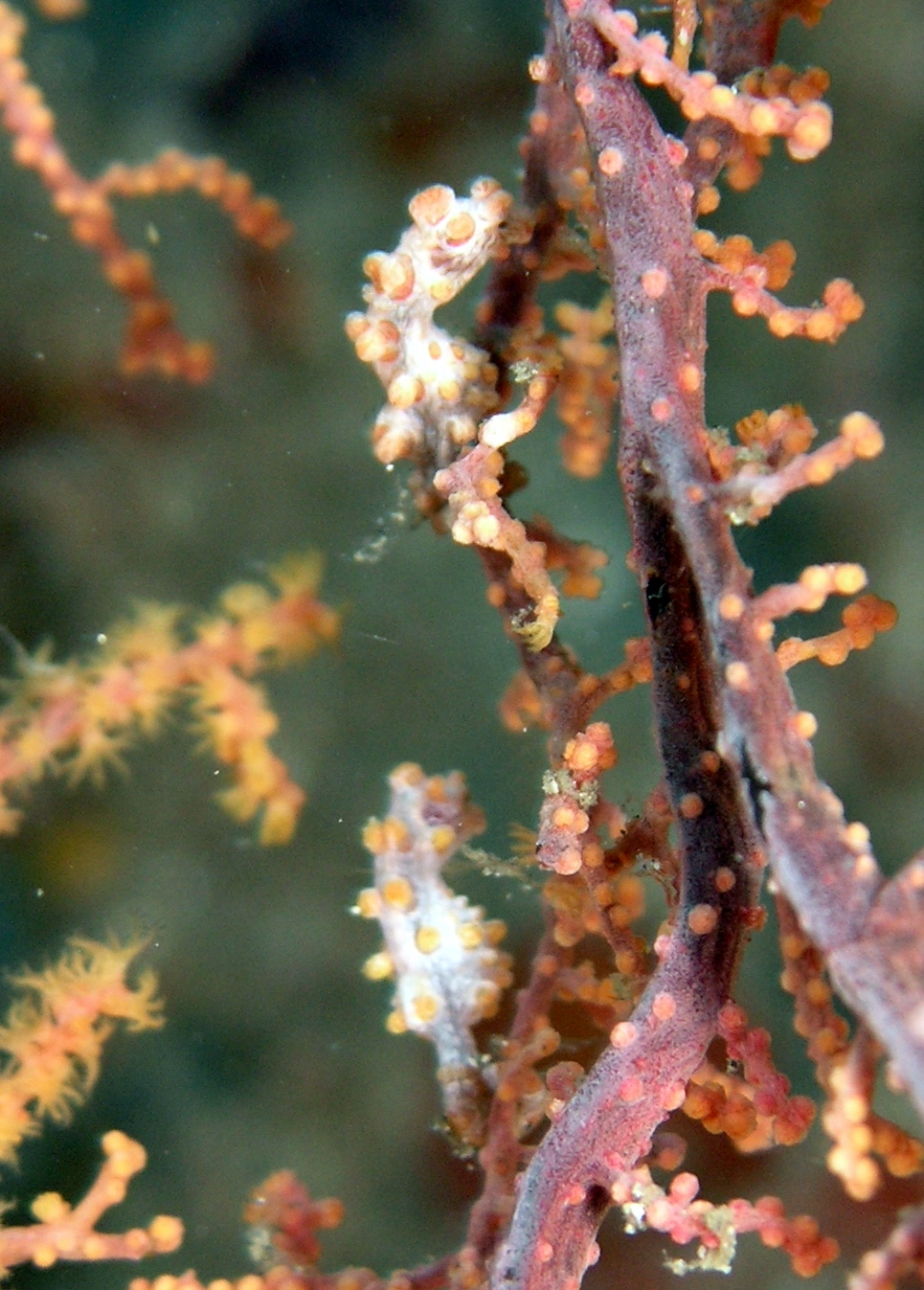
Nobody found a Bargibant's pygmy seahorse in the wild first. The species turned up in 1969 on a gorgonian already sitting in a New Caledonia aquarium, because a two-centimeter seahorse studded with polyp-matched tubercles is effectively part of its host. Each pair or small group spends adult life on a single Muricella sea fan, pink-on-pink or yellow-on-yellow, tails wrapped around the branches. Guides locate them by knowing individual fans, then point a stick at what looks like nothing until your eyes adjust and the fan grows a face. The photography ethics are blunt: the fans live on current-swept walls where a misplaced fin does decades of damage, and repeated strobe barrages visibly stress the animals, so many operations cap flash frames per group. Skip the shot unless your buoyancy has earned it.
Onde e quando ver um
"Residente" significa que a maioria dos mergulhos naquele destino os encontra; "sazonal" significa presença confiável nos meses listados; qualquer outra coisa é um bônus, não um plano.
| Destino | Fiabilidade | Meses | Notas |
|---|---|---|---|
| Raja AmpatIndonesia | Resident: seen on most dives | Todo o ano | |
| Bali & Nusa PenidaIndonesia | Resident: seen on most dives | Todo o ano | |
| Lembeh StraitIndonesia | Resident: seen on most dives | Todo o ano | |
| AnilaoPhilippines | Resident: seen on most dives | Todo o ano | |
| Kimbe BayPapua New Guinea | Resident: seen on most dives | Todo o ano | |
| WakatobiIndonesia | Resident: seen on most dives | Todo o ano |
Melhor mês, em resumo
Entendendo-os
Habitat: Lives exclusively on Muricella gorgonian sea fans on current-swept slopes and walls, matching the host's polyp color and texture.
Distribuição: Coral Triangle heartland (Indonesia, Philippines, Malaysia, Papua New Guinea), extending to northern Australia, Micronesia, and southern Japan.
Comportamento: Pairs and small groups spend adult life on a single fan, tails wrapped around branches; movement is measured in centimeters per day.
Dieta: Minute crustaceans picked from the water and the fan surface.
Tamanho: normalmente cerca de 0.02 m; documentado até 0.025 m (height; among the smallest seahorses known).
Como se comportar perto de um
Let the guide point, keep buoyancy faultless off the wall, never touch the fan, and accept a capped number of flash frames; many operators limit or ban strobes on pygmies.
Conservação
Formally Data Deficient; practical risks are damage to host gorgonians and cumulative harassment at heavily dived fans.
Pontos mapeados conhecidos por eles
Os locais destacados foram cartografados para esta espécie pelos nossos editores; os números são registos de ocorrência do GBIF num raio de cerca de 5 km do local desde 1990.
Assista
Dos canais oficiais

Wildlife of Monterey | New film in our auditorium

Live Aviary Cam | Monterey Bay Aquarium

Live Aviary Cam | Monterey Bay Aquarium
Os vídeos são ligações incorporadas para os canais dos próprios criadores. Não alojamos nada e creditamos tudo.