Tauchplätze, Saisons und Meereslebewesen – recherchiert, kartiert, geplant.
Menü
Reiseziele Tauchplätze Meeresleben Wracks News
Eine Reise planen Tauchtrip-Planer Wann tauchen Kostenrechner Vergleiche Meereslebewesen-Kalender Wassertemperatur Liveaboards Tauchbetriebe & Resorts Meeresschutzgebiete Druckkammern Weltkarte
Regionen Australien, Neuseeland & OstasienKaribik & WestatlantikEuropa, Atlantik & MittelmeerIndischer Ozean & OstafrikaPazifikinseln & MikronesienRotes Meer & Naher OstenSüdostasien & Korallen-DreieckAmerika & Östlicher Pazifik Länder
Lernen & Tools Alle Guides Zertifizierungen Ausrüstungsratgeber Videos Daten abfragen KI-Agenten API
Über uns Über uns Methodik Haftungsausschluss Kontakt
Deine Ansicht
★ Gespeichert

Deine gespeicherten Reiseziele, Tauchplätze und Tierarten — im Browser gespeichert.

API-GATEWAY

Kostenloser, schreibgeschützter JSON-Zugriff auf die gecachten Daten des Atlas.

Dunkelmodus

🧭 Geführte Ansicht
Neu beim Tauchen — Tiefen, Strömungen, Zertifizierungsstufen? Wir erklären jeden Begriff beim Stöbern in verständlicher Sprache. Dieselben Daten, mit integrierter Hilfe.

⚡ Expertenansicht
Du kennst den Unterschied zwischen einem Wall und einem Drift Dive. Nur die Daten – klar, schnell und kompakt. Das ist die Standardansicht.

Oberflächensprache
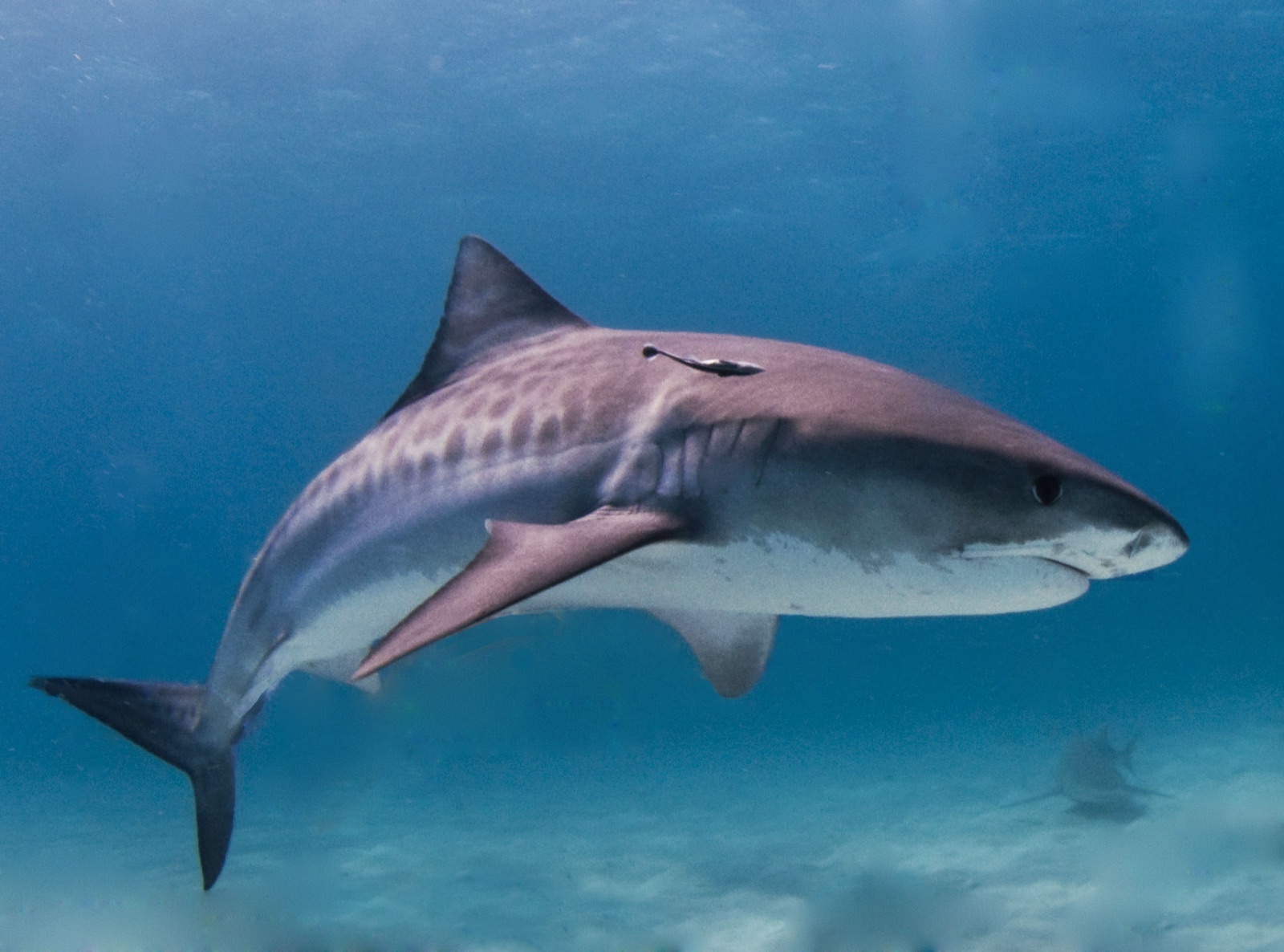
Tiger Shark — illustration
KI-generierte Illustration für The Scuba Atlas – illustrativ, kein Dokumentarfoto.

Sharks

Tiger Shark

Galeocerdo cuvier · Cartilaginous fish — family Galeocerdidae

IUCN: NT (decreasing) ~3.5 m total length; mature females commonly reach 4 m and exceptional animals past 5 m 1–100 m Tiefenbereich Gut dokumentiert

A big tiger shark owns whatever piece of ocean it is in. The head is broad and blunt, the eye large and unhurried, and the animal's approach is a straight, slow line that tests your composure long before it tests anything else. On the shallow sand of the Bahamas or Fiji's arena dives, tigers glide through groups of divers with a serenity that has rewritten the species' reputation — attentive management, not luck, keeps it that way. They are turtle specialists, garbage-can opportunists, and long-distance wanderers whose tracked migrations span ocean basins.

Respektfaktor: Treat With RespectOne of the few sharks implicated in serious unprovoked incidents, yet thousands of structured dives proceed calmly every year. The rules are constant vigilance, eye contact, redirection with a palm on the flank only when trained guides do it, and no surface swimming at known tiger sites.

Wo und wann man eines sieht

„Resident" bedeutet, dass die meisten Tauchgänge am jeweiligen Tauchziel eine Begegnung erwarten lassen; „saisonal" bedeutet, dass die Art in den genannten Monaten zuverlässig anzutreffen ist; alles andere ist ein Bonus, keine Planungsgrundlage.

ZielZuverlässigkeitMonateHinweise
Tiger Beach & Grand BahamaThe Bahamas Resident — seen on most dives Ganzjährig
Cocos IslandCosta Rica Resident — seen on most dives Ganzjährig
Beqa Lagoon & Pacific HarbourFiji Resident — seen on most dives Ganzjährig
Aliwal Shoal & UmkomaasSouth Africa Seasonal — reliable in season Feb–Jun
Coral Sea & Osprey ReefAustralia Occasional Ganzjährig
OʻahuUnited States Occasional Ganzjährig

Bester Monat auf einen Blick

MonatZuverlässige Reiseziele
January Tiger Beach & Grand Bahama · Cocos Island · Beqa Lagoon & Pacific Harbour · Coral Sea & Osprey Reef · Oʻahu
February Tiger Beach & Grand Bahama · Cocos Island · Beqa Lagoon & Pacific Harbour · Aliwal Shoal & Umkomaas · Coral Sea & Osprey Reef · Oʻahu
March Tiger Beach & Grand Bahama · Cocos Island · Beqa Lagoon & Pacific Harbour · Aliwal Shoal & Umkomaas · Coral Sea & Osprey Reef · Oʻahu
April Tiger Beach & Grand Bahama · Cocos Island · Beqa Lagoon & Pacific Harbour · Aliwal Shoal & Umkomaas · Coral Sea & Osprey Reef · Oʻahu
May Tiger Beach & Grand Bahama · Cocos Island · Beqa Lagoon & Pacific Harbour · Aliwal Shoal & Umkomaas · Coral Sea & Osprey Reef · Oʻahu
June Tiger Beach & Grand Bahama · Cocos Island · Beqa Lagoon & Pacific Harbour · Aliwal Shoal & Umkomaas · Coral Sea & Osprey Reef · Oʻahu
July Tiger Beach & Grand Bahama · Cocos Island · Beqa Lagoon & Pacific Harbour · Coral Sea & Osprey Reef · Oʻahu
August Tiger Beach & Grand Bahama · Cocos Island · Beqa Lagoon & Pacific Harbour · Coral Sea & Osprey Reef · Oʻahu
September Tiger Beach & Grand Bahama · Cocos Island · Beqa Lagoon & Pacific Harbour · Coral Sea & Osprey Reef · Oʻahu
October Tiger Beach & Grand Bahama · Cocos Island · Beqa Lagoon & Pacific Harbour · Coral Sea & Osprey Reef · Oʻahu
November Tiger Beach & Grand Bahama · Cocos Island · Beqa Lagoon & Pacific Harbour · Coral Sea & Osprey Reef · Oʻahu
December Tiger Beach & Grand Bahama · Cocos Island · Beqa Lagoon & Pacific Harbour · Coral Sea & Osprey Reef · Oʻahu

Sie verstehen

Lebensraum: Reef edges, lagoons, seagrass banks, and open water; comfortable from knee-deep flats to the deep blue

Verbreitung: Circumglobal in tropical and warm temperate seas, from the Caribbean and Hawaii to the Coral Sea, Indian Ocean, and South Pacific

Verhalten: Slow, curious, and supremely confident. Tigers approach divers more directly than most large sharks, often making repeated close passes with a deliberate, almost sleepy cadence that should not be mistaken for indifference. The dark bars that name the species fade with age but remain visible in good light.

Ernährung: The broadest menu of any reef shark — turtles, rays, fish, seabirds, carrion, and famously indigestible debris; adults are key predators of sea turtles

Größe: typischerweise rund 3.5 m; dokumentiert bis zu 5.5 m (total length; mature females commonly reach 4 m and exceptional animals past 5 m).

Wie man sich in ihrer Nähe verhält

Dive with operators who brief tiger protocol: dark gloves optional but no dangling gear, stay grouped and low, keep 360-degree awareness, never block an approach path, and exit the water calmly and together.

Naturschutz

Near Threatened globally with regional depletion from target fisheries, shark-control programs, and the fin trade. Bahamian and Fijian shark tourism demonstrates the species' economic value alive.

Bekannte Tauchplätze dafür

Ansehen

Aus den offiziellen Kanälen

Alle Videos →

Videos sind eingebettete Links zu den Kanälen der jeweiligen Ersteller – wir hosten nichts und geben für alles die Quelle an.

Quellen: Wikipedia ↗IUCN Red List ↗ · Fakten wurden anhand der oben genannten Quellen verifiziert; Felder ohne Quellenbeleg sind als noch nicht verifiziert gekennzeichnet.

Australien, Neuseeland & Ostasien

Cairns & the Ribbon ReefsNingaloo ReefCoral Sea & Osprey ReefOkinawa & the Kerama IslandsPoor Knights IslandsTownsville & the YongalaGreen IslandIzu Peninsula

Karibik & Westatlantik

BonaireCozumelRiviera Maya & the CenotesBelize Barrier ReefGrand CaymanIsla Mujeres & CancúnRoatánTiger Beach & Grand Bahama

Europa, Atlantik & Mittelmeer

Malta & GozoSilfra & IcelandThe AzoresCanary IslandsLarnaca & the ZenobiaScapa FlowArctic NorwayMadeira

Indischer Ozean & Ostafrika

North & South Malé AtollsAri AtollBaa Atoll & Hanifaru BayAliwal Shoal & UmkomaasMafia IslandMauritiusSeychellesSodwana Bay

Pazifikinseln & Mikronesien

PalauChuuk (Truk) LagoonFakaravaKona, HawaiʻiRangiroaTaveuni & Rainbow ReefBeqa Lagoon & Pacific HarbourEspiritu Santo

Rotes Meer & Naher Osten

Sharm El Sheikh & Ras MohammedBrothers, Daedalus & St John'sDahabHurghada & El GounaMarsa Alam & the Deep SouthAqabaDaymaniyat IslandsMusandam Peninsula

Südostasien & Korallen-Dreieck

Bali & Nusa PenidaKomodoRaja AmpatSipadan & MabulAnilaoCoronKoh TaoLembeh Strait

Amerika & Östlicher Pazifik

Galápagos IslandsCocos IslandFlorida KeysSea of Cortez & Cabo PulmoSocorro & the RevillagigedosBritish ColumbiaCalifornia Channel IslandsCosta Rica Pacific Coast