Tauchplätze, Saisons und Meereslebewesen – recherchiert, kartiert, geplant.
Menü
Reiseziele Tauchplätze Meeresleben Wracks News
Eine Reise planen Tauchtrip-Planer Wann tauchen Kostenrechner Vergleiche Meereslebewesen-Kalender Wassertemperatur Liveaboards Tauchbetriebe & Resorts Meeresschutzgebiete Druckkammern Weltkarte
Regionen Australien, Neuseeland & OstasienKaribik & WestatlantikEuropa, Atlantik & MittelmeerIndischer Ozean & OstafrikaPazifikinseln & MikronesienRotes Meer & Naher OstenSüdostasien & Korallen-DreieckAmerika & Östlicher Pazifik Länder
Lernen & Tools Alle Guides Zertifizierungen Ausrüstungsratgeber Videos Daten abfragen KI-Agenten API
Über uns Über uns Methodik Haftungsausschluss Kontakt
Deine Ansicht
★ Gespeichert

Deine gespeicherten Reiseziele, Tauchplätze und Tierarten — im Browser gespeichert.

API-GATEWAY

Kostenloser, schreibgeschützter JSON-Zugriff auf die gecachten Daten des Atlas.

Dunkelmodus

🧭 Geführte Ansicht
Neu beim Tauchen — Tiefen, Strömungen, Zertifizierungsstufen? Wir erklären jeden Begriff beim Stöbern in verständlicher Sprache. Dieselben Daten, mit integrierter Hilfe.

⚡ Expertenansicht
Du kennst den Unterschied zwischen einem Wall und einem Drift Dive. Nur die Daten – klar, schnell und kompakt. Das ist die Standardansicht.

Oberflächensprache

Vergleich

The Galápagos vs Cocos Island
Galápagos Islands

Galápagos Islands

Ecuador
Cocos Island

Cocos Island

Costa Rica
Die kurze AntwortBoth are cool-water, current-swept hammerhead theaters reached by liveaboard, and neither is a beginner's trip. The Galápagos adds breadth: whale sharks at Darwin in the June-to-November cool season, mola and marine iguanas in the warm months, and Ecuador's flights and park machinery to navigate. Cocos asks for roughly a day and a half of open-Pacific steaming each way and repays it with dense cleaning-station schools, reliable tiger sharks, and almost no other boats. Budgets land in the same high bracket; stomach and schedule often decide.
Auswählen Galápagos Islands Pick the Galápagos for the broader spectacle — hammerhead walls plus whale sharks in season, endemic oddities, and wildlife above the waterline.
Auswählen Cocos Island Pick Cocos if you are a shark purist with sea legs, trading a thirty-six-hour crossing for cleaning-station hammerheads in near-total solitude.

Die Zahlen, nebeneinander

Galápagos IslandsCocos Island
Beste MonateJun–NovJun–Nov
Wasser (dokumentierte Spanne)17–27 °C / 63–81 °F24–29 °C / 75–84 °F
Sichtweite10–25 m12–30 m
LevelAdvancedExpedition
Zwei-Tank-Bootstauchen$160–$260
Kartierte Tauchplätze76
Küstenplätze00
Wracks00
Liveaboards im Einsatz33
Zuverlässige Highlight-Arten Galápagos SharkGreen Sea TurtleGalápagos Sea LionScalloped HammerheadMarbled RayWhitetip Reef Shark Scalloped HammerheadWhitetip Reef SharkMarbled RaySilky SharkTiger Shark

Jede Zahl direkt aus den beiden Reiseziel-Einträgen gezogen — Spannen und Konfidenzangaben gelten wie auf den jeweiligen Seiten.

Die ausführlichere Antwort

These are the eastern Pacific's two great shark pilgrimages, and they share DNA: seamount-and-island diving, surge and thermoclines, negative entries, and scalloped hammerheads schooling overhead like weather. The differences are logistics and supporting cast.

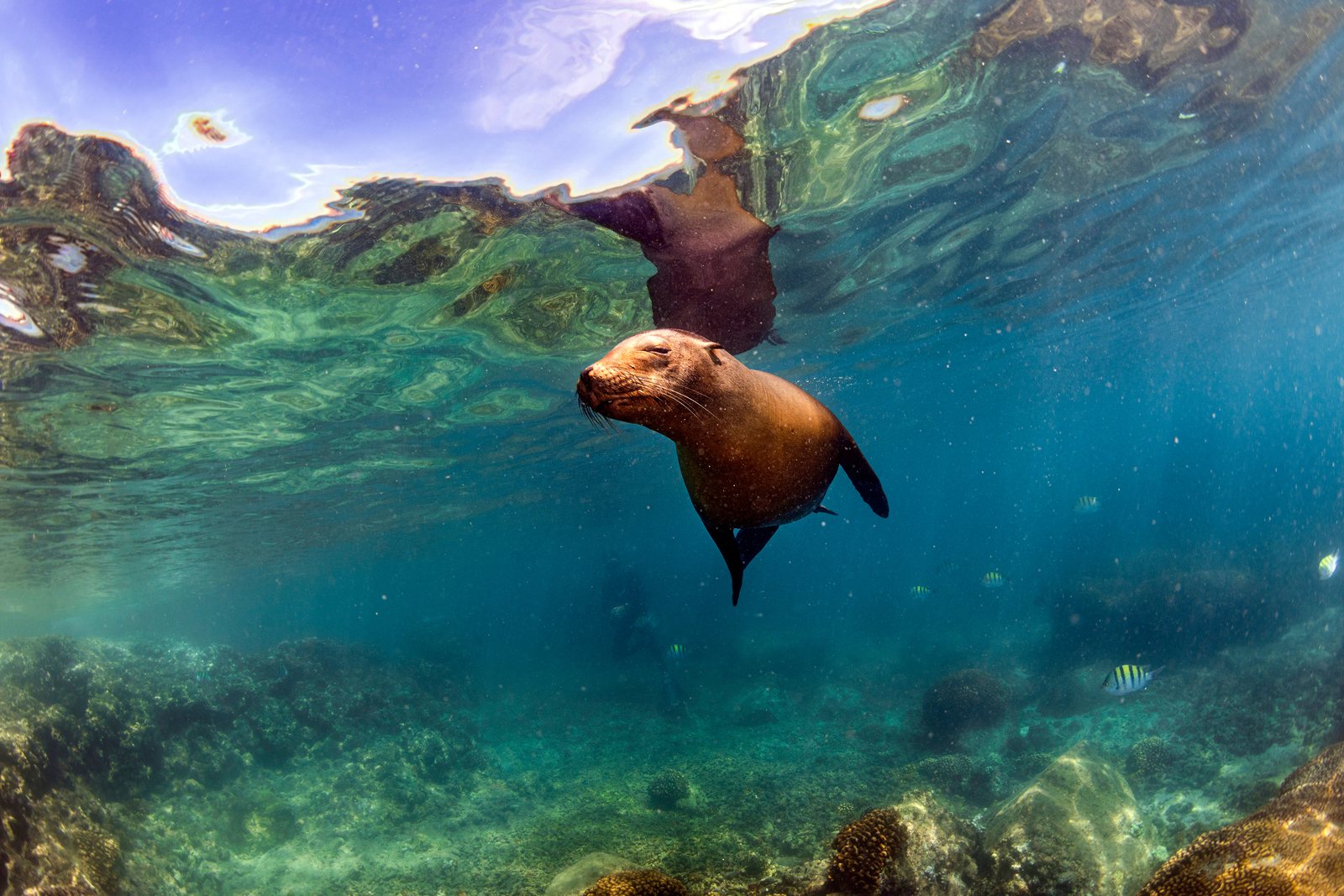
The Galápagos is reached by air through mainland Ecuador, so the liveaboard week starts without an ocean crossing, and the archipelago runs two distinct seasons. The cool, nutrient-rich June-to-November period brings the giants — whale sharks, most of them enormous females, cruise Darwin's reef — while the warmer December-to-May window clears the water for mantas and mobulas. Between shark dives the islands add what nowhere else can: mola at cold upwellings, penguins, sea lions in your safety stop, and marine iguanas grazing algae in the shallows. Land visits are limited on dive itineraries, but the wildlife comes to you.

Cocos is subtraction rather than addition. An uninhabited Costa Rican island 550 kilometers offshore, it is liveaboard-only after roughly 36 hours of steaming from Puntarenas, and apart from a ranger station there is nothing there but ocean life. Hammerheads queue at cleaning stations on Alcyone's deep plateau, tiger sharks patrol Manuelita with regularity, and the rainy June-to-November season delivers the biggest schools along with the roughest crossings. Boats are few and expedition-grade.

Operators on both routes expect advanced certification and real drift experience. If seasickness is a genuine concern, the Galápagos is the kinder itinerary; if crowds are, Cocos wins outright.

Redaktionelle Schätzung

Tiefer eintauchen

Australien, Neuseeland & Ostasien

Cairns & the Ribbon ReefsNingaloo ReefCoral Sea & Osprey ReefOkinawa & the Kerama IslandsPoor Knights IslandsTownsville & the YongalaGreen IslandIzu Peninsula

Karibik & Westatlantik

BonaireCozumelRiviera Maya & the CenotesBelize Barrier ReefGrand CaymanIsla Mujeres & CancúnRoatánTiger Beach & Grand Bahama

Europa, Atlantik & Mittelmeer

Malta & GozoSilfra & IcelandThe AzoresCanary IslandsLarnaca & the ZenobiaScapa FlowArctic NorwayMadeira

Indischer Ozean & Ostafrika

North & South Malé AtollsAri AtollBaa Atoll & Hanifaru BayAliwal Shoal & UmkomaasMafia IslandMauritiusSeychellesSodwana Bay

Pazifikinseln & Mikronesien

PalauChuuk (Truk) LagoonFakaravaKona, HawaiʻiRangiroaTaveuni & Rainbow ReefBeqa Lagoon & Pacific HarbourEspiritu Santo

Rotes Meer & Naher Osten

Sharm El Sheikh & Ras MohammedBrothers, Daedalus & St John'sDahabHurghada & El GounaMarsa Alam & the Deep SouthAqabaDaymaniyat IslandsMusandam Peninsula

Südostasien & Korallen-Dreieck

Bali & Nusa PenidaKomodoRaja AmpatSipadan & MabulAnilaoCoronKoh TaoLembeh Strait

Amerika & Östlicher Pazifik

Galápagos IslandsCocos IslandFlorida KeysSea of Cortez & Cabo PulmoSocorro & the RevillagigedosBritish ColumbiaCalifornia Channel IslandsCosta Rica Pacific Coast