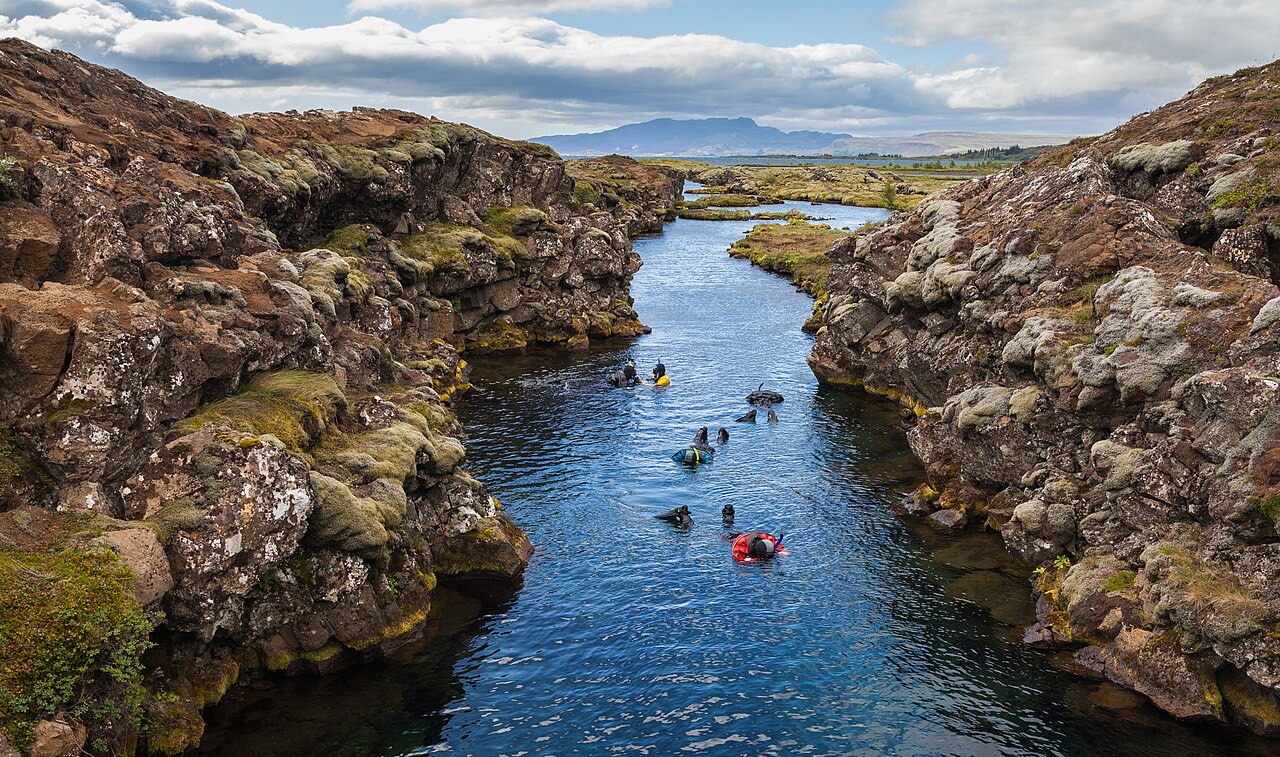
Silfra Fissure
Depth is the range from the top of the site to its usual maximum; "recommended cert" is the mainstream-agency level operators usually ask for, not a legal rule. Currents and visibility change daily, so treat everything here as planning ranges.
Silfra is the rare dive whose reputation undersells it. The fissure is a crack in the rift valley where the North American and Eurasian plates separate, flooded by glacial water that has spent decades filtering through lava before surfacing at 2–4 °C, clean enough to drink mid-dive. Visibility runs to the length of the site itself: in the Cathedral section the entire hundred-meter canyon hangs in view at once, blue over black basalt, with green algae streamers the only vegetation. The profile is shallow and the flow does the work; cold hands and camera settings are the only real challenges.
The moment you come for: Swimming a tectonic boundary, visibility beyond 80 m, drinkable glacier water, the Cathedral's blue perspective
Topography: Basalt canyon walls and boulder floor through the sections Big Crack, Silfra Hall, Silfra Cathedral and Silfra Lagoon
Current: A gentle constant flow pushes divers along the fissure toward the lagoon: navigation mostly takes care of itself.
Entry: Metal stairs at the entry and exit platforms inside Thingvellir National Park; all dives are guided and equipment is hauled from the nearby car park.
Know before you splash
Hazards: Water at 2–4 °C: regulator free-flows, rapid hand numbing and short no-fuss dive times. Listen to the cold-water briefing.
Permits & rules: Diving only through operators licensed by the park; drysuit prerequisite enforced; park fees apply.
Conservation: A protected site inside a UNESCO World Heritage national park: no touching the walls, no disturbing the algae, nothing removed.
For photographers
Wide angle: ★★★★★ · Macro: ★☆☆☆☆ (editors' 1–5 rating of what this site gives each style of shooting)