Big Fish
Great Barracuda
Sphyraena barracuda · Bony fish, family Sphyraenidae
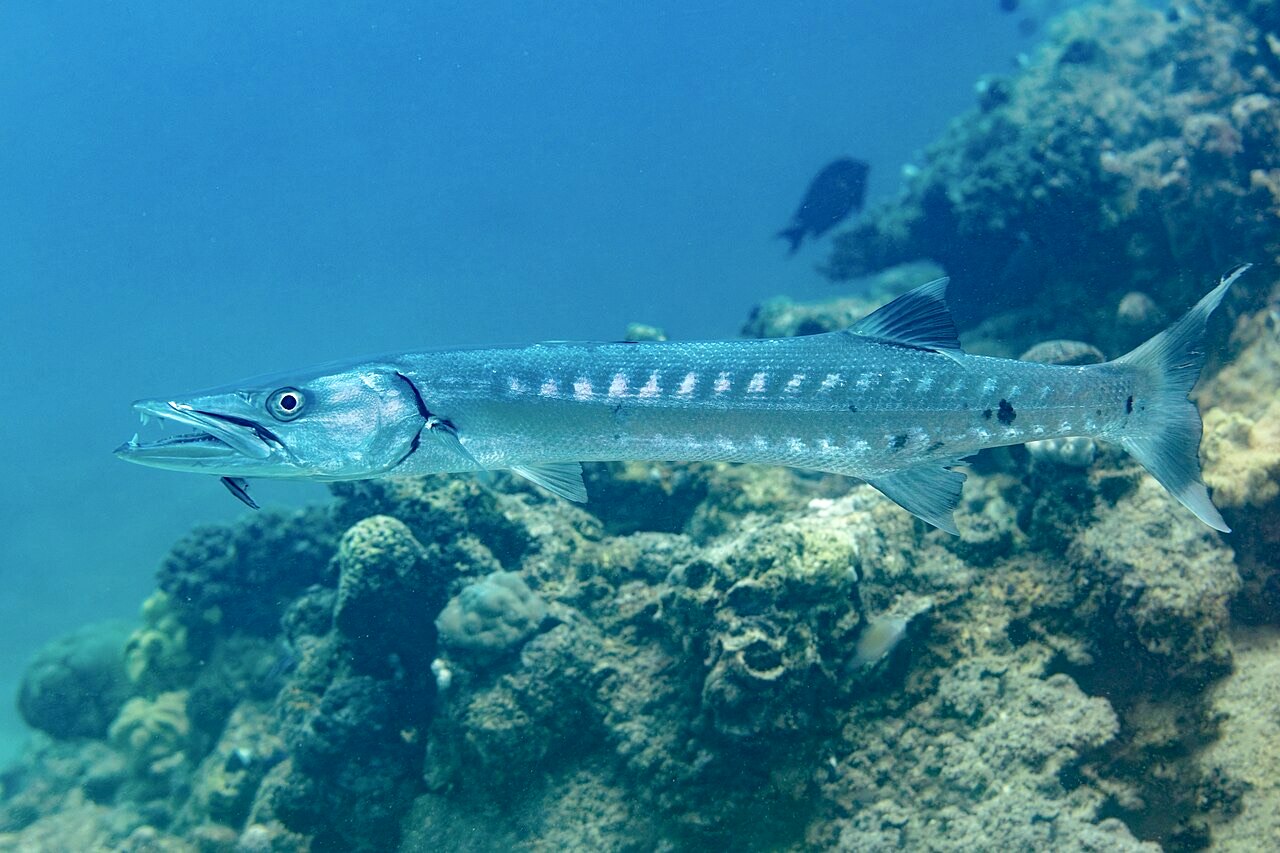
The great barracuda perfects the art of loitering with intent. You notice it the way you notice being watched: a silver bar hanging in the water column behind you, jaw slightly open on a display of needle teeth, eye swiveling with proprietary interest. It may escort your group for an hour, materializing at the safety stop like an auditor. Big adults own wrecks and pier pilings from Key Largo to the Red Sea, drab silver with scattered ink blotches until a hunting flush turns them briefly barred. The menace is theater (verified strikes are vanishingly rare), but the theater is excellent, and no Caribbean logbook is complete without a page of it.
Where and when to see one
"Resident" means most dives at that destination encounter them; "seasonal" means reliably present in the listed months; anything else is a bonus, not a plan.
| Destination | Reliability | Months | Notes |
|---|---|---|---|
| CozumelMexico | Resident: seen on most dives | Year-round | |
| BonaireBonaire | Resident: seen on most dives | Year-round | |
| Florida KeysUnited States | Resident: seen on most dives | Year-round | |
| Belize Barrier ReefBelize | Resident: seen on most dives | Year-round |
Best month, at a glance
| Month | Reliable destinations |
|---|---|
| January | Cozumel · Bonaire · Florida Keys · Belize Barrier Reef |
| February | Cozumel · Bonaire · Florida Keys · Belize Barrier Reef |
| March | Cozumel · Bonaire · Florida Keys · Belize Barrier Reef |
| April | Cozumel · Bonaire · Florida Keys · Belize Barrier Reef |
| May | Cozumel · Bonaire · Florida Keys · Belize Barrier Reef |
| June | Cozumel · Bonaire · Florida Keys · Belize Barrier Reef |
| July | Cozumel · Bonaire · Florida Keys · Belize Barrier Reef |
| August | Cozumel · Bonaire · Florida Keys · Belize Barrier Reef |
| September | Cozumel · Bonaire · Florida Keys · Belize Barrier Reef |
| October | Cozumel · Bonaire · Florida Keys · Belize Barrier Reef |
| November | Cozumel · Bonaire · Florida Keys · Belize Barrier Reef |
| December | Cozumel · Bonaire · Florida Keys · Belize Barrier Reef |
Understanding them
Habitat: Reefs, wrecks, piers, and open lagoon water; juveniles shelter in mangroves and seagrass
Range: Worldwide in tropical and subtropical seas, ubiquitous in the Caribbean and widespread across the Indo-Pacific
Behavior: A hoverer and follower. The great barracuda hangs motionless mid-water with a faint underbite sneer, then trails divers for entire dives at a fixed distance: behavior read as menace that is actually opportunism, waiting for the humans to flush something edible. Solitary as a big adult; the schooling 'tornado' species at famous points are its smaller chevron and blackfin cousins.
Diet: Fish taken with a lunging strike and scissor jaws; the severed-then-swallowed technique handles prey nearly its own size
Size: typically around 1.0 m; documented up to 1.8 m (total length).
How to behave around one
Leave shiny jewelry on the boat, never hand-feed, keep speared fish away from your body, and resist backing away theatrically. The fish takes station wherever you go anyway.
Conservation
Least Concern; locally pressured by fishing, and large individuals in some regions carry ciguatera, a reason many islands don't eat them, which quietly protects the big ones.
Charted sites known for them
Highlighted sites were charted for this species by our editors; numbers are GBIF occurrence records logged within about 5 km of a site since 1990.
Watch
From the official channels

Wildlife of Monterey | New film in our auditorium

Live Aviary Cam | Monterey Bay Aquarium

Live Aviary Cam | Monterey Bay Aquarium
Videos are embedded links to their creators' own channels. We host nothing and credit everything.