Big Fish
Great Barracuda
Sphyraena barracuda · Bony fish, family Sphyraenidae
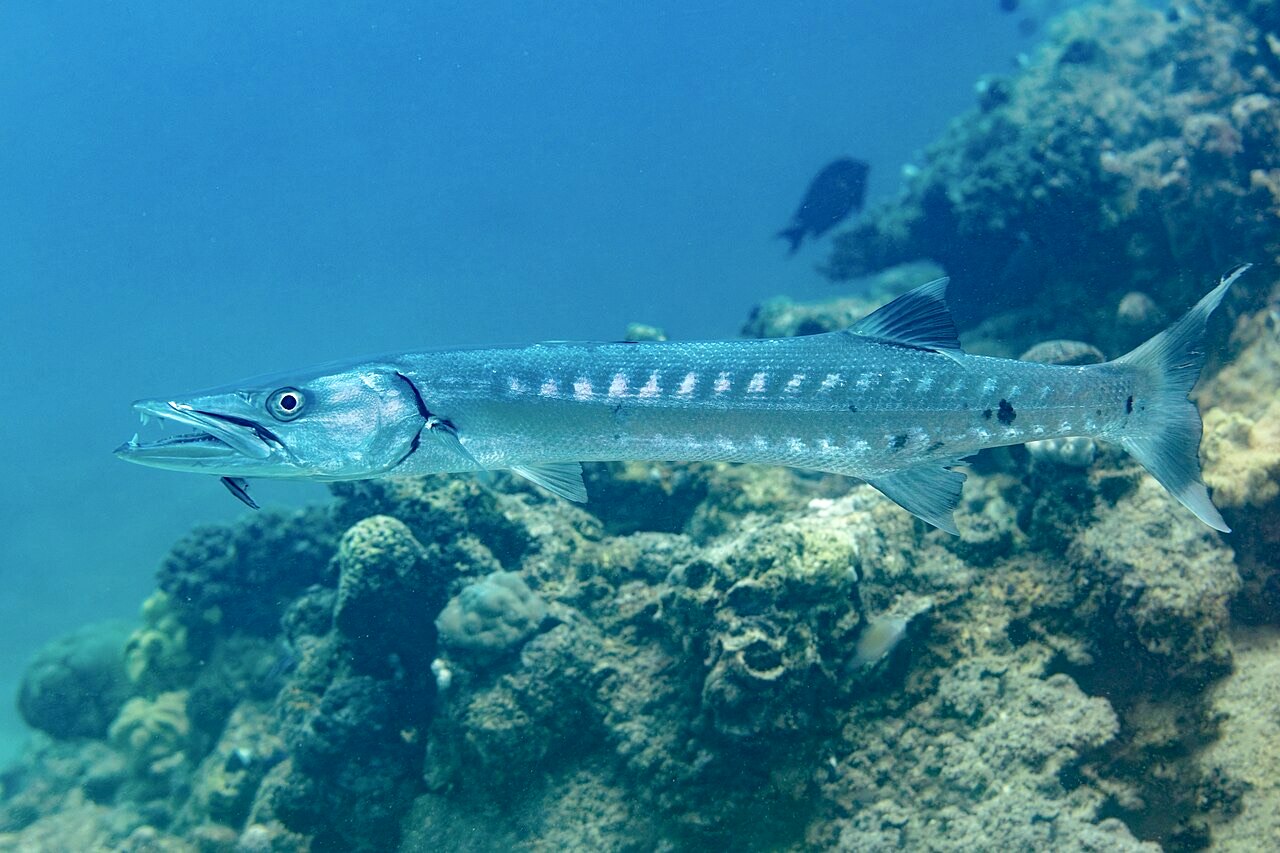
The great barracuda perfects the art of loitering with intent. You notice it the way you notice being watched: a silver bar hanging in the water column behind you, jaw slightly open on a display of needle teeth, eye swiveling with proprietary interest. It may escort your group for an hour, materializing at the safety stop like an auditor. Big adults own wrecks and pier pilings from Key Largo to the Red Sea, drab silver with scattered ink blotches until a hunting flush turns them briefly barred. The menace is theater (verified strikes are vanishingly rare), but the theater is excellent, and no Caribbean logbook is complete without a page of it.
Où et quand en observer un
« Résident » signifie que la plupart des plongées sur ce site permettent de les observer ; « saisonnier » signifie qu'ils sont présents de manière fiable durant les mois indiqués ; tout le reste est un bonus, pas une certitude.
| Destination | Fiabilité | Mois | Notes |
|---|---|---|---|
| CozumelMexico | Resident: seen on most dives | Toute l'année | |
| BonaireBonaire | Resident: seen on most dives | Toute l'année | |
| Florida KeysUnited States | Resident: seen on most dives | Toute l'année | |
| Belize Barrier ReefBelize | Resident: seen on most dives | Toute l'année |
Meilleur mois, en un coup d'œil
| Mois | Destinations fiables |
|---|---|
| January | Cozumel · Bonaire · Florida Keys · Belize Barrier Reef |
| February | Cozumel · Bonaire · Florida Keys · Belize Barrier Reef |
| March | Cozumel · Bonaire · Florida Keys · Belize Barrier Reef |
| April | Cozumel · Bonaire · Florida Keys · Belize Barrier Reef |
| May | Cozumel · Bonaire · Florida Keys · Belize Barrier Reef |
| June | Cozumel · Bonaire · Florida Keys · Belize Barrier Reef |
| July | Cozumel · Bonaire · Florida Keys · Belize Barrier Reef |
| August | Cozumel · Bonaire · Florida Keys · Belize Barrier Reef |
| September | Cozumel · Bonaire · Florida Keys · Belize Barrier Reef |
| October | Cozumel · Bonaire · Florida Keys · Belize Barrier Reef |
| November | Cozumel · Bonaire · Florida Keys · Belize Barrier Reef |
| December | Cozumel · Bonaire · Florida Keys · Belize Barrier Reef |
Les comprendre
Habitat: Reefs, wrecks, piers, and open lagoon water; juveniles shelter in mangroves and seagrass
Aire de répartition: Worldwide in tropical and subtropical seas, ubiquitous in the Caribbean and widespread across the Indo-Pacific
Comportement: A hoverer and follower. The great barracuda hangs motionless mid-water with a faint underbite sneer, then trails divers for entire dives at a fixed distance: behavior read as menace that is actually opportunism, waiting for the humans to flush something edible. Solitary as a big adult; the schooling 'tornado' species at famous points are its smaller chevron and blackfin cousins.
Régime alimentaire: Fish taken with a lunging strike and scissor jaws; the severed-then-swallowed technique handles prey nearly its own size
Taille: généralement autour de 1.0 m; documenté jusqu'à 1.8 m (total length).
Comment se comporter avec lui
Leave shiny jewelry on the boat, never hand-feed, keep speared fish away from your body, and resist backing away theatrically. The fish takes station wherever you go anyway.
Conservation
Least Concern; locally pressured by fishing, and large individuals in some regions carry ciguatera, a reason many islands don't eat them, which quietly protects the big ones.
Sites répertoriés connus pour leur présence
Les sites mis en évidence ont été cartographiés pour cette espèce par nos éditeurs ; les chiffres correspondent aux occurrences GBIF enregistrées dans un rayon d'environ 5 km d'un site depuis 1990.
Regarder
Depuis les canaux officiels

Wildlife of Monterey | New film in our auditorium

Live Aviary Cam | Monterey Bay Aquarium

Live Aviary Cam | Monterey Bay Aquarium
Les vidéos sont des liens intégrés vers les chaînes de leurs créateurs. Nous n'hébergeons rien et créditons tout.