Turtles
Hawksbill Turtle
Eretmochelys imbricata · Marine reptile, family Cheloniidae
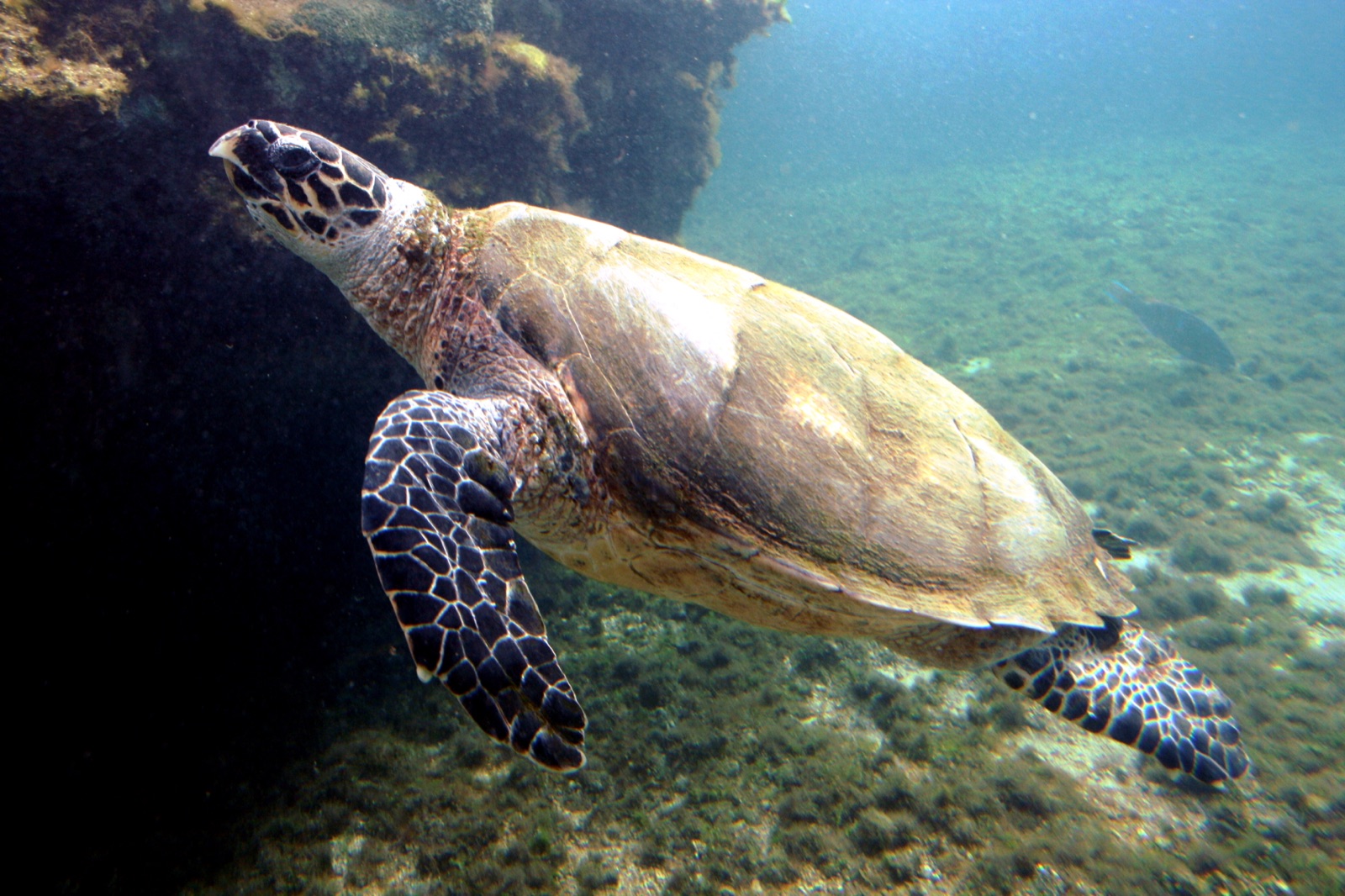
Every reef diver's favorite worker, the hawksbill is a compact turtle with a raptor's beak, tortoiseshell shingles overlapping down its back, and no time to waste. You hear one before you see it (the rasp and crunch of a sponge being demolished), then find the animal head-down in a crevice, hind flippers braced, scattering fragments for the wrasses that attend it. That tortoiseshell, amber marbled with black, drove centuries of harvest for combs and spectacle frames and pushed the species to Critically Endangered; trade is banned now, and reefs from Cozumel to Sipadan still offer daily audiences with the survivor.
Dove e quando avvistarne uno
"Residente" significa che la maggior parte delle immersioni in quella destinazione li incontra; "stagionale" significa che sono presenti in modo affidabile nei mesi indicati; qualsiasi altra cosa è un bonus, non un piano.
| Destinazione | Affidabilità | Mesi | Note |
|---|---|---|---|
| CozumelMexico | Resident: seen on most dives | Tutto l'anno | |
| BonaireBonaire | Resident: seen on most dives | Tutto l'anno | |
| Sharm El Sheikh & Ras MohammedEgypt | Resident: seen on most dives | Tutto l'anno | |
| Tubbataha ReefsPhilippines | Resident: seen on most dives | Mar–Jun | |
| SeychellesSeychelles | Resident: seen on most dives | Oct–Feb |
Il mese migliore, a colpo d'occhio
| Mese | Destinazioni affidabili |
|---|---|
| January | Cozumel · Bonaire · Sharm El Sheikh & Ras Mohammed · Seychelles |
| February | Cozumel · Bonaire · Sharm El Sheikh & Ras Mohammed · Seychelles |
| March | Cozumel · Bonaire · Sharm El Sheikh & Ras Mohammed · Tubbataha Reefs |
| April | Cozumel · Bonaire · Sharm El Sheikh & Ras Mohammed · Tubbataha Reefs |
| May | Cozumel · Bonaire · Sharm El Sheikh & Ras Mohammed · Tubbataha Reefs |
| June | Cozumel · Bonaire · Sharm El Sheikh & Ras Mohammed · Tubbataha Reefs |
| July | Cozumel · Bonaire · Sharm El Sheikh & Ras Mohammed |
| August | Cozumel · Bonaire · Sharm El Sheikh & Ras Mohammed |
| September | Cozumel · Bonaire · Sharm El Sheikh & Ras Mohammed |
| October | Cozumel · Bonaire · Sharm El Sheikh & Ras Mohammed · Seychelles |
| November | Cozumel · Bonaire · Sharm El Sheikh & Ras Mohammed · Seychelles |
| December | Cozumel · Bonaire · Sharm El Sheikh & Ras Mohammed · Seychelles |
Capirle
Habitat: Coral reefs above all; forages among sponges on walls and ledges, resting in crevices
Distribuzione: Circumtropical, tied tightly to coral reef systems of the Caribbean, Red Sea, Indian Ocean, Coral Triangle, and Pacific
Comportamento: The busiest of the turtles: where greens graze placidly, hawksbills work the reef like foragers on a deadline, tearing at sponges with the hooked beak, wedging under plate corals, surfacing briefly and diving back to the job. Usually solitary and often indifferent to a quiet diver at close range.
Dieta: A sponge specialist (one of very few vertebrates that can live on toxic reef sponges) plus tunicates, anemones, and jellyfish
Dimensioni: tipicamente intorno a 0.8 m; documentato fino a 1.0 m (carapace length).
Come comportarsi in sua presenza
Stay off the reef while watching one feed, no touching or trailing a foraging animal from above, and let it breathe unobstructed: hawksbills spook if boxed against the wall.
Conservazione
Critically Endangered after centuries of tortoiseshell trade; CITES bans the trade and many nesting beaches are guarded, but illegal trinket sales persist. Buy nothing made of shell.
Siti mappati noti per avvistamenti
I siti evidenziati sono stati schedati per questa specie dai nostri redattori; i numeri sono record di occorrenza GBIF registrati entro circa 5 km dal sito a partire dal 1990.
Guarda
Dai canali ufficiali

Wildlife of Monterey | New film in our auditorium

Live Aviary Cam | Monterey Bay Aquarium

Live Aviary Cam | Monterey Bay Aquarium
I video sono link incorporati ai canali dei rispettivi autori. Non ospitiamo nulla e accreditiamo tutto.