Rays
Southern Stingray
Hypanus americanus · Cartilaginous fish, family Dasyatidae
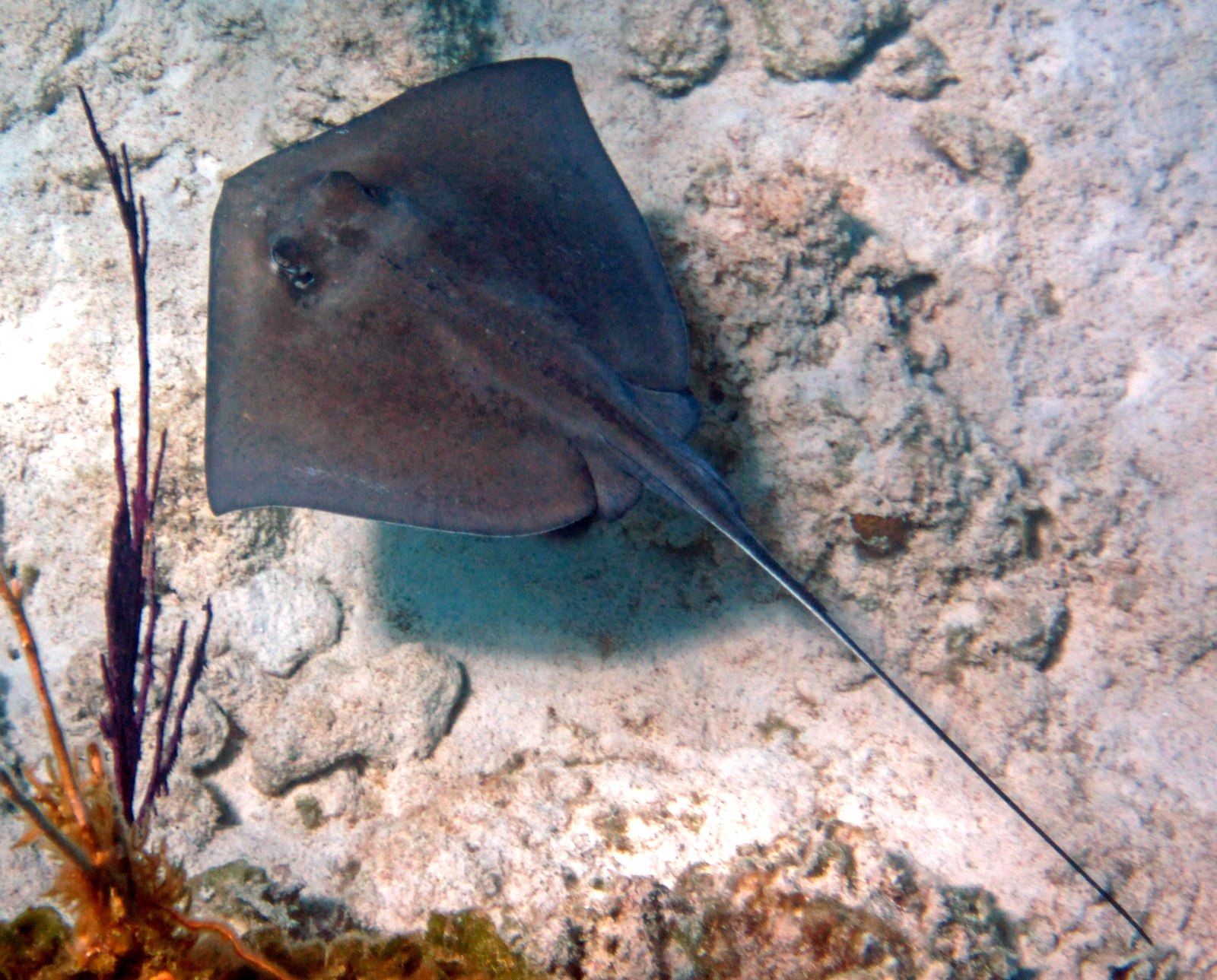
The southern stingray is Caribbean sand made animate: a gray-brown diamond that erupts from an apparently empty bottom, wingtips rippling, whip tail trailing, a cloud of silt hanging where it lay. Watch a flat for ten minutes and its excavation pits reveal a workaday hunter that spends its life reading the sediment for buried shellfish. At Grand Cayman's sandbar the species runs a second career greeting visitors by the dozen, velvet wings brushing snorkelers in water hip-deep, an interaction refined by rules on feeding and handling. In its wild mode it is wary, quick, and best appreciated from a body length away.
Where and when to see one
"Resident" means most dives at that destination encounter them; "seasonal" means reliably present in the listed months; anything else is a bonus, not a plan.
| Destination | Reliability | Months | Notes |
|---|---|---|---|
| BonaireBonaire | Resident: seen on most dives | Year-round | |
| Grand CaymanCayman Islands | Resident: seen on most dives | Year-round | |
| Belize Barrier ReefBelize | Resident: seen on most dives | Year-round | |
| Florida KeysUnited States | Occasional | Year-round |
Best month, at a glance
| Month | Reliable destinations |
|---|---|
| January | Bonaire · Grand Cayman · Belize Barrier Reef · Florida Keys |
| February | Bonaire · Grand Cayman · Belize Barrier Reef · Florida Keys |
| March | Bonaire · Grand Cayman · Belize Barrier Reef · Florida Keys |
| April | Bonaire · Grand Cayman · Belize Barrier Reef · Florida Keys |
| May | Bonaire · Grand Cayman · Belize Barrier Reef · Florida Keys |
| June | Bonaire · Grand Cayman · Belize Barrier Reef · Florida Keys |
| July | Bonaire · Grand Cayman · Belize Barrier Reef · Florida Keys |
| August | Bonaire · Grand Cayman · Belize Barrier Reef · Florida Keys |
| September | Bonaire · Grand Cayman · Belize Barrier Reef · Florida Keys |
| October | Bonaire · Grand Cayman · Belize Barrier Reef · Florida Keys |
| November | Bonaire · Grand Cayman · Belize Barrier Reef · Florida Keys |
| December | Bonaire · Grand Cayman · Belize Barrier Reef · Florida Keys |
Understanding them
Habitat: Sand flats, lagoons, and seagrass beds; buries itself to the eyes between foraging bouts
Range: Western Atlantic from the mid-US coast through the Gulf of Mexico and Caribbean to southern Brazil
Behavior: A diamond-shaped bottom forager that leaves feeding pits across every Caribbean sand flat, usually trailed by a jack or snapper hoping for leftovers. Ordinarily retiring: the famous boldness at Grand Cayman's Stingray City is learned behavior from decades of fishermen's scraps, now managed as a wildlife attraction.
Diet: Worms, crustaceans, and small fish excavated from sand with jets of water and flapping wings
Size: typically around 1.0 m; documented up to 1.5 m (disc width; large females dwarf males).
How to behave around one
At interaction sites follow staff handling rules and keep feeding to guides; on ordinary dives, don't hover directly over a buried ray, don't dig them out, and give feeding animals space to work.
Conservation
Near Threatened; inshore fishing and habitat loss press on it outside protected areas, while interaction-site populations are monitored for the effects of feeding and handling.
Charted sites known for them
Highlighted sites were charted for this species by our editors; numbers are GBIF occurrence records logged within about 5 km of a site since 1990.
Watch
From the official channels

Wildlife of Monterey | New film in our auditorium

Live Aviary Cam | Monterey Bay Aquarium

Live Aviary Cam | Monterey Bay Aquarium
Videos are embedded links to their creators' own channels. We host nothing and credit everything.