Rays
Southern Stingray
Hypanus americanus · Cartilaginous fish, family Dasyatidae
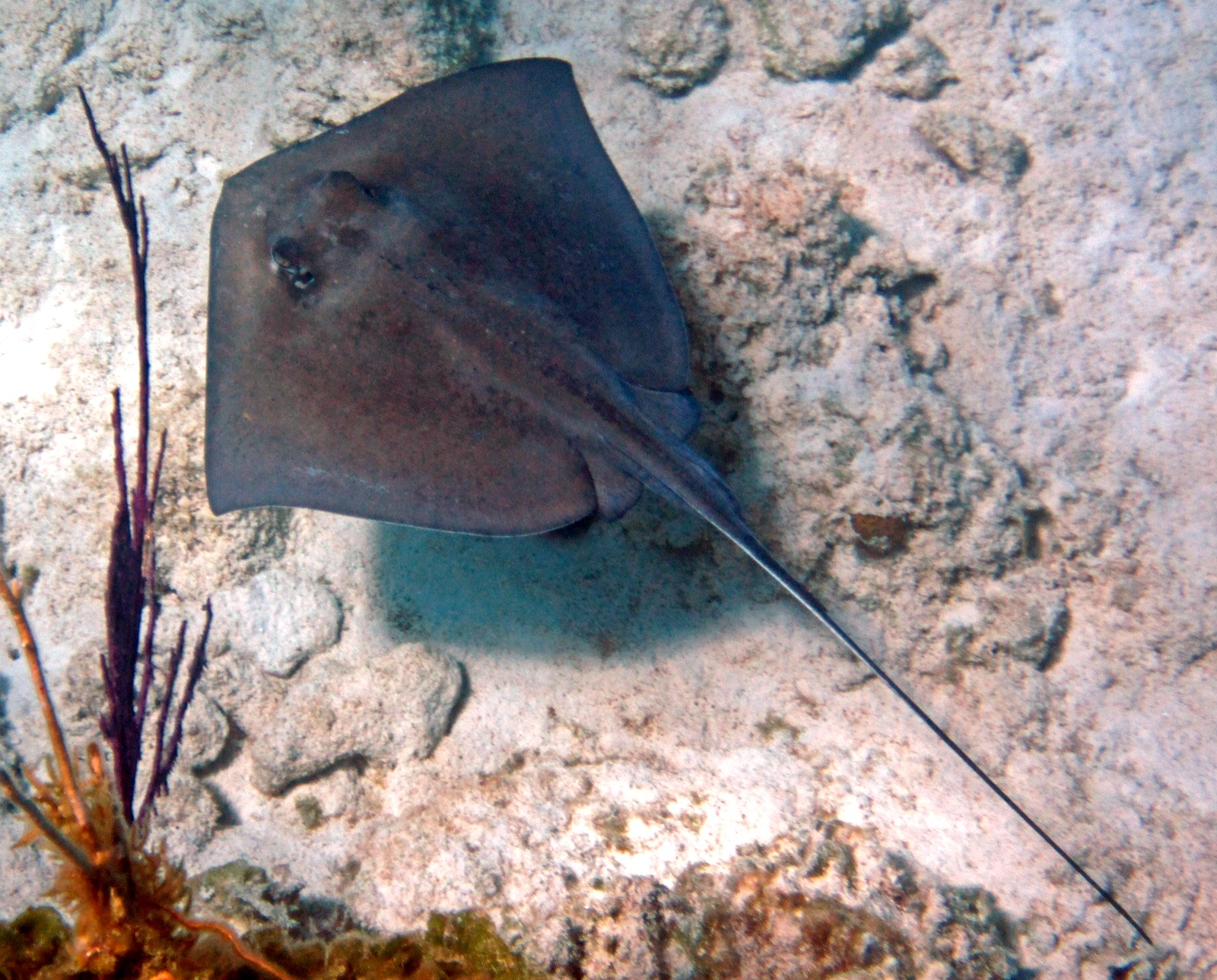
The southern stingray is Caribbean sand made animate: a gray-brown diamond that erupts from an apparently empty bottom, wingtips rippling, whip tail trailing, a cloud of silt hanging where it lay. Watch a flat for ten minutes and its excavation pits reveal a workaday hunter that spends its life reading the sediment for buried shellfish. At Grand Cayman's sandbar the species runs a second career greeting visitors by the dozen, velvet wings brushing snorkelers in water hip-deep, an interaction refined by rules on feeding and handling. In its wild mode it is wary, quick, and best appreciated from a body length away.
Où et quand en observer un
« Résident » signifie que la plupart des plongées sur ce site permettent de les observer ; « saisonnier » signifie qu'ils sont présents de manière fiable durant les mois indiqués ; tout le reste est un bonus, pas une certitude.
| Destination | Fiabilité | Mois | Notes |
|---|---|---|---|
| BonaireBonaire | Resident: seen on most dives | Toute l'année | |
| Grand CaymanCayman Islands | Resident: seen on most dives | Toute l'année | |
| Belize Barrier ReefBelize | Resident: seen on most dives | Toute l'année | |
| Florida KeysUnited States | Occasional | Toute l'année |
Meilleur mois, en un coup d'œil
| Mois | Destinations fiables |
|---|---|
| January | Bonaire · Grand Cayman · Belize Barrier Reef · Florida Keys |
| February | Bonaire · Grand Cayman · Belize Barrier Reef · Florida Keys |
| March | Bonaire · Grand Cayman · Belize Barrier Reef · Florida Keys |
| April | Bonaire · Grand Cayman · Belize Barrier Reef · Florida Keys |
| May | Bonaire · Grand Cayman · Belize Barrier Reef · Florida Keys |
| June | Bonaire · Grand Cayman · Belize Barrier Reef · Florida Keys |
| July | Bonaire · Grand Cayman · Belize Barrier Reef · Florida Keys |
| August | Bonaire · Grand Cayman · Belize Barrier Reef · Florida Keys |
| September | Bonaire · Grand Cayman · Belize Barrier Reef · Florida Keys |
| October | Bonaire · Grand Cayman · Belize Barrier Reef · Florida Keys |
| November | Bonaire · Grand Cayman · Belize Barrier Reef · Florida Keys |
| December | Bonaire · Grand Cayman · Belize Barrier Reef · Florida Keys |
Les comprendre
Habitat: Sand flats, lagoons, and seagrass beds; buries itself to the eyes between foraging bouts
Aire de répartition: Western Atlantic from the mid-US coast through the Gulf of Mexico and Caribbean to southern Brazil
Comportement: A diamond-shaped bottom forager that leaves feeding pits across every Caribbean sand flat, usually trailed by a jack or snapper hoping for leftovers. Ordinarily retiring: the famous boldness at Grand Cayman's Stingray City is learned behavior from decades of fishermen's scraps, now managed as a wildlife attraction.
Régime alimentaire: Worms, crustaceans, and small fish excavated from sand with jets of water and flapping wings
Taille: généralement autour de 1.0 m; documenté jusqu'à 1.5 m (disc width; large females dwarf males).
Comment se comporter avec lui
At interaction sites follow staff handling rules and keep feeding to guides; on ordinary dives, don't hover directly over a buried ray, don't dig them out, and give feeding animals space to work.
Conservation
Near Threatened; inshore fishing and habitat loss press on it outside protected areas, while interaction-site populations are monitored for the effects of feeding and handling.
Sites répertoriés connus pour leur présence
Les sites mis en évidence ont été cartographiés pour cette espèce par nos éditeurs ; les chiffres correspondent aux occurrences GBIF enregistrées dans un rayon d'environ 5 km d'un site depuis 1990.
Regarder
Depuis les canaux officiels

Wildlife of Monterey | New film in our auditorium

Live Aviary Cam | Monterey Bay Aquarium

Live Aviary Cam | Monterey Bay Aquarium
Les vidéos sont des liens intégrés vers les chaînes de leurs créateurs. Nous n'hébergeons rien et créditons tout.