Rays
Southern Stingray
Hypanus americanus · Cartilaginous fish, family Dasyatidae
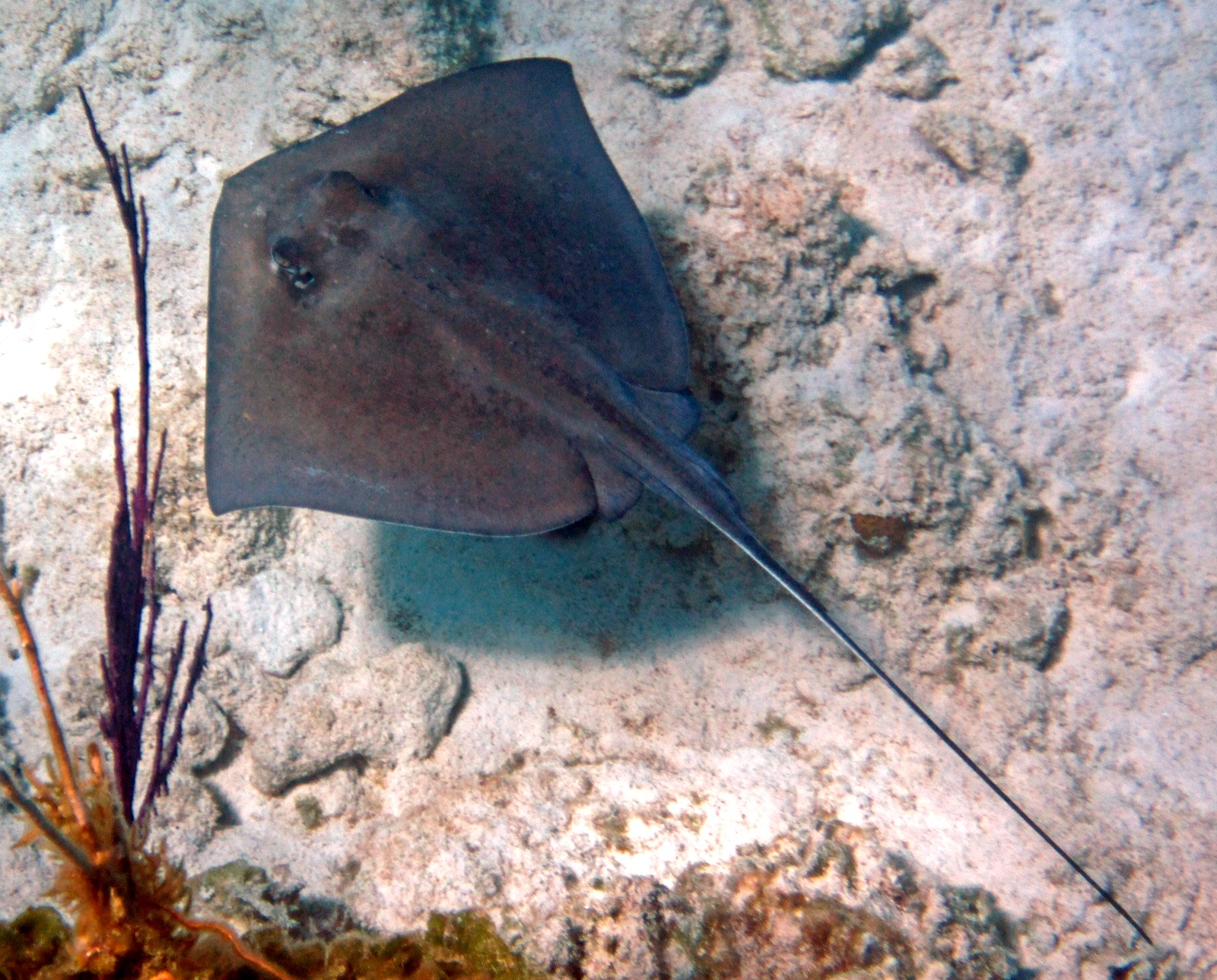
The southern stingray is Caribbean sand made animate: a gray-brown diamond that erupts from an apparently empty bottom, wingtips rippling, whip tail trailing, a cloud of silt hanging where it lay. Watch a flat for ten minutes and its excavation pits reveal a workaday hunter that spends its life reading the sediment for buried shellfish. At Grand Cayman's sandbar the species runs a second career greeting visitors by the dozen, velvet wings brushing snorkelers in water hip-deep, an interaction refined by rules on feeding and handling. In its wild mode it is wary, quick, and best appreciated from a body length away.
Dove e quando avvistarne uno
"Residente" significa che la maggior parte delle immersioni in quella destinazione li incontra; "stagionale" significa che sono presenti in modo affidabile nei mesi indicati; qualsiasi altra cosa è un bonus, non un piano.
| Destinazione | Affidabilità | Mesi | Note |
|---|---|---|---|
| BonaireBonaire | Resident: seen on most dives | Tutto l'anno | |
| Grand CaymanCayman Islands | Resident: seen on most dives | Tutto l'anno | |
| Belize Barrier ReefBelize | Resident: seen on most dives | Tutto l'anno | |
| Florida KeysUnited States | Occasional | Tutto l'anno |
Il mese migliore, a colpo d'occhio
| Mese | Destinazioni affidabili |
|---|---|
| January | Bonaire · Grand Cayman · Belize Barrier Reef · Florida Keys |
| February | Bonaire · Grand Cayman · Belize Barrier Reef · Florida Keys |
| March | Bonaire · Grand Cayman · Belize Barrier Reef · Florida Keys |
| April | Bonaire · Grand Cayman · Belize Barrier Reef · Florida Keys |
| May | Bonaire · Grand Cayman · Belize Barrier Reef · Florida Keys |
| June | Bonaire · Grand Cayman · Belize Barrier Reef · Florida Keys |
| July | Bonaire · Grand Cayman · Belize Barrier Reef · Florida Keys |
| August | Bonaire · Grand Cayman · Belize Barrier Reef · Florida Keys |
| September | Bonaire · Grand Cayman · Belize Barrier Reef · Florida Keys |
| October | Bonaire · Grand Cayman · Belize Barrier Reef · Florida Keys |
| November | Bonaire · Grand Cayman · Belize Barrier Reef · Florida Keys |
| December | Bonaire · Grand Cayman · Belize Barrier Reef · Florida Keys |
Capirle
Habitat: Sand flats, lagoons, and seagrass beds; buries itself to the eyes between foraging bouts
Distribuzione: Western Atlantic from the mid-US coast through the Gulf of Mexico and Caribbean to southern Brazil
Comportamento: A diamond-shaped bottom forager that leaves feeding pits across every Caribbean sand flat, usually trailed by a jack or snapper hoping for leftovers. Ordinarily retiring: the famous boldness at Grand Cayman's Stingray City is learned behavior from decades of fishermen's scraps, now managed as a wildlife attraction.
Dieta: Worms, crustaceans, and small fish excavated from sand with jets of water and flapping wings
Dimensioni: tipicamente intorno a 1.0 m; documentato fino a 1.5 m (disc width; large females dwarf males).
Come comportarsi in sua presenza
At interaction sites follow staff handling rules and keep feeding to guides; on ordinary dives, don't hover directly over a buried ray, don't dig them out, and give feeding animals space to work.
Conservazione
Near Threatened; inshore fishing and habitat loss press on it outside protected areas, while interaction-site populations are monitored for the effects of feeding and handling.
Siti mappati noti per avvistamenti
I siti evidenziati sono stati schedati per questa specie dai nostri redattori; i numeri sono record di occorrenza GBIF registrati entro circa 5 km dal sito a partire dal 1990.
Guarda
Dai canali ufficiali

Wildlife of Monterey | New film in our auditorium

Live Aviary Cam | Monterey Bay Aquarium

Live Aviary Cam | Monterey Bay Aquarium
I video sono link incorporati ai canali dei rispettivi autori. Non ospitiamo nulla e accreditiamo tutto.