Rays
Spotted Eagle Ray
Aetobatus narinari · Cartilaginous fish, family Aetobatidae
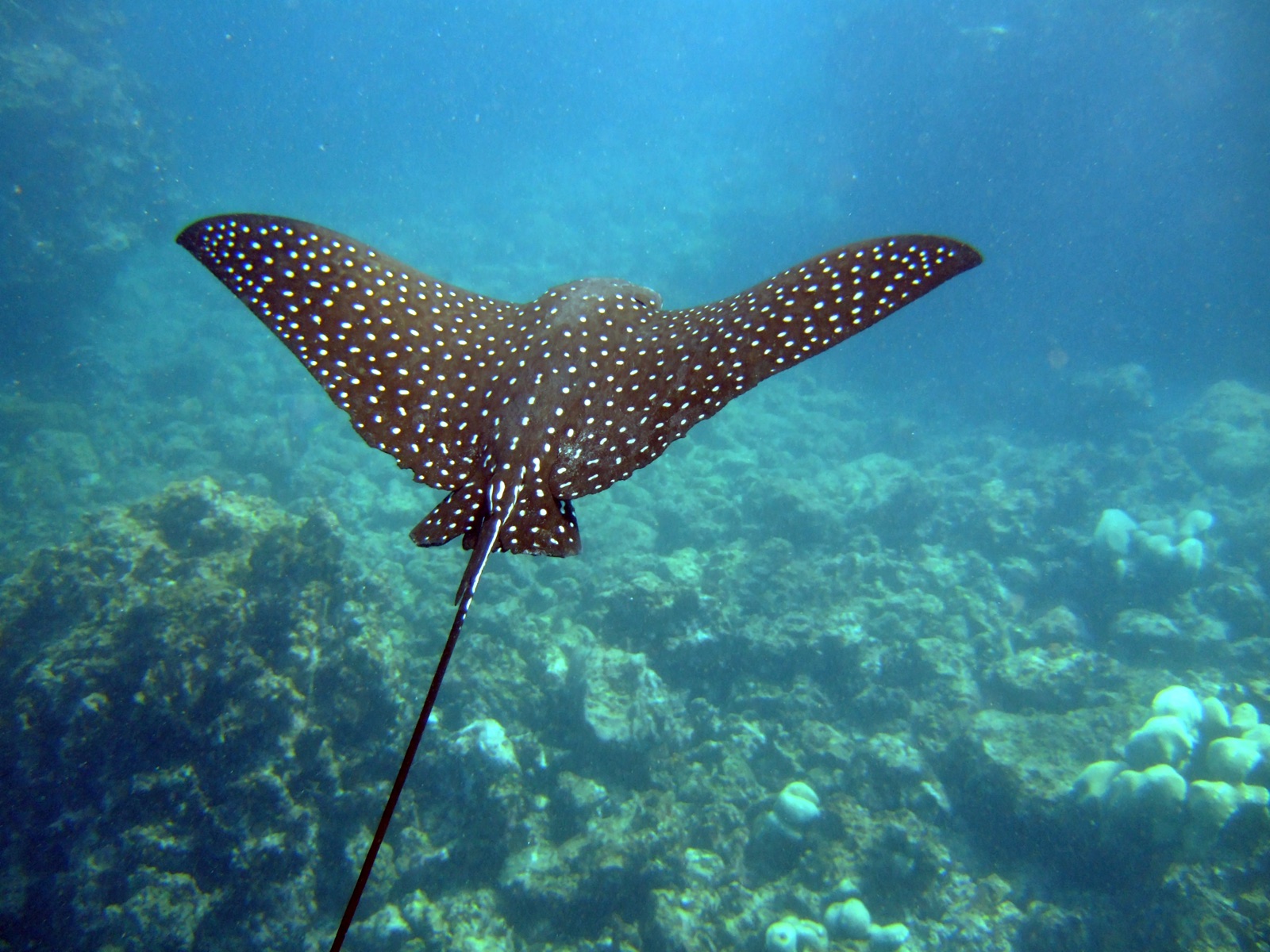
The spotted eagle ray is the ocean's best argument that elegance scales. The dorsal surface is midnight blue stippled with white polka dots, the head oddly duck-like with its flattened snout, and the flight (there is no better word) is a slow, powerful glide on wings that can span three meters. Cozumel divers watch winter squadrons stack in formation off the northern walls like migrating geese; Caymanian and Bonairean reef regulars see singles rooting craters into the sand for buried conch, wreathed in opportunistic snappers. Fast, wary, and long-tailed, it grants close passes strictly on its own terms.
Dove e quando avvistarne uno
"Residente" significa che la maggior parte delle immersioni in quella destinazione li incontra; "stagionale" significa che sono presenti in modo affidabile nei mesi indicati; qualsiasi altra cosa è un bonus, non un piano.
| Destinazione | Affidabilità | Mesi | Note |
|---|---|---|---|
| Grand CaymanCayman Islands | Resident: seen on most dives | Tutto l'anno | |
| CozumelMexico | Seasonal: reliable in season | Dec–Mar | |
| BonaireBonaire | Occasional | Tutto l'anno | |
| Belize Barrier ReefBelize | Occasional | Tutto l'anno |
Il mese migliore, a colpo d'occhio
| Mese | Destinazioni affidabili |
|---|---|
| January | Grand Cayman · Cozumel · Bonaire · Belize Barrier Reef |
| February | Grand Cayman · Cozumel · Bonaire · Belize Barrier Reef |
| March | Grand Cayman · Cozumel · Bonaire · Belize Barrier Reef |
| April | Grand Cayman · Bonaire · Belize Barrier Reef |
| May | Grand Cayman · Bonaire · Belize Barrier Reef |
| June | Grand Cayman · Bonaire · Belize Barrier Reef |
| July | Grand Cayman · Bonaire · Belize Barrier Reef |
| August | Grand Cayman · Bonaire · Belize Barrier Reef |
| September | Grand Cayman · Bonaire · Belize Barrier Reef |
| October | Grand Cayman · Bonaire · Belize Barrier Reef |
| November | Grand Cayman · Bonaire · Belize Barrier Reef |
| December | Grand Cayman · Cozumel · Bonaire · Belize Barrier Reef |
Capirle
Habitat: Sand flats, channel mouths, and the open water off reef walls; digs in sand for buried prey
Distribuzione: Tropical western Atlantic and Caribbean; Indo-Pacific animals are now treated as the closely related ocellated eagle ray (Aetobatus ocellatus), all but identical to divers
Comportamento: Flies rather than swims: long pointed wings beating in slow strokes as it patrols walls solo or in echelon squadrons. Wary of divers, it holds a polite distance and departs with two unhurried wingbeats. Winter gatherings off Cozumel's northern walls can number dozens.
Dieta: Clams, conch, whelks, and crustaceans crushed with plate-like teeth built for shell-cracking
Dimensioni: tipicamente intorno a 1.7 m; documentato fino a 3.3 m (disc width; the whip tail can more than double the animal's total length).
Come comportarsi in sua presenza
Hold your line along the wall and let squadrons pass. Swimming at them ends the encounter for the whole group. Never corner one against the reef or grab the trailing tail.
Conservazione
Endangered: inshore net fisheries take a heavy toll across the range, and slow reproduction gives little resilience; protected in several Caribbean jurisdictions where it anchors dive tourism.
Siti mappati noti per avvistamenti
I siti evidenziati sono stati schedati per questa specie dai nostri redattori; i numeri sono record di occorrenza GBIF registrati entro circa 5 km dal sito a partire dal 1990.
Guarda
Dai canali ufficiali

Wildlife of Monterey | New film in our auditorium

Live Aviary Cam | Monterey Bay Aquarium

Live Aviary Cam | Monterey Bay Aquarium
I video sono link incorporati ai canali dei rispettivi autori. Non ospitiamo nulla e accreditiamo tutto.