Reef Fish
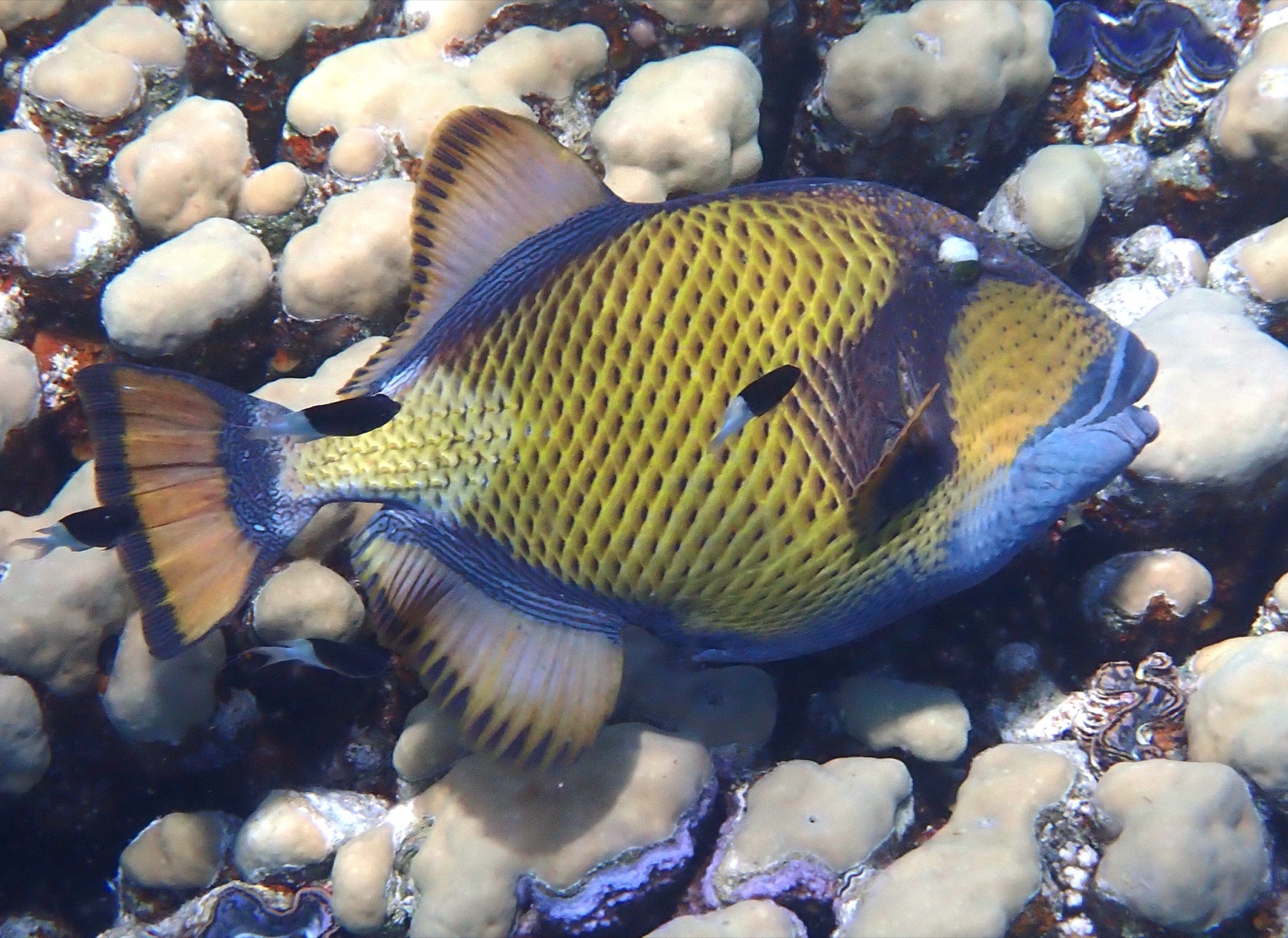
Titan Triggerfish
Balistoides viridescens · Bony fish, family Balistidae (triggerfishes); the largest triggerfish on Indo-Pacific reefs
Outside nesting periods a titan triggerfish is simply an impressive reef resident: a heavy, mottled excavator that flips rubble and bites through urchins and branching coral while smaller fish shadow it for scraps. During nesting everything changes. The female guards a shallow pit of eggs at the center of a territory shaped like an inverted cone widening toward the surface, so ascending feels like escape but actually keeps a diver inside the claim. The response drill is unglamorous and effective: level off, turn, and swim horizontally away low over the reef, keeping fins or a camera housing between you and the fish. Bites are not venomous but can pierce a wetsuit and break skin. Give any guarded patch of rubble a wide, flat detour and the drama never starts.
Where and when to see one
"Resident" means most dives at that destination encounter them; "seasonal" means reliably present in the listed months; anything else is a bonus, not a plan.
| Destination | Reliability | Months | Notes |
|---|---|---|---|
| Sharm El Sheikh & Ras MohammedEgypt | Resident: seen on most dives | Year-round | |
| Sipadan & MabulMalaysia | Resident: seen on most dives | Year-round | |
| North & South Malé AtollsMaldives | Resident: seen on most dives | Year-round | |
| KomodoIndonesia | Resident: seen on most dives | Year-round | |
| Cairns & the Ribbon ReefsAustralia | Resident: seen on most dives | Year-round | |
| Similan Islands & Richelieu RockThailand | Resident: seen on most dives | Year-round |
Best month, at a glance
Understanding them
Habitat: Lagoon and seaward reefs with rubble and sand patches for nest pits; often seen excavating or trailing an entourage of scavenging fish.
Range: Tropical Indo-Pacific from the Red Sea and East Africa to French Polynesia and southern Japan.
Behavior: Territorial year-round, dramatically so when nesting; the guarded territory extends upward like an inverted cone above the nest pit, so climbing feels like escape but is not.
Diet: Sea urchins, crabs, mollusks, tube worms, and branching coral, flipped and crunched with heavy protruding teeth.
Size: typically around 0.5 m; documented up to 0.75 m (total length).
How to behave around one
If charged, level off and swim horizontally away low over the reef, keeping fins or a camera housing between you and the fish; never ascend directly and never corner the animal.
Conservation
No major targeted fishery; large adults can carry ciguatera and are best left off menus.
Charted sites known for them
Highlighted sites were charted for this species by our editors; numbers are GBIF occurrence records logged within about 5 km of a site since 1990.
Watch
From the official channels

Wildlife of Monterey | New film in our auditorium

Live Aviary Cam | Monterey Bay Aquarium

Live Aviary Cam | Monterey Bay Aquarium
Videos are embedded links to their creators' own channels. We host nothing and credit everything.