Rays
Oceanic Manta Ray
Mobula birostris · Cartilaginous fish, family Mobulidae
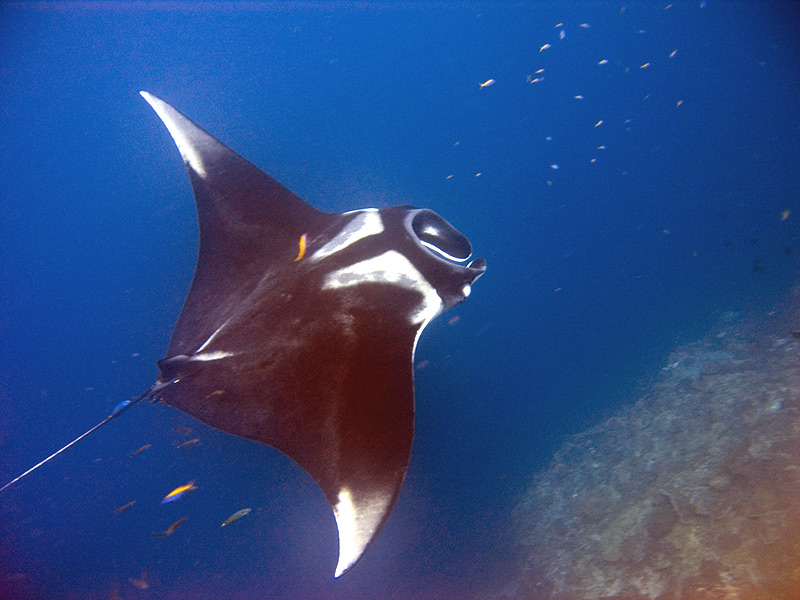
An oceanic manta arriving overhead turns divers into an audience. Six meters of black wing eclipse the surface light, cephalic fins unfurled, the white shoulder chevrons and inky belly patterns as individual as fingerprints. At the Revillagigedo seamounts they seek divers out, banking centimeter-close and lingering in exhaled bubbles as though testing a spa jet, an interaction unmatched in big-animal diving. This is a genuinely oceanic species, visiting divable water only at scattered outposts, and it pays a heavy price beyond them: gill-plate fisheries have cut deep, and the 2020 Endangered listing recognizes a giant with a very slow reproductive engine.
Onde e quando ver um
"Residente" significa que a maioria dos mergulhos naquele destino os encontra; "sazonal" significa presença confiável nos meses listados; qualquer outra coisa é um bônus, não um plano.
| Destino | Fiabilidade | Meses | Notas |
|---|---|---|---|
| Raja AmpatIndonesia | Seasonal: reliable in season | Oct–Apr | |
| Socorro & the RevillagigedosMexico | Seasonal: reliable in season | Nov–May | |
| Galápagos IslandsEcuador | Occasional | Todo o ano | |
| Isla Mujeres & CancúnMexico | Occasional | Jun–Aug | |
| Tofo BeachMozambique | Occasional | Todo o ano |
Melhor mês, em resumo
| Mês | Destinos fiáveis |
|---|---|
| January | Raja Ampat · Socorro & the Revillagigedos · Galápagos Islands · Tofo Beach |
| February | Raja Ampat · Socorro & the Revillagigedos · Galápagos Islands · Tofo Beach |
| March | Raja Ampat · Socorro & the Revillagigedos · Galápagos Islands · Tofo Beach |
| April | Raja Ampat · Socorro & the Revillagigedos · Galápagos Islands · Tofo Beach |
| May | Socorro & the Revillagigedos · Galápagos Islands · Tofo Beach |
| June | Galápagos Islands · Isla Mujeres & Cancún · Tofo Beach |
| July | Galápagos Islands · Isla Mujeres & Cancún · Tofo Beach |
| August | Galápagos Islands · Isla Mujeres & Cancún · Tofo Beach |
| September | Galápagos Islands · Tofo Beach |
| October | Raja Ampat · Galápagos Islands · Tofo Beach |
| November | Raja Ampat · Socorro & the Revillagigedos · Galápagos Islands · Tofo Beach |
| December | Raja Ampat · Socorro & the Revillagigedos · Galápagos Islands · Tofo Beach |
Entendendo-os
Habitat: Open ocean, oceanic islands, and seamounts; visits shallow cleaning stations and surface plankton slicks, with tagged dives far deeper
Distribuição: Circumglobal in tropical and warm temperate oceans, concentrating seasonally at offshore islands: the Revillagigedos, Raja Ampat's deeper stations, Ecuador and Peru, Mozambique, and mid-ocean ridges
Comportamento: Where reef mantas commute, oceanics wander, crossing basins between seamounts and boiling upwellings. Around divers at Socorro they are famously interactive, banking to hold a diver in view, hovering in bubble streams, and returning repeatedly over a full dive; whether they seek the sensation or the inspection, the choice is visibly theirs.
Dieta: Zooplankton filtered on long open-water feeding runs and at productive upwellings
Tamanho: normalmente cerca de 4.5 m; documentado até 7.0 m (disc width; the largest ray on Earth).
Como se comportar perto de um
Hold still and let the manta pilot the encounter, keep off cleaning stations, never touch (the mucus layer protects them), and avoid chasing when one breaks away; at Socorro, guides brief a no-bubbles-directly-beneath courtesy that many mantas ignore on purpose.
Conservação
Endangered since 2020, driven by targeted gill-plate fisheries and bycatch; protected under CITES and CMS, with sanctuaries in Mexico, Indonesia, and elsewhere doing measurable good.
Pontos mapeados conhecidos por eles
Os locais destacados foram cartografados para esta espécie pelos nossos editores; os números são registos de ocorrência do GBIF num raio de cerca de 5 km do local desde 1990.
Assista
Dos canais oficiais

Wildlife of Monterey | New film in our auditorium

Live Aviary Cam | Monterey Bay Aquarium

Live Aviary Cam | Monterey Bay Aquarium
Os vídeos são ligações incorporadas para os canais dos próprios criadores. Não alojamos nada e creditamos tudo.