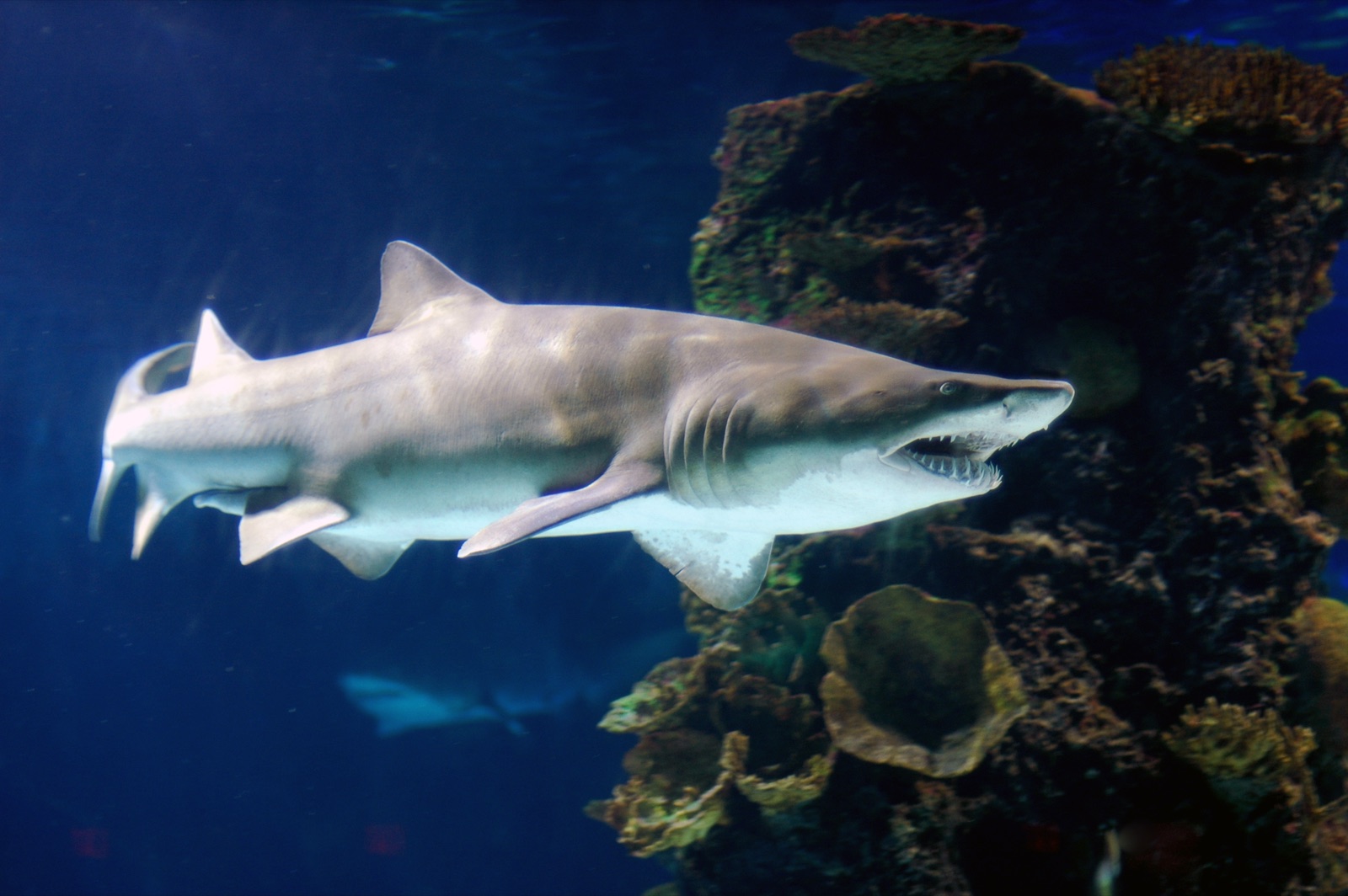
Sharks
Sand Tiger (Ragged-Tooth) Shark
Carcharias taurus · Cartilaginous fish, family Odontaspididae
Nothing sells the sand tiger encounter like the mismatch between look and manner. The mouth is a cutlery drawer tipped out (rows of ragged, protruding teeth beneath a flat predatory eye), yet the animal wearing it hangs in a wreck's shadow like a parade balloon, easing between divers without a flicker of concern. Off North Carolina they gather on Second World War hulls by the dozen, motionless in the gloom of a hold. Off South Africa the 'raggies' pack Aliwal's gullies in winter. Slowest of breeders (two pups after intrauterine cannibalism winnows each litter), the species collapses fast wherever fishing finds it, hence the Critically Endangered listing.
Nơi và thời điểm có thể gặp
"Thường trú" nghĩa là hầu hết các lần lặn tại điểm đó đều gặp được chúng; "theo mùa" nghĩa là chúng xuất hiện đáng tin cậy trong các tháng được liệt kê; bất kỳ điều gì ngoài ra là điểm thưởng, không phải kế hoạch.
| Điểm đến | Độ tin cậy | Các tháng | Ghi chú |
|---|---|---|---|
| North Carolina Outer BanksUnited States | Resident: seen on most dives | May–Oct | |
| Aliwal Shoal & UmkomaasSouth Africa | Seasonal: reliable in season | Jun–Nov | |
| Sodwana BaySouth Africa | Occasional | Quanh năm |
Tháng tốt nhất, nhìn tổng quan
| Tháng | Điểm đến đáng tin cậy |
|---|---|
| January | Sodwana Bay |
| February | Sodwana Bay |
| March | Sodwana Bay |
| April | Sodwana Bay |
| May | North Carolina Outer Banks · Sodwana Bay |
| June | North Carolina Outer Banks · Aliwal Shoal & Umkomaas · Sodwana Bay |
| July | North Carolina Outer Banks · Aliwal Shoal & Umkomaas · Sodwana Bay |
| August | North Carolina Outer Banks · Aliwal Shoal & Umkomaas · Sodwana Bay |
| September | North Carolina Outer Banks · Aliwal Shoal & Umkomaas · Sodwana Bay |
| October | North Carolina Outer Banks · Aliwal Shoal & Umkomaas · Sodwana Bay |
| November | Aliwal Shoal & Umkomaas · Sodwana Bay |
| December | Sodwana Bay |
Tìm hiểu về chúng
Môi trường sống: Wrecks, ledges, gutters, and caves over the continental shelf; gulps surface air to hover neutrally in the water column
Phạm vi phân bố: Warm temperate coasts of the Atlantic, Indian, and western Pacific oceans, famously the US East Coast, South Africa, and eastern Australia, where it is called the grey nurse shark
Hành vi: Hangs almost motionless in shaded structure by day, mouth slightly agape in a permanent bristle of teeth, drifting among divers with slow tail strokes. The only shark known to gulp and store surface air for buoyancy. Aggregates seasonally at traditional sites for mating and gestation.
Chế độ ăn: Fish including small sharks and rays, hunted mostly at night; the snaggle-toothed jaws are for gripping, not shearing
Kích thước: thường vào khoảng 2.5 m; ghi nhận đến độ sâu 3.2 m (total length).
Cách ứng xử khi ở gần loài này
Move slowly through wreck interiors and gutters they occupy, never block a shark's exit, no touching during close drift-bys, and follow local aggregation-site rules on diver numbers and approach distance.
Bảo tồn
Critically Endangered globally as of 2021. Australia protected its grey nurse populations decades ago after spearfishing collapses; recovery everywhere is slow arithmetic against a two-pup reproductive rate.
Các điểm lặn đã ghi nhận có loài này
Các điểm được làm nổi bật là những điểm đã được ban biên tập ghi chép cho loài này; các con số là bản ghi xuất hiện từ GBIF được ghi nhận trong phạm vi khoảng 5 km của điểm lặn kể từ năm 1990.
Xem
Từ kênh chính thức

Wildlife of Monterey | New film in our auditorium

Live Aviary Cam | Monterey Bay Aquarium

Live Aviary Cam | Monterey Bay Aquarium
Video là các liên kết nhúng dẫn đến kênh của chính tác giả. Chúng tôi không lưu trữ gì và ghi công đầy đủ.